

Don't want to trade it yourself?
Our desk runs DEX portfolios on profit share.
AI crypto is entering a post-chatbot era. The next wave of value creation may be found in the infrastructure layer supporting autonomous AI agents.
These digital entities stand to accumulate crypto assets, execute transactions, rent server time, and coordinate with other programs. The emergence of independent AI agents creates demand for crypto settlement, identity management, execution, and ownership.
What Is the AI-Crypto Race Really About?
Why Autonomous AI Agents Need Crypto Infrastructure
While self-governing AI agents can make decisions, these programs lack the economic infrastructure required to operate independently. Crypto underpins many financial instruments, including settlement, permissions, digital identity, and programmable money. The combination of these elements creates a fertile environment for machine-to-machine commerce.
From AI Assistants to Autonomous Economic Actors
Traditional AI assistants are programmed to respond to queries and provide information in a deterministic fashion. By comparison, autonomous AI agents can perform complex tasks and transactions beyond simple question-answering. This divergence allows software to become an economic actor in its own right, which explains why the top AI agent crypto projects will see competition for market share.
Where Blockchain Fits Into the Agent Economy
Blockchains can serve as distributed ledger technology for autonomous AI agent wallets, smart contracts, and economic systems. These digital assets enable self-governing software to interact with permissioned or public networks.
In addition, cryptographic signatures allow AI-driven applications to conduct transactions without human oversight. Not all autonomous AI agent transactions require settlement on a blockchain, but open markets promote competition among infrastructure providers.
How to Identify the AI Crypto Projects With Real Infrastructure Value
AI Utility and Real-World Demand
A compelling use case is critical for any credible AI crypto project. Compute power, payments, and coordination are far more valuable than self-generating tokens. Real-world adoption matters more than branding, so investors should scrutinize whether users would adopt an AI product with a fundamentally different token design.
Network Activity, Adoption and Developer Growth
Actual transactions and usage of an AI crypto product typically manifest in on-chain value transfers, computational workloads, or developer activity. The focus should be on sustained engagement rather than adoption bursts attributable to hype. Developer infrastructure is equally important, as competent coders are necessary to extend the capabilities of an autonomous AI agent platform.
Token Utility and Value Capture
Token utility tends to reflect the network’s fundamental value proposition. Settlement, staking, payments, or access to data can all contribute to demand for a particular AI crypto project’s token. Weak utility design can cause value capture challenges, which is why the best tokens for autonomous AI agents have intrinsic value tied to network usage.
Scalability, Security and Decentralization
Autonomous AI agents have the potential to generate tremendous transaction volume and computational workloads. An appropriate infrastructure layer should not restrict adoption by limiting throughput or execution capacity. At the same time, security is paramount, since autonomous agents handling crypto assets can experience sharp value declines due to exploits. Decentralization is desirable but often comes at the cost of scalability.
Competitive Moat and Long-Term Potential
A strong economic moat helps the most valuable AI crypto projects maintain their dominance over time. Liquidity, developer lock-in, hardware advantages, data control, or network effects all contribute to moat formation in the autonomous AI agent economy. Autonomous AI agents are unlikely to form lasting moats through branding alone, which can undermine speculative value.
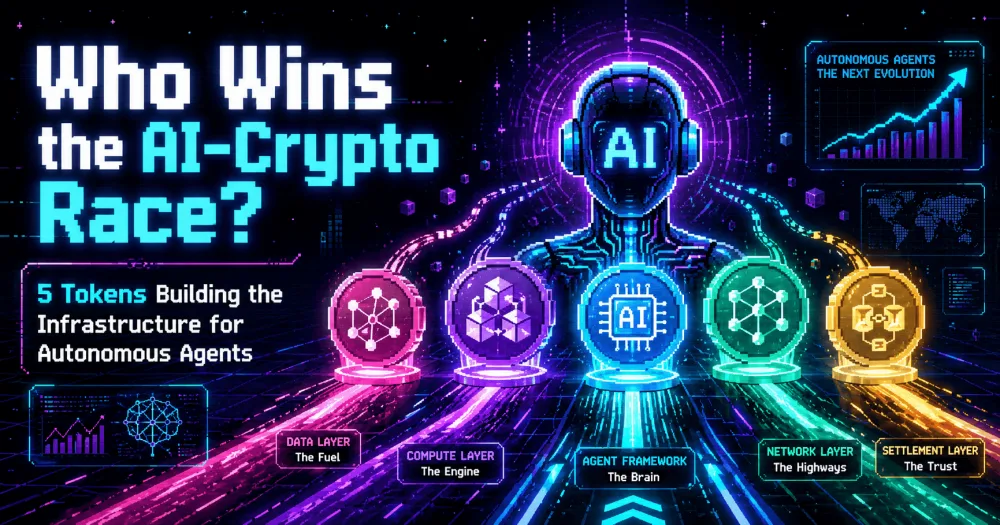
5 Crypto Tokens Building the Infrastructure for Autonomous AI Agents
Bittensor (TAO): The Decentralized Intelligence Layer
Bittensor enables the creation of open markets for scarce digital commodities. Specialized subnets can be programmed to generate a wide range of outputs, including inference, computation, predictions, and storage. TAO▲$215.61’s fundamental value proposition is to design appropriate incentive mechanisms for each emerging market. The network’s focus is on decentralized intelligence rather than individual agents.
NEAR Protocol (NEAR): The Blockchain for AI Agents
NEAR▲$2.04 is investing heavily in becoming the preferred settlement layer for autonomous AI agents. Cross-chain composability and smart contract programmability are central to the protocol’s vision for AI agents.
NEAR intends to facilitate the creation of self-governing applications through its Chain Signatures technology and NEAR Intents functionality. The addition of Shade agents represents another step towards establishing NEAR as the blockchain for autonomous AI agents.
Artificial Superintelligence Alliance (FET): The AI Agent Coordination Bet
The Artificial Superintelligence Alliance brings together Fetch.ai, SingularityNET and CUDOS to create an end-to-end solution for autonomous AI agents. This ecosystem’s token utility spans across agent coordination, model markets, compute re
The alliance better positions its participants to compete against more integrated rivals like Bittensor. FET▲$0.1892 has the best potential to disrupt the autonomous AI agent economy by dominating multiple critical infrastructure layers simultaneously.
Render (RENDER): The GPU Infrastructure Play
Render is a decentralized network for renting GPU processing power. The company’s initial focus on democratizing access to graphics rendering has created tremendous demand from AI developers.
RENDER▲$1.61 has since evolved into a general-purpose GPU-as-a-service marketplace that supports training, inference, and other graphics-intensive operations. The token’s value derivation from actual processing power makes it particularly compelling as an infrastructure layer for autonomous AI agents.
Virtuals Protocol (VIRTUAL): The Agent Creation and Commerce Layer
Virtuals aims to build an end-to-end economy for autonomous AI agents. The company’s product suite facilitates the creation of self-governing software, including identity management, wallet infrastructure, job markets, and capital markets.
The Agent Commerce Protocol enables autonomous agents to discover and hire third-party contractors. VIRTUAL best represents the autonomous AI agent economy by targeting its infrastructure at the software level itself.
TAO vs. NEAR vs. FET vs. RENDER vs. VIRTUAL
Which Token Has the Strongest AI Utility?
While TAO has the strongest overarching thesis for decentralized intelligence, RENDER possesses deep value through its network of GPU miners. FET and VIRTUAL better represent the autonomous AI agent economy, while NEAR occupies an intermediary position as a potential settlement layer.
Which Project Has the Clearest Path to Revenue?
RENDER has a clear advantage over its peers by directly monetizing demand for processing power. Virtuals has an analogous position within the autonomous AI agent economy, although its path to profitability is less obvious. TAO also benefits from demand for its subnet bandwidth, but its tokenomics are more complicated than RENDER’s. By contrast, NEAR and FET better represent their respective markets without necessarily deriving value from them directly.
Which Token Has the Best Value-Capture Model?
TAO’s value capture potential derives from its ability to organize emerging marketsENDER, which effectively channels demand for processing power towards its native token. VIRTUAL has the potential to dominate autonomous agent commerce, which would also facilitate significant value capture. NEAR and FET possess value capture potential but lack the infrastructure position to control their markets
Which Project Has the Biggest Adoption Potential?
NEAR has the potential to acquire users beyond the autonomous AI agent economy by virtue of its cross-chain capabilities. VIRTUAL better represents the fundamental value captured by self-governing software, while FET can benefit from an expanding open agent economy. TAO, meanwhile, has already achieved significant mindshare by pioneering decentralized intelligence markets.
Which Token Carries the Highest Risk?
VIRTUAL bears the most downside risk by targeting autonomous agent commerce at a premature stage. The token’s an unprecedented scale. TAO also encounters intense competition at the fundamental research level. By comparison, RENDER has relatively few risks by targeting a well-defined market with an established supply-demand dynamic
| Token | Core Role In AI-Crypto | Main AI Utility | Revenue / Demand Driver | Value-Capture Potential | Adoption Potential | Risk Level |
|---|---|---|---|---|---|---|
| Bittensor (TAO) | Decentralized intelligence layer | Incentivizes AI models, subnets and digital commodities | Demand for intelligence, inference and specialized subnet services | High — TAO directly supports subnet incentives and participation | High if decentralized AI markets expand | High — complex incentives and strong competition |
| NEAR Protocol (NEAR) | Blockchain execution layer for AI agents | Cross-chain execution, Chain Signatures, Intents and agent infrastructure | Network activity, transactions and agent-driven cross-chain usage | Medium — AI growth must translate into broader NEAR activity | Very High due to wider blockchain use cases | Medium-High — AI thesis competes with general L1 positioning |
| Artificial Superintelligence Alliance (FET) | AI agent coordination layer | Agent creation, discovery, communication and autonomous coordination | Agent services, network activity and ecosystem adoption | Medium-High if agent activity creates sustained token demand | High if open multi-agent networks gain traction | High — execution complexity and crowded AI-agent market |
| Render (RENDER) | Decentralized GPU infrastructure | GPU access for rendering, AI inference and compute workloads | Real demand for decentralized GPU resources | High — utility connects directly with compute demand | High as AI compute requirements grow | Medium — clearer demand model, but strong centralized competition |
| Virtuals Protocol (VIRTUAL) | Agent creation and commerce layer | AI agent creation, identity, wallets and agent-to-agent transactions | Agent services, commerce and ecosystem fees | High Potential if agent commerce scales | Very High in a large autonomous agent economy | Very High — adoption remains early and speculative |
The Biggest Catalysts for the AI-Crypto Sector in 2026
AI Agents Start Moving Money On-сhain
The autonomous AI agent economy will see value realization through its ability to perform financial transactions. Wallet-equipped AI software can pay for goods and services, including server costs and model access. This development will directly benefit the crypto market by creating demand for on-chain settlement mechanisms.
Stablecoins Become the Payment Rail for AI Agents
Stablecoins represent a critical enabler for autonomous AI agents by providing the medium of exchange. Software developers are likely to adopt stablecoins as payment instruments due to their volatility characteristics and continuous availability. The autonomous AI agent economy may see the emergence of stablecoin-based settlement layers at both the infrastructure and application levels.
Rising Demand for Decentralized Compute
The demand for GPU reputing providers benefit substantially. Traditional organizations are unlikely to meet the requirements of self-governing software applications due to their permissioned nature. The permissionless infrastructure layer better suits autonomous agents, which is why RENDER possesses significant long-term potential
Agent-to-Agent Commerce and Autonomous DeFi
Autonomous AI agents can utilize permissionless markets to discover and bind to counterparties. One agent can provide computation and database services to another in exchange for economic rents. Autonomous DeFi applications are likely to see rapid innovation by focusing on the unique requirements of self-governing software.
The Growth of Open and Interoperable Agent Networks
Interoperability will be vital to the growth of autonomous agent networks due to the fragmented developer landscape. Autonomous AI agents must be able to communicate seamlessly despite being built on different infrastructures. The importance of open standards will see permissioned networks suffer significantly compared to their decentralized competitors.
What Could Go Wrong With the AI-Crypto Thesis?
AI Agents May Not Need Blockchains
Many autonomous AI agents will be built on centralized cloud infrastructure for the foreseeable future. Permissioned systems offer significant advantages over their decentralized counterparts in terms of ease of use and customer support. The fundamental value captured by self-governing software is unlikely to directly benefit the crypto economy if appropriate on-chain settlement mechanisms do not emerge.
Centralized AI Infrastructure Still Has a Major Advantage
The large technology firms possess significant advantages in their ability to provide end-to-end solutions for autonomous AI agents. These companies can provide superior developer experiences, better model markets and more efficient compute relar areas of focus that cannot be addressed by traditional rivals
Token Speculation Could Outpace Real Adoption
The funding boom for AI-related crypto projects has created significant valuation risks for the broader ecosystem. Many projects suffer from weak token design that fails to consider the token’s role within the broader business plan. Autonomous AI agents will benefit from the infrastructure provided by crypto protocols, but investors must be wary of hype fueling speculative froth around these innovations.
Security, Exploits and Autonomous Agent Risks
Autonomous AI agents introduce new security concerns by facilitating permissionless transactions. Prompt injection and other forms of attacks by bad actors can lead to significant losses for developers. The programmable nature of self-governing software means that threats can manifest in various ways, including faulty smart contract code.
Regulatory and Compliance Challenges
Regulatory scrutiny of autonomous AI agents is likely to accelerate due to their capacity to facilitate autonomous transactions. Financial regulators may impose restrictions on how self-governing software can handle funds or execute payments. Similar challenges can emerge at the consumer and enterprise levels, which will constrain the development of certain AI-driven applications.
Which AI Crypto Token Could Win the Race?
The Best AI Infrastructure Bet
TAO appears to be the best infrastructure play for autonomous AI agents by focusing on decentralized intelligence markets. The protocol’s potential value capture surface is considerable due to the breadth of its potential applications. However, competition from other protocols targeting the same fundamental market threatens to erode TAO’s potential market position.
The Best AI Agent Bet
FET represents the best value proposition for open agent coordination by addressing a critical infrastructure layer for autonomous AI agents. The token’s exposure to the broader autonomous agent economy grants it significant long-term potential. VIRTUAL is an attractive alternative by better focusing on the needs of self-governing software.
The Highest-Risk, Highest-Upside Bet
VIRTUAL possesses the highest risk/reward profile among the tokens on this list due to its early-stage positioning. The autonomous agent economy has the potential to disrupt traditional software markets by utilizing self-governing programs for a broad spectrum of applications.
These dynamics create substantial value capture potential for the first-mover infrastructure providers. However, this vision faces considerable risks given the current early-stage positioning of autonomous agents.
The Most Convincing Long-Term Value-Capture Thesis
RENDER possesses the most compelling value capture potential in AI crypto due to its straightforward value proposition. Demand for GPUs will drive autonomous AI agent adoption, regardless of whether they run on permissioned or decentralized infrastructure. In addition, the token’s exposure to other GPU-based applications enhances its growth prospects.
| Category | Strongest Candidate | Why |
|---|---|---|
| Best AI Infrastructure Bet | TAO | Broad exposure to decentralized intelligence markets |
| Best AI Agent Bet | FET | Strong focus on autonomous agent coordination and discovery |
| Best Compute Bet | RENDER | Direct exposure to growing GPU demand |
| Best Adoption Potential | NEAR | AI agents can benefit from its broader cross-chain ecosystem |
| Highest Upside Potential | VIRTUAL | Could benefit heavily if agent-to-agent commerce becomes mainstream |
| Highest Risk | VIRTUAL | Business model depends on a still-emerging autonomous agent economy |
| Clearest Value-Capture Thesis | RENDER / TAO | Both connect token demand closely with network resource usage |
AI-Crypto Race: Final Verdict
The 5 Tokens to Watch as Autonomous Agents Scale
The TAO, NEAR, FET, RENDER, and VIRTUAL tokens represent five distinct approaches to building an autonomous agent economy. Each of these protocols better fulfills certain niche functions, but none provides an end-to-end solution for self-governing software programs. The best AI agent crypto projects will see value accrue to the tokens facilitating economic interactions among autonomous AI agents.
What Is AI Crypto?
AI crypto refers to cryptocurrencies and blockchain protocols that seek to facilitate artificial intelligence, decentralized computation, autonomous agents or other machine-driven processes. This space encompasses infrastructure development, application programming interfaces and tokenized service markets.
What Are the Best AI Crypto Tokens for Autonomous Agents?
TAO, NEAR, FET, RENDER and VIRTUAL represent the best AI crypto tokens for autonomous agents by targeting critical infrastructure layers. The best AI agent crypto tokens will reflect strong adoption and appropriate token utility.
Why Do Autonomous AI Agents Need Crypto?
Crypto enables autonomous AI agents to accumulate value, execute transactions and coordinate with other programs. These capabilities are significantly more challenging to implement within a traditional financial framework.
What Is the Best AI Agent Infrastructure Crypto Project?
The best AI agent infrastructure crypto projects will seek to dominate a particular niche. TAO represents the best bet for decentralized intelligence markets, while RENDER better serves permissionless GPU re
Are AI Crypto Coins High-Risk Investments?
AI crypto coins typically possess substantial risk and reward potential. Investors should conduct thorough research before buying AI crypto tokens due to their speculative nature.
Source: bitcoinfoundation.org