

Don't want to trade it yourself?
Our desk runs DEX portfolios on profit share.
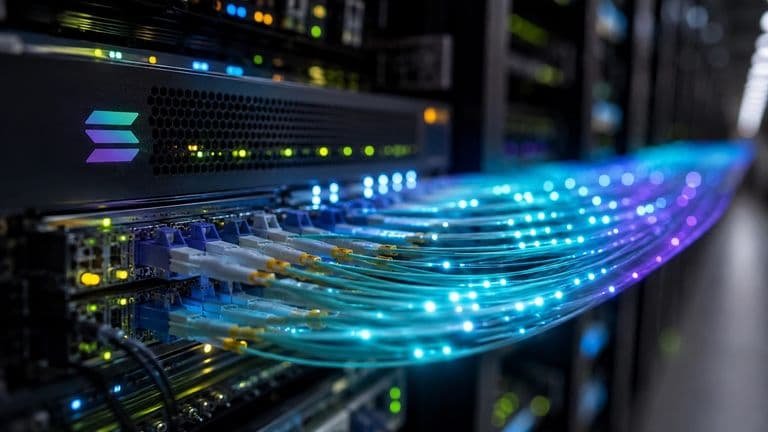
Solana has begun rolling out a major performance upgrade that will gradually reduce its block, or slot, time from 400 milliseconds to 200 milliseconds, potentially doubling the frequency at which new blocks are produced.
The upgrade is being implemented in four stages, with the network moving from 400ms to 350ms, then 300ms, 250ms and finally 200ms. Solana’s official documentation confirms that each reduction is activated through separate feature gates across successive epochs, with the rollout able to pause if block-skip rates become too high.
Solana Begins Its Push Toward 200ms
At the final 200ms stage, Solana would theoretically produce around 300 slots per minute, compared with approximately 150 at 400ms.
Importantly, the upgrade is not designed to simply increase the amount of data processed by the network. Solana says the shorter slot duration is intended to improve latency and make the network more competitive for applications that require faster confirmations. The change also reduces the period during which an individual leader controls block production, which the Solana Foundation says can improve censorship resistance and fairness.
The change is being delivered through the Agave validator software, with validators required to adopt compatible versions before the relevant feature gates activate.
Reliability Remains a Key Test
The biggest question surrounding the 200ms rollout is whether validators can maintain reliable performance as the network demands faster block production.
Solana’s rollout explicitly includes a safeguard: the network will not move to the next 50ms reduction if block-skip rates become excessive.
That makes validator adoption and network performance important metrics to monitor throughout the upgrade.
The network currently has hundreds of validators and hundreds of millions of SOL in active stake. Current validator data shows an active stake of roughly 435.7 million SOL.
200ms Blocks Are Not the Same as Faster Finality
The block-time reduction is only one part of Solana’s broader performance roadmap.
A separate upgrade, Alpenglow, is targeting substantially faster transaction finality. Research on the upgrade has placed its target around 100–150 milliseconds, meaning faster block production and faster final settlement are being addressed as separate technical challenges.
Related:Solana Alpenglow Upgrade: 150ms Finality and What It Means for SOL
That distinction matters. A blockchain can produce blocks rapidly without necessarily finalizing transactions at the same speed.
Together, shorter slots and Alpenglow could significantly reduce the time users and applications wait for transactions to be confirmed and finalized.
For context, Solana’s own documentation says the 200ms change is expected to provide 2x faster confirmations while maintaining the existing ticks-per-slot, leader span and slots-per-epoch structure.
Solana’s Speed Advantage Could Get Even Bigger
Solana already operates with a much shorter slot interval than <a href="https://xpertsstudio.com/bitcoin-price-prediction-today-btc-nears-80k-after-18-rally-news/” title=”Bitcoin Price Prediction Today: BTC Nears $80K After 18% Rally | News”>Bitcoin and Ethereum. Moving from 400ms to 200ms would widen that infrastructure advantage further.
But speed alone is not enough. The network must maintain low skip rates and reliable validator participation while operating at the faster cadence.
That is why the staged rollout is important: developers can evaluate the network after each 50ms reduction instead of making the entire change simultaneously.
SOL Investors Are Watching the Upgrade
The upgrade arrives as investors are already paying close attention to Solana’s network activity and institutional demand.
A recent report found that Solana ETFs recorded $10.26 million in weekly inflows, their strongest weekly inflow since May, although the capital was concentrated in a small number of funds.
What Comes Next for Solana?
The move toward 200ms represents an important step in Solana’s effort to reduce latency without compromising reliability.
The network will move through four separate stages rather than immediately switching to 200ms. Validators and developers will monitor skipped blocks and network performance before each subsequent reduction.
If the rollout proceeds smoothly, Solana will have a significantly faster block cadence. Combined with Alpenglow’s planned improvements to transaction finality, the upgrades could strengthen the network’s position in applications where speed and low latency are critical.
For now, however, reliability is just as important as speed. The success of the 200ms rollout will ultimately depend on whether Solana can maintain stable block production as the network pushes its performance limits.
Source: www.altcoinbuzz.io
1 Comment
Pingback: Shinhan taps Solana for Korean won tokenized fund – xpertsstudio