

Don't want to trade it yourself?
Our desk runs DEX portfolios on profit share.
Add to Google Preferred Sources
Japan’s Consumer Affairs Agency published an interim proposal on August 24 for comprehensive regulation of “dark patterns”—website and app interface designs that unfairly steer consumers toward unintended contracts or away from cancellations. The agency aims to submit legislation to next year’s ordinary Diet session, with an eye toward amending the Act on Specified Commercial Transactions. According to interviews with the agency’s Transaction Policy Division, crypto asset transactions fall under the Financial Instruments and Exchange Act and the Payment Services Act, making direct regulation through the Specified Commercial Transactions Act unlikely. Meanwhile, a Financial System Council working group has already flagged that crypto asset exchange service providers’ apps make access to sales venues—which carry wider spreads—easier than access to exchanges. Once crypto assets transition to FIEA oversight, such interface steering could become subject to investor protection rules.
Key Elements
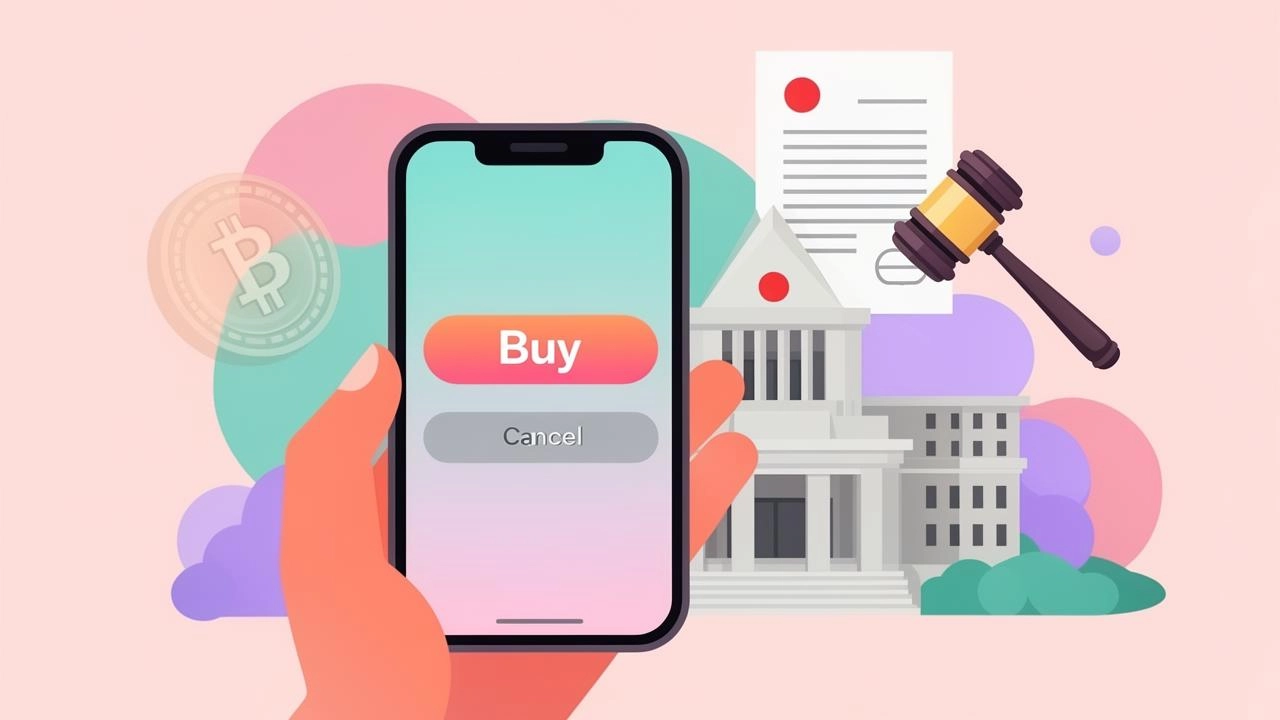
Japan’s Consumer Affairs Agency published an interim proposal on August 24 for comprehensive regulation of “dark patterns”—website and app interface designs that steer consumers toward unintended contracts or away from cancellations. The agency aims to submit legislation to next year’s ordinary Diet session, with an eye toward amending the Act on Specified Commercial Transactions.
The regulatory focus is squarely on general internet transactions such as e-commerce. According to an interview with Yamamoto of the agency’s Transaction Policy Division, the likelihood of crypto asset exchange service providers being directly regulated by the agency is currently low. Crypto asset transactions fall under the Financial Instruments and Exchange Act (FIEA) and the Payment Services Act, and as long as the framework remains within the Specified Commercial Transactions Act, dual regulation is structurally unlikely.
Yamamoto stated, “If a framework outside the Specified Commercial Transactions Act were adopted, there could be implications for the FIEA and other laws. In that case, we would need to discuss coordination with Japan’s Financial Services Agency and consistency of rules.” Having previously served at the FSA, Yamamoto also noted, “It is generally not envisioned that the Consumer Affairs Agency’s laws would be layered on top of sectors where industry-specific laws are already firmly established,” indicating that no concrete discussions have advanced at this stage that would encroach on FIEA or Payment Services Act territory.
Interface Steering Issues Lurking in Crypto Asset Trading
While administratively separated, concerns over interface design in crypto asset trading have already been raised in national policy discussions. Crypto asset trading comes in two forms: “exchanges,” where users place orders against each other on an order book, and “sales venues,” where users buy and sell directly at prices quoted by the operator. Sales venues generally carry wider spreads (the gap between bid and ask prices) than exchanges, which tends to generate revenue for operators but results in higher effective transaction costs for users.
At the fourth meeting of the Financial System Council’s “Working Group on Crypto Asset Systems” held last October, committee member Shinichiro Matsuo (professor at Georgetown University), noting the presence of Consumer Affairs Agency representatives as observers, made the following remarks about steering through app interface design:
“What I would like to point out verbally this time concerns dark patterns. Among crypto asset exchange businesses, there are two different formats: exchanges and sales venues. In many cases, sales venues have wider spreads. On top of that, in exchange service apps that offer both sales venue and exchange businesses, access to sales venues is made easier than access to exchanges. It has been pointed out that there are cases where users are, so to speak, unconsciously steered in that direction.”
Matsuo further emphasized that once crypto asset transactions transition to FIEA oversight, strict regulations under the FIEA—including the suitability principle, conflict-of-interest prevention, and prohibition of misleading representations—should apply to such steering interfaces based on investor protection rules.
The Reality of Consumer Consultation Channels and the Regulatory Outlook
When asked whether interface steering issues specific to crypto asset trading have reached the Consumer Affairs Agency’s consultation channels, Yamamoto expressed the view that “because crypto assets are highly specialized, consumers who have suffered harm are unlikely to immediately consult the general hotline, ‘188’ (Consumer Hotline).”
Relatedly, on August 24, the “Study Group on the Desirable Industrial Structure for Digital Assets” released the final 2026 version of its discussion paper. The group is led by Matsuo and Tetsuo Morishita, professor at Sophia University, and comprises volunteer practitioners and researchers. The paper systematically examines the impact of enhanced disclosure requirements and the introduction of insider trading regulations—following the 2026 transition of crypto asset regulation from the Payment Services Act to the FIEA—on exchange service providers, wallet operators, DeFi, and TradFi.
The Consumer Affairs Agency’s moves on dark pattern regulation are not expected to lead to direct regulatory tightening on the crypto asset industry in the short term. However, as the transition to FIEA oversight progresses, interface steering issues—including the access design between sales venues and exchanges—could come under stricter supervision by Japan’s Financial Services Agency from an investor protection standpoint. Crypto asset exchange service providers will need to respond not only to the Consumer Affairs Agency’s regulatory developments but also to the shape of conduct regulations following the FIEA transition.
Once added, BigGo Finance appears first in Google Search Top Stories, so you get the broadest, most up-to-the-minute, and most comprehensive global financial news first.
Source: finance.biggo.com