


Don't want to trade it yourself?
Our desk runs DEX portfolios on profit share.
AI translated#bitcoin price#Opinions#regulation#USA
CLARITY Act Fails in U.S. Senate, Crypto Market Falls
CLARITY Act fails in Senate; crypto market slides.
The CLARITY Act, a bill to regulate digital assets, failed in the U.S. Senate. The vote split 49 in favor and 50 against.
Democrats opposed it over concerns related to crypto assets and President Donald Trump’s income.
Crypto market and stocks fall
On the news, bitcoin fell to $75,038. At the time of writing, the largest cryptocurrency is trading at $75,825 (-1.9% over the past 24 hours).
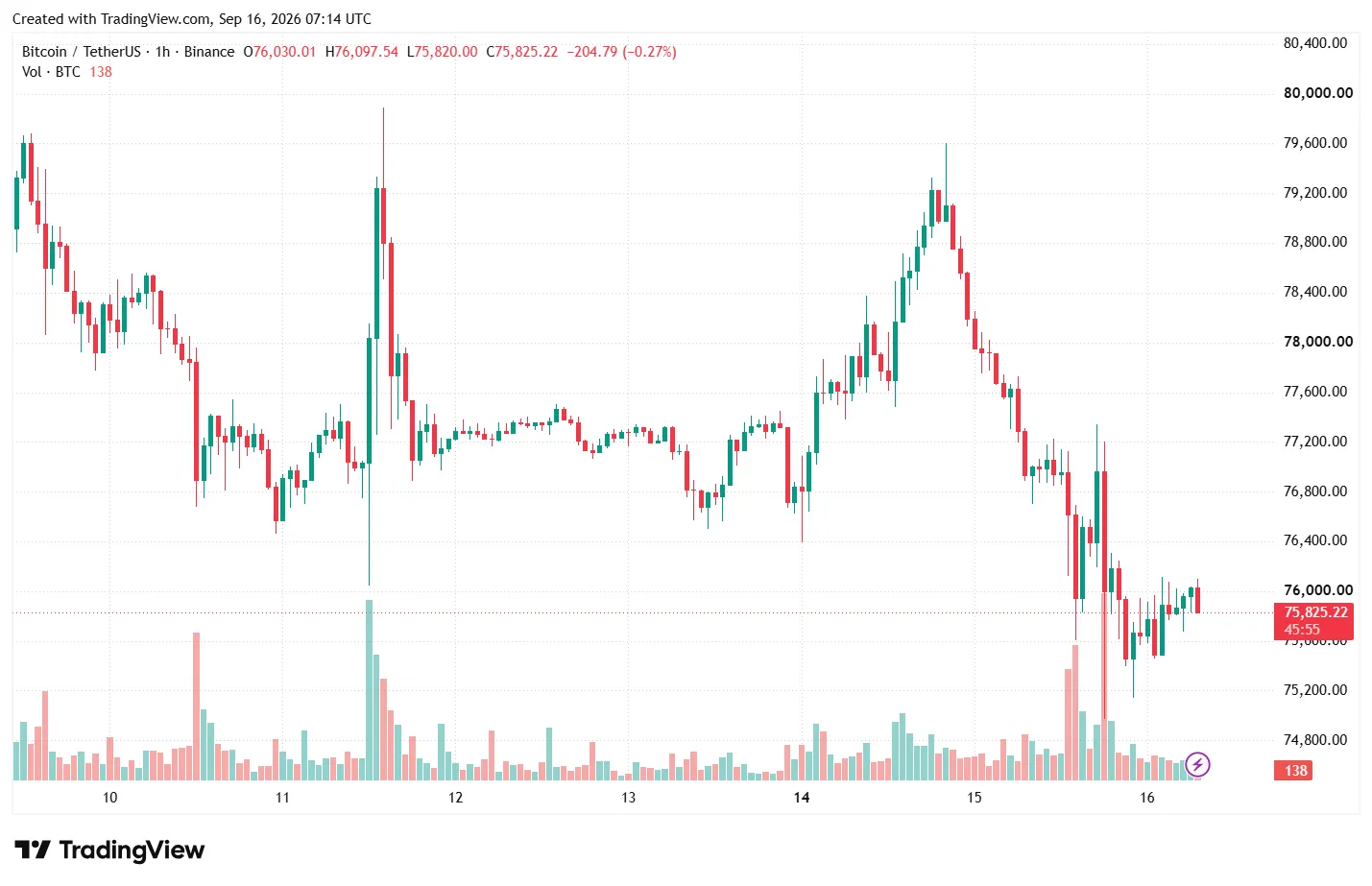
Altcoins also fell: Ethereum lost 3.4%, Solana 4.1%, and XRP 8.3%. The GMCI 30 index of the 30 largest crypto assets <a href="https://www.theblock.co/indices/broad-market/277090/gmci-30-gm30″ rel=”nofollow noopener” target=”_blank”>fell 4.16%.
Shares of sector companies declined as well. Coinbase and Circle dropped more than 10%. Strategy fell 5.4%, and BitMine lost 8.4%.
Record outflows from bitcoin ETFs
Following the bill’s failure, spot bitcoin ETFs saw the largest outflows since late June. On September 15, investors pulled $450.33 million from 13 U.S. funds (after a $160.04 million inflow the day before).
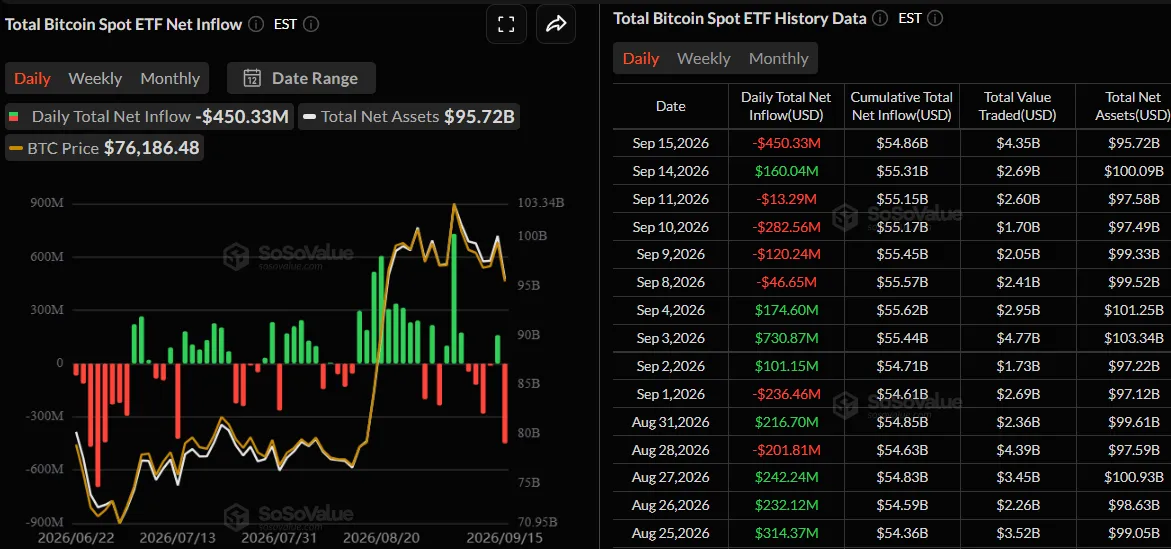
Fidelity’s FBTC led outflows, losing $214.75 million. It was followed by BlackRock’s IBIT ($161.69 million), Grayscale’s GBTC ($44.14 million), ARK 21Shares’ ARKB ($17.38 million) and Bitwise’s BITB ($12.36 million).
Community reaction
Market participants called the vote disappointing. The industry is now looking to new rules from the SEC and the CFTC.
Jessica Martinez, U.S. policy director at Fireblocks, said the company will continue working with both agencies. Ripple CEO Brad Garlinghouse called the result “painful” and urged a review of why it was rejected.
https://x.com/bgarlinghouse/status/2099943667473543484
On the eve of the vote, U.S. Securities and Exchange Commission Chair Paul Atkins pledged to develop clear rules for the crypto market. However, businesses doubt that agency policies will give investors the same level of certainty as a full law.
NEAR general counsel Abhishek Vaidyanathan noted that companies now depend entirely on regulators’ decisions and guidance.
“Companies planning budgets for 2027 will face another delay. This forces them back to case-by-case assessments and endless legal work,” he added.
Bitget Wallet COO Alvin Kan stressed that the halt of the CLARITY Act keeps uncertainty in place. It remains unclear how securities and money transmission rules apply to crypto products.
Wincent senior director Paul Howard believes the outcome reflects traditional banks’ fear for their market share rather than shortcomings of crypto technology. He called the very discussion of market structure at this level a major achievement.
Prospects for passage
Politicians are split: while some aides call the bill “dead,” Republican Senator Tom Tillis promised to continue working on the document.
1inch general counsel Orest Havryliak urged viewing the situation as a delay, not an endpoint. He noted that laws of this scale are rarely passed on the first try.
NEAR’s Abhishek Vaidyanathan is less optimistic. In his view, the next Congress will have to take up the market structure question. The Senate’s schedule ahead of the November 3 elections is highly constrained.
Analysts’ views
Arctic Digital head of research Justin d’Anethan is confident the initiative’s failure did not deal a fatal blow to the market.
“Previous all-time highs were reached without the Clarity Act at all. The market will continue to move based on the balance of supply and demand,” he said.
D’Anethan added that major players see the situation as a timing delay rather than the closure of opportunities.
BTC Markets analyst Rachel Lucas said regulation has never been the industry’s main brake. The current cycle depends entirely on macroeconomics rather than headlines. The key factors for the market are:
- actions by the Fed on the policy rate;
- the pace of inflows into ETFs;
- alternative regulatory paths that do not require 60 votes in the Senate.
According to Lucas, capital is not leaving the industry but rotating. The ETH/BTC pair rose 25% in the third quarter, and privacy coins gained 213% since the October peak. Such asset rotation rules out investor panic.
At the same time, there is pressure from miners. Bitcoin’s hash rate is 12% below the December 2025 peak as large miners shift capacity to artificial intelligence workloads.
“For a fourth-quarter recovery, what’s needed is not Congress but stabilization in macroeconomics,” Lucas concluded.
Experts agree that, for bitcoin today, interest rate levels matter more than regulatory clarity from authorities.
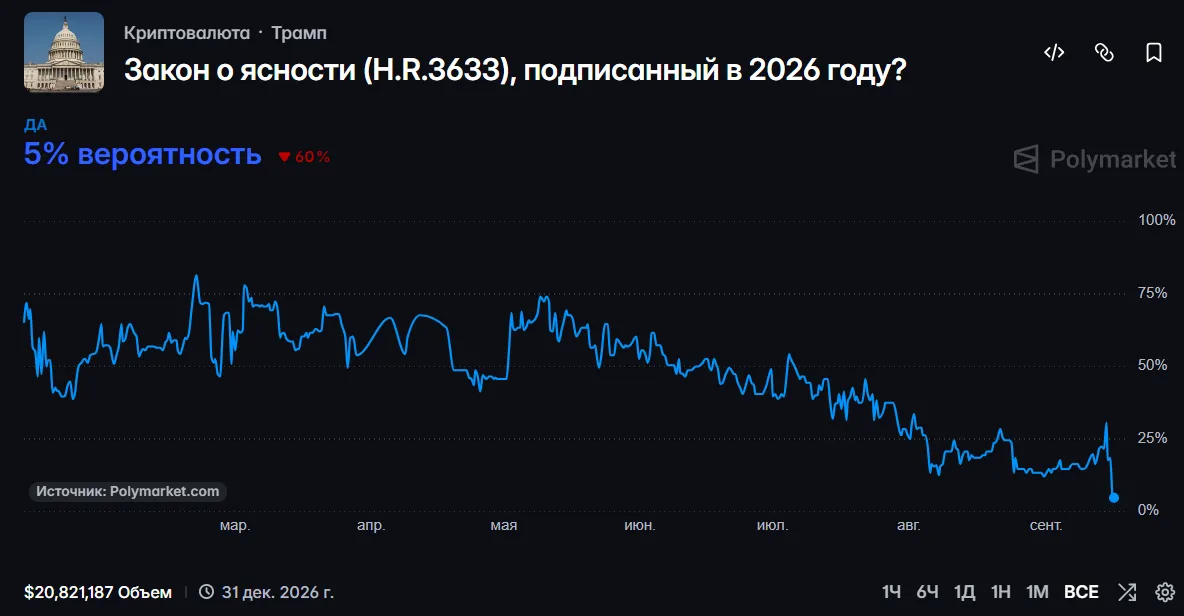
Following the document’s rejection, odds on Polymarket that the CLARITY Act will be signed into law in 2026 fell to 5%. That is the lowest reading since the market opened in January.
On September 14, U.S. President Donald Trump agreed to tighten restrictions on officials’ crypto business activities.
Found a mistake in the text? Select it and press CTRL+ENTER
Why the U.S. is buying the yen
UK Regulator Clarifies New Rules for Crypto Businesses
Nvidia CEO Opposes New AI Regulations
Phemex CEO Calls AI a Threat to the Crypto Industry
CryptoQuant contributor sees signal of Bitcoin bear phase ending
Opinion: Higher Rates Are Reshaping Markets
Google Expands Pilot Program to Pay Publishers for AI Content Contributions
Democrats Reject Final Version of CLARITY Act, Propose Counteroffer
Bloomberg Analyst Warns Bitcoin Could Drop to $10,000
Source: forklog.com
4 Comments
Pingback: Eyes on Fed Decision After Bitcoin Trades Near 4 – xpertsstudio
Pingback: Public Bitcoin Miners Operate at a Loss as Production Costs Exceed Bitcoin Price by 29% – xpertsstudio
Pingback: The Fed Decides at 2 pm ET Wednesday. What a Hike Does to Bitcoin, XRP and Ethereum the Day After Congress Failed. – xpertsstudio
Pingback: Bitcoin absorbs initial pre-Fed sell-off, leaving $70K as a critical test for Warsh’s Fed decision – xpertsstudio