


Don't want to trade it yourself?
Our desk runs DEX portfolios on profit share.
AI translated#Bitcoin#Opinions#regulation#USA
Bitwise Sees Crypto Market Growth Possible Without CLARITY Act
Crypto market growth possible without CLARITY Act, says Bitwise CIO.
The cryptocurrency market can continue to grow even without the adoption of the CLARITY Act, according to Bitwise’s Chief Investment Officer Matt Hougan. He reassessed the impact of the bill’s failure in the U.S. Senate.
“I no longer consider the previous scenario the most likely. On the contrary, I think the failure of the CLARITY Act may be far less significant than today’s headlines suggest,” Hougan wrote.
Why Hougan Changed His Assessment
In January, Bitwise’s investment head compared the CLARITY Act to Punxsutawney Phil, the groundhog whose behavior traditionally predicts the length of winter in the U.S. He suggested that the initiative’s failure would bring another six weeks of unfavorable trends to the digital asset sector.
Now, Hougan points to the divergence between Bitcoin prices and the expectations of Polymarket participants.
The leading cryptocurrency rose from a local low of around $57,950 on July 1 to over $80,000 by September 4. Meanwhile, from July 1 to September 15, the probability of the CLARITY Act passing in 2026 on the platform fell from 39% to 18%.
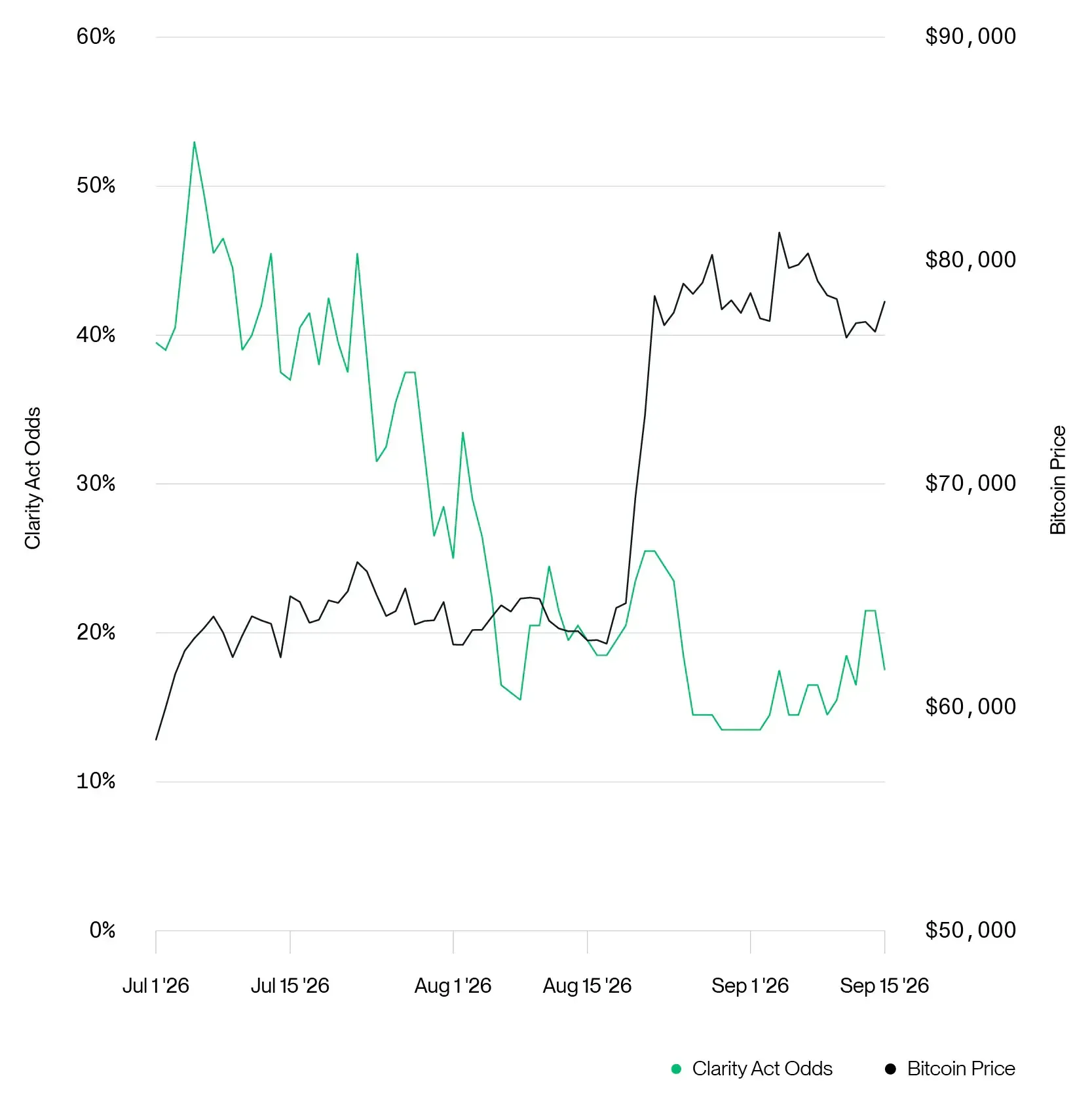
If continued growth depended on the bill, its declining prospects would have been accompanied by a drop in Bitcoin’s price, the expert believes. In reality, the metrics moved in opposite directions.
Wall Street also did not wait for Congress’s decision. Hougan cited the launch of the Robinhood Chain, the release of Solana-ETF by Morgan Stanley, and the first settlements of DTCC with tokenized stocks as examples.
In his view, companies are counting on a favorable approach from the current leadership of the SEC and CFTC. The heads of both agencies have expressed readiness to independently adopt some of the rules outlined in the CLARITY Act.
However, such measures cannot fully replace the law. The next administration could revise the regulators’ decisions, and only Congress can expand the CFTC’s powers in the spot crypto market.
After the vote, Bitcoin lost about 4%. Hougan attributed the decline not only to the situation surrounding the CLARITY Act but also to concerns about interest rates and oil prices.
Democrats to Continue Negotiations
On September 16, Democratic Senator Kirsten Gillibrand and six other party members confirmed their intention to continue working on the CLARITY Act.
“This week was a setback, but not the end of important work. We remain committed to working with both parties to pass the law,” the joint statement said.
The senators advocated for rules that would protect consumers, hold violators accountable, create certainty for businesses, and establish ethical restrictions for elected officials.
Their stance is notable against the backdrop of recent Republican concessions. According to the authors of the final draft, it included 126 significant changes at the Democrats’ request.
U.S. President Donald Trump also agreed to tighten restrictions on officials’ participation in the crypto business.
Officials and their spouses were proposed to be required to sell significant stakes in industry companies or transfer them to independent management. State prosecutors were to be given the ability to enforce these requirements through the courts.
Nevertheless, the compromises did not help the project gain support from any Democrats. On September 15, the Senate considered a procedural proposal necessary to move forward with discussing the CLARITY Act. Approval required 60 votes; the result was 49 “for” and 50 “against.”
According to the Senate roll call, all 49 votes in favor of the proposal came from Republicans. Among Democrats, 44 voted against. The initiative was also rejected by four Republicans and two independent senators.
All seven Democrats who later announced their intention to continue working on the law did not support the start of its consideration.
Before the vote, Bernstein analysts called the Republican concessions “as extensive as possible” and suggested they might help attract a few Democratic votes.
Found a mistake in the text? Select it and press CTRL+ENTER
SEC Permits Limited Trading of Tokenized Stocks
Analysts Divided on Bitcoin Outlook After Fed Meeting
US House Committee Approves Bill for Strategic Bitcoin Reserve
Bitcoin Core 32.0 Enters Final Testing Phase
IBM Secures $1 Billion from US for Quantum Wafer Production
Why the U.S. is buying the yen
UK Regulator Clarifies New Rules for Crypto Businesses
Nvidia CEO Opposes New AI Regulations
Phemex CEO Calls AI a Threat to the Crypto Industry
Source: forklog.com