

Don't want to trade it yourself?
Our desk runs DEX portfolios on profit share.
<a href="https://xpertsstudio.com/bitcoin-treasuries-buy-just-5-9k-btc-in-three-months-as-paper-losses-linger/” title=”Bitcoin treasuries buy just 5.9K BTC in three months as paper losses linger”>Bitcoin’s math problem is a machine that hasn’t been built yet — but that hasn’t stopped developers from moving anyway. Bitcoin quantum resistance has jumped from a theoretical debate to an active engineering priority, after developers published a roadmap aimed at shielding the network from quantum computers before they become powerful enough to break its cryptography. The timing isn’t random: new research shared this week shows the computing power needed for a future quantum attack on Bitcoin and Ethereum has already dropped by more than half compared with estimates from just months earlier.
Key takeaways
- Bitcoin developers, led by Christine Kim, published a post-quantum security roadmap detailing interventions including BIP-360, SHRINCS, Lifeboat, and Dropkick.
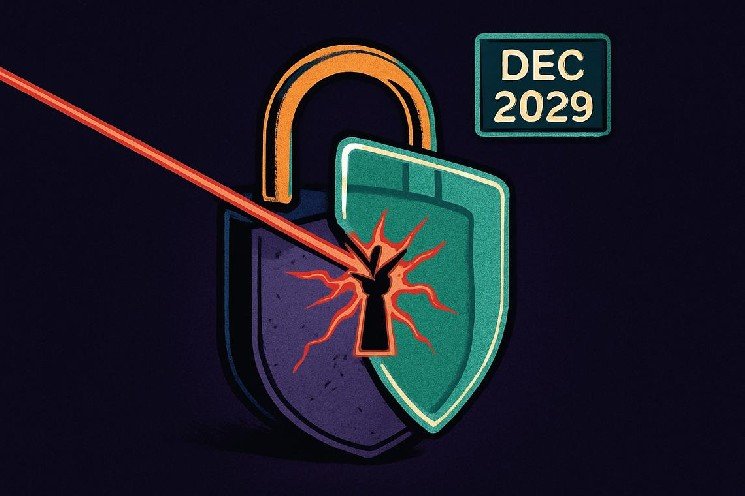
- The stated goal is to make Bitcoin quantum-resistant by December 2029.
- A new research paper shared with CoinDesk shows the estimated workload for a key step in a quantum attack on Bitcoin and Ethereum has fallen more than 50% below a benchmark Google Quantum AI published in March.
- Microsoft, Cloudflare, and Google are targeting the same December 2029 deadline for migrating to post-quantum cryptography.
- $XRP is targeting 2028 for its own four-phase security framework, while Ethereum is also aiming for December 2029.
Why Quantum Computers Are Suddenly a Bitcoin Problem
Quantum computers could break the cryptography protecting Bitcoin by 2030, and that estimate keeps getting sharper as researchers chip away at the problem from multiple directions. According to data shared by major Bitcoin developer Christine Kim, quantum computers are advancing quickly enough that asymmetric cryptography — the math underpinning wallet signatures — could become powerless after that point, pushing digital networks toward faster, more coordinated defenses.
No longer confined to theory, the threat is detailed in a paper shared with CoinDesk by researchers from the Ethereum Foundation, Theta Labs, StarkWare, and other organizations, which outlines a quantum circuit requiring 1,151 logical qubits and about 1.3 million Toffoli gates to carry out a key calculation used in Shor’s algorithm — the quantum technique that might ultimately convert an exposed public key into a private one, enabling an attacker to sign transactions as though they were the wallet’s legitimate owner. That combined score of about 1.5 billion is more than 50% below the roughly 3 billion figure Google Quantum AI reported in March, though the paper notes the comparison isn’t perfectly apples-to-apples because the two designs use different accounting rules. A second version of the circuit, built closer to how Shor’s algorithm would actually run, still scored about 1.96 billion — below Google’s earlier figures.
The optimization came from an unusual mix of contributors. Researchers, working alongside AI coding agents, tackled the problem through an open challenge, building on each other’s improvements. Humans reportedly picked the research directions and made the bigger structural changes, while AI agents handled implementation, repeated testing, and smaller tweaks. Both Bitcoin and Ethereum rely on secp256k1, the exact cryptographic scheme targeted by this research, which is part of why the findings matter to both networks simultaneously.
No existing quantum computer can use this research to break Bitcoin or Ethereum today — the researchers optimized just one piece of a much larger attack and left out physical error correction and other real-world costs. But the finding illustrates something developers have been saying for a while: the attack doesn’t need better hardware to get closer. It just needs smarter math, and that math is improving faster than expected. This is one of the reasons Bitcoin’s quantum resistance planning has shifted from a background research topic to a published, dated roadmap.
Bitcoin’s Post-Quantum Security Roadmap
Bitcoin developers aren’t waiting to find out how far the quantum attack estimates fall next. The core team, led by Christine Kim, has consolidated years of research into a structured response to the threat, publishing a post-quantum security roadmap built to protect the blockchain’s infrastructure, validators, private states, and wallets end-to-end.
The Tools Behind the Plan
The roadmap names four coordinated interventions: BIP-360, SHRINCS, Lifeboat, and Dropkick. Together, they’re described as a comprehensive answer to the long-term risk quantum computing poses, rather than a single patch. The framing suggests developers see this less as one upgrade and more as a layered defense — a strategy that matches how seriously the network treats a threat that, according to the roadmap’s own timeline, isn’t expected to materialize for several more years but requires years of lead time to prepare for regardless.
This is where the “why now” question gets answered. Migrating a live, global financial network to new cryptography isn’t something that happens overnight — wallets, exchanges, and infrastructure providers all need time to adopt new standards before old ones become risky. Publishing the roadmap now, years ahead of the danger window, gives the ecosystem runway to test, argue over, and eventually implement the changes without doing it under pressure.
A Race Against a 2029 Deadline
Bitcoin’s target is now on the calendar: developers are aiming to achieve quantum resistance across data layers, consensus, and execution by December 2029. That date isn’t arbitrary, and it isn’t Bitcoin’s alone.
Other Blockchains and Tech Giants Are Moving Too
The same December 2029 deadline has been set by Microsoft, Cloudflare, and Google, which are expecting their own systems to transition to post-quantum cryptography by then. That kind of alignment across major tech infrastructure providers has intensified scrutiny of any protocol still relying on elliptic-curve signatures — the same category of cryptography Bitcoin and Ethereum both use today.
Other blockchains are running on similar clocks. $XRP unveiled a four-phase security framework on August 31, targeting completion by 2028 — a year ahead of Bitcoin’s goal. Ethereum released its own post-quantum security framework on September 9, also aiming for quantum resistance by December 2029, putting it on the same timeline as Bitcoin’s newly published plan.
Seen together, these overlapping deadlines say something about where the industry’s collective risk tolerance sits. Whether that coordination is deliberate or simply a byproduct of shared research and shared urgency, the practical effect is the same: by the end of the decade, most of crypto’s biggest networks intend to have moved off the cryptography that quantum computers are expected to eventually defeat. The gap between now and then is where the real work — and the real uncertainty — lives.
Why is Bitcoin concerned about quantum computing?
Quantum computers could break the cryptography protecting Bitcoin by 2030, threatening the security of blockchain networks.
What is Bitcoin doing to prepare for the quantum threat?
Bitcoin developers published a post-quantum security roadmap led by Christine Kim, detailing interventions like BIP-360, SHRINCS, Lifeboat, and Dropkick.
When does Bitcoin aim to become quantum-resistant?
The goal is to make Bitcoin quantum-resistant by December 2029.
Are other companies or blockchains also planning for quantum security?
Yes. Microsoft, Cloudflare, and Google plan to migrate to post-quantum cryptography by 2029, $XRP has a framework targeting completion by 2028, and Ethereum is also aiming for December 2029.
Article produced with the assistance of artificial intelligence and reviewed by the editorial team.
Source: cryptonews.net