

Don't want to trade it yourself?
Our desk runs DEX portfolios on profit share.
Circle launched Arc’s public mainnet on September 16, 2026, deploying Arc network in a live production environment after Arc’s public testnet in October 2025.
Arc Mainnet Is Live: What Actually Launched?
With Arc Mainnet launch, it built an open Layer 1 for financial markets based on real-time value transfer and agentic economic behavior, with fees alternatively paid in USDC▼$0.9998 and transactions settled in under one second.
More Than 100 Applications Are Available From Day One
From day one, over 100 applications and more than 100 institutional and ecosystem builders have been building on Lens, including in trading, lending, wallets, exchanges, infrastructure, and AI. Partners include Uniswap, Aave, Morpho, MetaMask, Phantom, Binance Wallet, and Chainlink.
This means that not only the blockchain itself was released, but also the applications, assets, and markets. Circle states that Arc connects to more than 20 other blockchains through its CCTP and Gateway infrastructure.
Arc Is Positioning Itself as a Financial Network, Not Another General-Purpose L1
Circle states that Arc will be a purpose-built “Economic OS” supporting payments and foreign exchange (FX), tokenized assets, lending and capital markets, and infrastructure for autonomous agents, as opposed to simply a general-purpose smart-contract chain.
That positioning helps explain what is Arc blockchain in practice: an EVM-compatible Layer 1 aimed at financial applications, with stablecoin-denominated fees and deterministic sub-second finality being among its key design decisions.
| Feature | Arc Mainnet at Launch |
| Launch date | September 16, 2026 |
| Network type | EVM-compatible Layer 1 built for financial applications |
| Ecosystem | 100+ applications and 100+ institutional and ecosystem builders |
| Gas & fees | USDC-based, stablecoin-denominated transaction fees |
| Finality | Deterministic settlement in under one second |
| Key applications | Uniswap, Aero, Aave and Morpho |
| Wallet support | MetaMask, Ledger, Phantom, Rainbow and Trust Wallet |
| Interoperability | 20+ blockchains through Circle CCTP and Gateway |
| Primary use cases |
What Users Can Actually Do on Arc Right Now
At launch, major trading and liquidity applications such as Uniswap, Aero, as well as the lending infrastructure apps Aave and Morpho, are available on the network. Major self-custodial wallets such as MetaMask, Ledger, Phantom, Rainbow, and Trust Wallet support the network. Major centralized exchanges have also integrated support in some capacity with Arc.
So what is Arc Mainnet today is much more than a developers’ network – Circle launched with real assets, DeFi markets, wallets, exchanges and infrastructure available to users from block one.
At the same time, the scale of integrations is not evidence that this has translated into user adoption or transaction volume since that will only be revealed post-launch.
The Institutions Behind Arc Are the Real Story
To understand what is the Arc ecosystem, its institutional participation extends beyond companies simply deploying applications onchain.
Circle, for example, has brought banks, asset managers, payment networks and market-infrastructure providers into the network’s operation and integration layer as part of Arc ecosystem launch.
BlackRock, Visa, Mastercard and DTCC Join the Validator Set
Founding Arc validators include BlackRock, DTCC, Galaxy, ICE, Mastercard, MoneyGram, SBI Group, Standard Chartered, Sumitomo Corporation, Visa and Worldpay, and Circle. According to Circle, these validators will onboard gradually and be directly responsible for validating the network.
The participation of Arc BlackRock and Arc Visa is not just branding, as they are among the founding validators listed by Arc, along with DTCC and Mastercard.
Which Banks, Payment Companies and Financial Firms Are Integrating Arc
According to Circle, banks building on Arc include BNY, BTG Pactual, Commerzbank, HSBC, Lead Bank, Société Générale, Standard Chartered, and State Street. Payments companies building on Arc include JCB, Mastercard, MoneyGram, Rain, Thunes, Visa and Wirex.
Another group is asset managers and providers of tokenized assets. Circle names BlackRock, Bitwise, Janus Henderson, Maple, ProShares and New York Life Investment Management as examples of firms building tokenized financial products onchain alongside Centrifuge.
Why Circle Chose a Permissioned Validator Model
While Arc is open to both users and developers, participation as a validator is permissioned. Circle states this gives a defined governance perimeter with known and vetted validators, helping banks with accountability and infrastructure risk controls.
The proposal attempts to align better with Basel cryptoasset standards and CPMI-IOSCO framework standards on governance, operational resilience and settlement finality. Circle believes identifiable validators and deterministic finality may ease regulatory and risk assessment for financial institutions.
What Makes Arc Different From Ethereum and Other L1s?
While Arc retains the EVM development environment, Circle’s Arc network design enables stablecoin-dominated transaction fees, provides deterministic settlement and native interoperability. These are perceived as optimizing Arc network for payments and financial markets without requiring users to hold a volatile native asset for day-to-day transactions.
USDC Is the Gas Token
Unlike Ethereum, which pays transaction fees in the native asset ETH▲$2,518.27, Circle states that Arc USDC is used to pay for transaction fees. Circle does not require another asset to be used to pay transaction fees, so the costs are simply denominated in US dollars.
USDC is also available as an ERC-20 interface, allowing developers to programmatically interact with the underlying balance using existing EVM patterns.
Sub-Second Finality and Predictable Fees
Arc achieves deterministic finality within a capacity of less than one second. According to Circle, once a transaction is finalized, it is settled without the probabilistic confirmation processes of some blockchain networks.
Stablecoin-denominated fees, starting with USDC, are intended to keep fees guaranteed low and predictable to make transaction costs more predictable for applications such as payments, trading, and other financial applications.
EVM Compatibility Without ETH as the Native Asset
According to Circle, Arc is EVM compatible, meaning developers can use Solidity and existing Ethereum tools such as Foundry, Hardhat, viem, and ethers.js with relatively few changes to deployed contracts.
The primary difference is that it does not require ETH for the native asset for gas; instead, USDC Arc is used for gas, creating an Ethereum-compatible execution environment that also uses a stablecoin-based fee model.
20+ Blockchain Connectivity Through CCTP and Gateway
At launch, Arc provides interoperability with over 20 blockchainsve cross-chain transfers, and Gateway supports a single USDC balance across supported blockchains
Circle is also expanding CCTP beyond USDC, with a stated roadmap for support for other Circle-issued assets and infrastructure for other issuers to issue assets from Arc to more than 20 chains.
| Feature | Arc | Ethereum |
| Gas asset | USDC | ETH |
| Fee denomination | US dollar-denominated | ETH-denominated |
| Execution environment | EVM-compatible | EVM |
| Smart contracts | Solidity | Solidity |
| Finality model | Deterministic, sub-second | Epoch-based finality |
| Primary positioning | Payments and financial markets | General-purpose smart-contract platform |
| Developer tooling | Foundry, Hardhat, viem, ethers.js | Foundry, Hardhat, viem, ethers.js |
| Crosschain infrastructure | CCTP and Gateway | Third-party bridges and interoperability protocols |
| Connected networks | 20+ through Circle infrastructure | Depends on the bridge/protocol used |
Inside the Arc Ecosystem at Launch
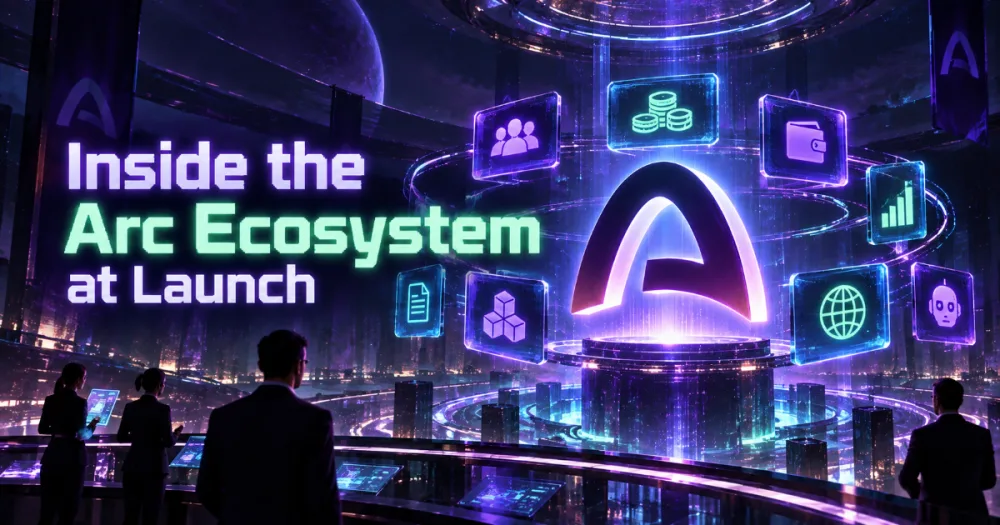
At launch, the Arc ecosystem projects list included over 100 applications, while Circle reported more than 100 institutional and ecosystem builders.
Circle describes the launch stack as covering trading, lending, tokenized assets, payments, wallets, custody and AI agent infrastructure rather than relying on applications to arrive after mainnet.
Uniswap Brings Liquidity to Arc
Uniswap v2, v3, v4 and UniswapX are all live on Arc, available through the Uniswap Web App, Wallet and API. Uniswap is Arc’s preferred DEX and provides swaps and liquidity infrastructure from day one.
For developers, this is the core liquidity layer that can be used for stablecoin trade, collateralized lending and borrowing, and additional use cases, as well as a trading venue for cirBTC at launch.
Aave and Morpho Bring Lending Markets
Aave and Morpho are used as baseline onchain credit markets for Arc’s launch. Participants including Bitwise, Cumberland, Galaxy, Gauntlet and Keyrock contribute liquidity, risk management and credit strategies
Aave’s Arc proposal, which was based on USDC, EURC, WETH and cirBTC, shows how lending will be paired within Arc with the stablecoins and other financial products.
StableFX Brings 24/7 Cross-Currency Settlement
Circle StableFX is live on Arc, providing 24/7 programmable foreign exchange, and there are more than 20 fully reserved stablecoins in operation or onboarding. The protocol implements atomic payment-versus-payment settlement, seeking to minimize the settlement window and counterparty risk.
That makes FX a first-class citizen in Arc stablecoin ecosystem, instead of a service layered on top of it.
BUIDL and USYC Bring Tokenized Funds Onchain
BUIDL$1.00, a tokenized fund offered by BlackRockalongside the tokenized funds offered by Janus Henderson, JAAA$1.05 and JTRSY$1.12
These, together with Arc’s trading, lending, borrowing, FX and payments infrastructure, give tokenized funds more onchain utility than a simple transfer between wallets.
Payments, Wallets and Custody Infrastructure
The initial Arc blockchain projects are in its payments and access infrastructure. Circle Payments Network is built on top of Arc; Arc lists Mastercard, Visa, MoneyGram, Worldpay, Global Payments and many others as participating payments companies.
Supported wallets include MetaMask, Phantom, Ledger, Rainbow, and Trust Wallet; supported institutional custodians include BitGo, Copper, Fireblocks, Fordefi and Zodia Custody.
AI Agents Become Part of the Economic Stack
Arc also launches Circle Agent Stack, a policy-controlled wallet module that enables AI agents to hold and send digital assets. Agent services offered on Arc include Alethieum, Architect, Arrays, BlockRun, Goldsky, Kite AI, Ornn, Orthogonal and Virtuals in early access.
Built-in support for “agentic economic activity” was designed from the beginning, meaning that decentralized transactions were one of Arc’s first use cases rather than something that was tacked on later.
Arc’s Full-Stack Strategy: From USDC to Tokenized Assets
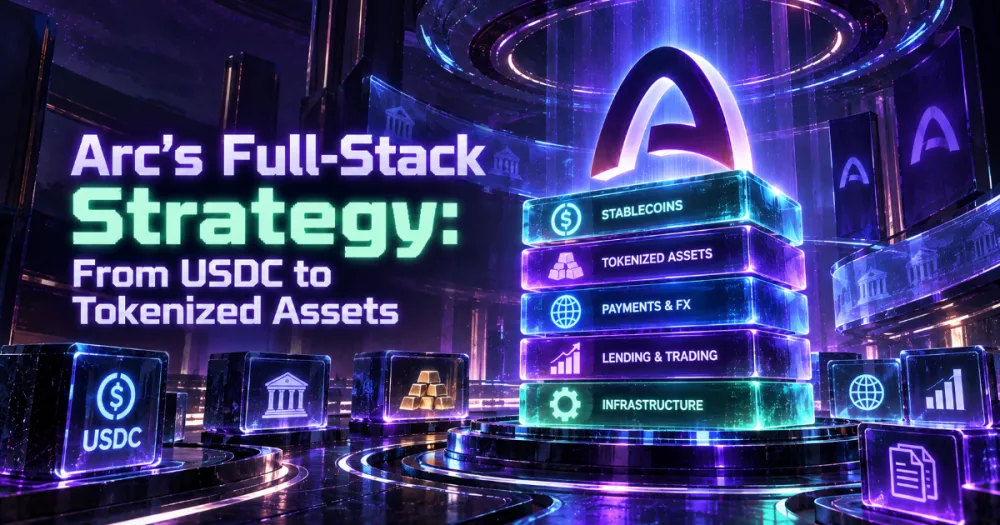
Arc mainnet offers stablecoins, tokenized funds, Bitcoin, FX, and cross-chain infrastructure on a single settlement layer. According to Circle, this can be considered a full-stack financial platform since it launches with these assets and markets, rather than introducing them as separate infrastructure.
USDC and EURC as Native Financial Infrastructure
USDC is the primary asset in Arc stablecoin ecosystem. It serves as the network’s gas token and acts as its settlement and liquidity layer. EURC is native to the network, allowing applications to access Circle-issued dollar and euro stablecoins directly on the network.
Both of these complementary products are closely integrated with Circle’s overall ecosystem, including Mint, CCTP and Gateway, allowing developers and institutional customers to combine stablecoin payments and liquidity with cross-chain movement rather than considering them separately.
Local Fiat Stablecoins and Cross-Border Settlement
Arc supports a much larger set of currencies than USDC and EURC. At the launch of Arc on mainnet, Circle listed more than 20 stablecoins either live or onboarding, such as the Australian dollar, Brazilian real, Japanese yen, Mexican peso and South African rand.
In conjunction with 24/7 FX execution and payment-versus-payment (PvP) settlements for supported assets, Circle Payments Network is available to Arc’s cross-border payments workflows. StableFX participants are compliance-screened and supported local stablecoins are provided
Tokenized Funds, RWAs and Programmable Assets
Arc launched with the BlackRock BUIDL fund, tokenized by Securitize, Circle’s USYC fund, and Janus Henderson’s JAAA and JTRSY funds. It is complemented with lending, borrowing, trading, payments infrastructure, and foreign exchange services.
The EVM compatibility of Arc allows developers to issue programmable assets and tokenized RWAs using Solidity-based contracts and Ethereum development conventions.
Bitcoin and Other Assets on Arc
Bitcoin exposure is through a Circle wrapped bitcoin product, cirBTC, which is issued at a 1:1 ratio with native BTC▲$77,666.00, with reserves onchain being auditable by third parties. cirBTC can be used as collateral, liquidity, and in Arc’s DeFi activities.
Circle has stated that users who are eligible can convert BTC, cbBTC, or wBTC to cirBTC 1:1 at no conversion charge. Arc’s mainnet tools allow WETH and other assets conversion in addition to stablecoins.
Why Circle Wants the Entire Financial Stack on One Network
Circle’s plans include adding payments, FX, lending, trading, and tokenized assets to the settlement layer, and the ability to send an asset on Arc to any of the 20+ blockchains in Circle’s interoperability infrastructure.
The end result would be a vertically integrated stack from issuance to liquidity, settlement, and cross-chain, with Circle envisioning that Arc will largely serve as the settlement layer tying together the pre-existing products rather than as a standalone blockchain product.
| Layer | Assets / Infrastructure | Role on Arc |
| Dollar stablecoin | USDC | Gas, settlement and liquidity |
| Euro stablecoin | EURC | Euro-denominated payments and liquidity |
| Local currencies | 20+ stablecoins live or onboarding | FX and cross-border settlement |
| Tokenized funds | BUIDL, USYC, JAAA, JTRSY | Onchain investment and RWA infrastructure |
| Bitcoin | cirBTC | BTC exposure, collateral and DeFi liquidity |
| Other crypto assets | WETH and supported tokens | Trading, lending and DeFi |
| FX infrastructure | StableFX | 24/7 cross-currency settlement |
| Interoperability | CCTP, Gateway | Connectivity across 20+ blockchains |
The $10 Billion ARC Token Is Here. But Is It Actually Launching?
Circle has now created ARC onchain, but that does not mean the token is publicly available. The company has stated that the genesis mint is a technical milestone, not an ARC token launch.
Circle Has Minted 10 Billion ARC
Circle completed the genesis mint in the United States during mainnet launch week. Circle minted the entire 10 billion ARC initial supply during genesis. Circle describes ARC as a proposed native coordination asset for security, utility, and governance.
The mint follows the token’s design release earlier that month, and Circle released an ARC whitepaper in May 2026 after a $222 million presale with a $3 billion fully diluted network value.
Why ARC Is Not Needed to Pay Gas
ARC is not an Arc gas asset. Instead of paying network fees in the native token, users pay in USDC, preserving Arc’s model of dollar-denominated transaction costs without requiring a native token with price volatility.
This distinction is central to what is the ARC token, as its use would be for network coordination, rather than regular transaction expenses.
What ARC Is Supposed to Do
According to Circle, ARC token will operate as a digital commodity for coordinating security, utility, and governance, and that staking and delegation are meant to expand the network’s participation and its operation.
ARC would not represent Circle equity or provide a claim on the company’s revenues, profits, assets or CRCL shares.
Why Circle Has Not Committed to a Public Token Launch
For anyone asking is the ARC token launching, Circle’s current answer remains no: the token has not publicly launched, and no final decision has been made. The design, functionality, timing, and rollout remain subject to change.
This is an important difference because, while the initial supply exists, public availability, live staking and governance mechanics do not.
The Planned Move From Proof of Authority to Proof of Stake
Arc initially launches with an institutional validator set using Proof of Authority. Circle intends to migrate to Proof of Stake in 2027, at which point ARC could be used to stake or delegate tokens in Proof of Authority.
Circle frames are part of a broader move towards distributed participation in the network, with Proof of Stake and ARC-based staking on the roadmap but not enabled on the mainnet.
Arc’s AI Bet Goes Beyond Crypto Trading
Arc has said that it sees agents as economic actors, and not just users of the trading strategies. According to Circle, agents currently use its infrastructure for dealing, payments, liquidity routing, and interacting with contracts. From genesis, Arc was designed around the needs of this class.
Arc Studio Turns AI Into a Development Tool
Arc Studio is an onchain programming agent that takes natural language user instructions and produces Solidity contracts, application logic, and deployment-ready code. It can conduct security analysis and verify the state of live blockchains, and deploy applications to Arc Testnet or eight other EVM testnets.
The tool also reflects the developer side of what projects are built on Arc: Circle says their community had built over 1200 projects before the public mainnet, and Arc Studio is intended to be a place for developers to build even more.
Agent Stack Gives AI Agents Financial Capabilities
The Circle Agent Stack includes Agent Wallets, Marketplace, CLI, Skills, and Nanopayments. Agents can hold and send USDC, find paid services, and make and receive payments within human-defined spending limits, allowlists, and other constraints.
According to Circle, Agent Stack lets users access hundreds of paid endpoints. In Q2, Circle announced over 900 paid services, while 99.3% of x402 agent-payment volume was settled in USDC.
AgentVM and the Push Toward Autonomous Transactions
AgentVM was still under development, but Circle intends it to allow agents to handle sensitive data in an isolated environment that Arc can use to record verifiable provenance without exposing the data contained within it.
Arc roadmap includes the Agent Sector, a verifiable agent identity and auditable agent records. Circle considers these a future infrastructure of the roadmap and not currently deployed on the mainnet.
Why Stablecoin Infrastructure Matters for Machine Payments
Circle seeks to capture the machine payment market with USDC, which has programmable settlement and stable value suitable for autonomous software. The costs of sending nanopayments through Gateway are effectively zero due to the absence of gas fees, allowing transactions as low as $0.000001. This makes the protocol ideal for high-frequency payments for APIs, data, and other machine-consumed services.
This explains why USDC is used by Arc, as it is the gas token for Arc and a part of Circle’s agent-to-agent and pay-per-use network. In fact, per Circle, USDC makes up 98.8% of all transaction volume.
What Arc Still Needs to Prove
Arc entered its public mainnet with over 100 applications and major financial institutions. As the mainnet launch happened on 16 September, for the first time there is not enough history on the public mainnet to determine sustained demand for transactions, institutional assets moving, or prolonged use of applications.
Can Arc Generate Real Stablecoin Transaction Volume?
Circle says Arc’s testnet has handled over 700 million transactions in less than a year. Mainnet must show that payments, FX, lending, and tokenized assets can create lasting economic activity not just during testing, but in real-world use.
The initial liquidity is large, as Circle reported more than $74 billion worth of USDC circulated at the time of launch. Whether or not usage of the existing USDC Arc infrastructure results in meaningful stablecoin mainnet usage needs production data.
Will Institutional Firms Move Assets Beyond Pilot Programs?
BlackRock, DTCC, Visa, Mastercard and others are founding validators. Banks BNY, HSBC, Société Générale, Standard Chartered and State Street have connected to Arc. Asset managers and RWA issuers are working on tokenized products based on public core and standard.
The next thing to watch will be the scale of production activity. More than 100 institutional and ecosystem builders integrated with and stressed Arc’s private mainnet in preparation for the public mainnet, where these integrations and ecosystem activities will initially be deployed and observed.
Can 100+ Launch Applications Become a Sustainable Ecosystem?
On day one, over 100 supported applications launched, including Uniswap, Aave, and Morpho, along with exchanges, wallets, and infrastructure providers. According to Circle, over 1,200 projects have been built by Arc’s developer community.
Those numbers answer what projects are built on Arc at launch, but not how many will retain users and liquidity over time. Since mainnet is only a day old, sustainable application activity cannot yet be established from public production history.
Can Circle Turn USDC Liquidity Into a Network Effect?
Circle instrumented Arc with USDC, EURC, CCTP, Gateway, StableFX, and Circle Payments Network, enabling the company to bring together USDC liquidity with payment, FX, lending, trading, and cross-chain payments under one product stack.
Another way to approximate network effect in Arc ecosystem would be whether any such integrations lead to users and institutions keeping their liquidity and activity on Arc itself. Network effect could also be further measured in adoption and transaction volumes following the public mainnet launch on September 16.
Arc Roadmap: What Comes Next
Arc intends for the public mainnet launch to be the first step in Circle’s roadmap, including privacy features, specialized high-throughput environments, expanded validator participation, and infrastructure for financial institutions and autonomous agents.
Confidential Transactions and Institutional Privacy
Circle is working on implementing a separate Privacy Sector with opt-in confidential transactions, private balances, and selective disclosure of financial data, to keep sensitive commercial information off of the public ledger while maintaining auditability and governance.
Network privacy, although not yet available, is mentioned as being in development by Circle and is not part of Arc’s launch feature set.
A Dedicated High-Throughput Payments Environment
For high-volume payments, Circle claims to be targeting over 100,000 transactions per second throughput in the payment sector for stablecoins, compared to performance tests in the thousands of TPS, which Arc had shown previously.
This sector is designed to complement Arc’s existing sub-second deterministic finality and USDC-denominated fees, and provide a specialized execution environment for payment workloads.
Proof of Stake and the Future Role of ARC
Under the current permissioned Proof-of-Authority model, Circle has suggested moving Arc to a Proof of Stake network in 2027 to use Arc as a coordination mechanism for network security, utility, and governance.
However, does Arc have a token available to the public? No. Though Circle has minted the first 10 billion ARC to the network, it is under no obligation to distribute it, and fees on the network are paid using USDC.
Post-Quantum Security
Mitigations against post-quantum attacks have partially launched. Arc supports opt-in SLH-DSA-SHA2-128s wallet signatures. Longer-term post-quantum mitigation includes quantum-resilient private state, offchain infrastructure, and eventually, validator authentication.
Circle warns that due to the early stage of post-quantum standards, the algorithms and implementation plans may see changes as the standards, hardware, and ecosystem are refined.
The Expansion of Arc’s Financial and Agentic Ecosystem
Circle plans to build out a number of Network Sectors within Agent, including verifiable identity and auditable provenance for AI-agents, interoperability, high-volume payments of stablecoins, and payments and privacy workstreams.
For Arc ecosystem, that roadmap extends beyond the applications that were present at launch to include infrastructure that is for financial, machine-based activity. This is still in a number of areas, to varying degrees, being defined and validated, and currently remains unproven for scale and adoption.
| Roadmap Area | Planned Development | Current Status |
| Institutional privacy | Confidential transactions, private balances and selective disclosure | In development |
| Payments | Dedicated environment targeting 100,000+ TPS | Planned |
| Consensus | Transition from Proof of Authority toward Proof of Stake | Targeted for 2027 |
| ARC | Potential staking, delegation and network coordination | Not publicly launched |
| Post-quantum security | Quantum-resistant private state and validator authentication | Partially implemented / expanding |
| AI agents | Verifiable agent identity and auditable provenance | Planned |
| Network Sectors | Specialized environments for payments, privacy and agents | In development |
When Did Arc Mainnet Go Live?
For anyone asking when did Arc Mainnet launch, the date was September 16, 2026, with more than 100 applications spanning trading, lending, payments, tokenized assets, wallets, and AI infrastructure available at launch.
Who Operates and Validates the Arc Network?
Arc launched using a permissioned Proof-of-Authority model, which relies on founding validators, including Circle, BlackRock, Visa, Mastercard, DTCC, Standard Chartered, ICE and other financial services and payments companies.
Why Does Arc Use USDC for Transaction Fees?
Arc uses USDC as a gas asset, meaning transaction fees are quoted in a crypto stablecoin pegged to the US dollar, as opposed to fees paid in a volatile native asset, negating the need to hold a separate token for fees.
Is ARC Available to Buy or Trade?
No public launch has been announced. Circle has stated that the minting of an initial 10 billion tokens should not be interpreted as a promise of a public launch.
What Can Users Do on Arc Today?
Swap, pool, lend, accept payments, and tokenize asset applications are available through integrated wallets and infrastructure, and the protocol is interoperable with other blockchains through Circle’s interoperability stack.
Source: bitcoinfoundation.org
1 Comment
Pingback: Arbitflow Introduces AI-Supported Managed Crypto Trading With Humans Retaining Final Decisions – xpertsstudio