

Don't want to trade it yourself?
Our desk runs DEX portfolios on profit share.
AI Agents Bring A New Payment Era To The XRP Ledger
16h35 ▪7min read ▪ byLuc Jose A.
Getting informed▪AltcoinsSummarize this article with:
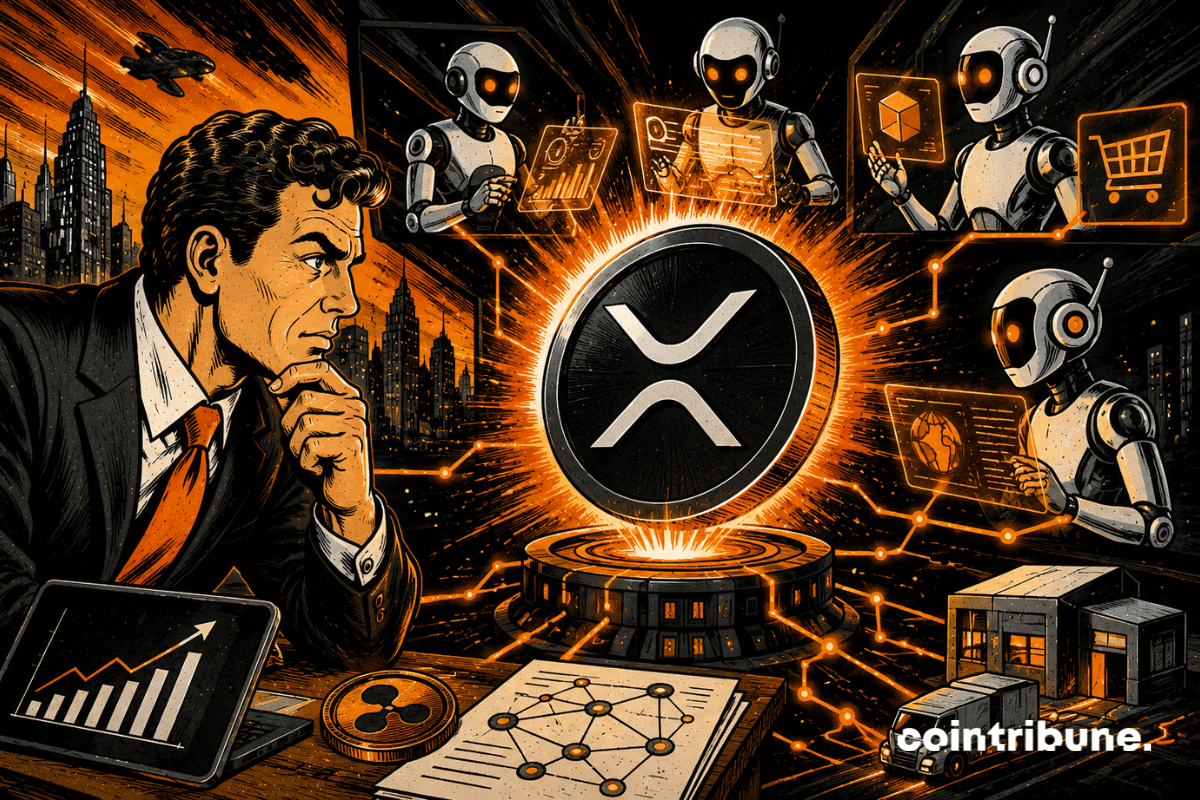
AI now goes beyond simple analysis and advisory functions. It already makes payments. Thanks to the advent and development of autonomous agents capable of conducting banking and commercial transactions, the role of the XRP Ledger will undergo an evolution. In addition to its function as a visible settlement infrastructure, the network could also serve as a secondary financial layer, directly solicited by machines. This revolution also shifts the question of adoption. Beyond the traded volumes, the value of the blockchain would now be assessed by its ability to automate various payments, organize flows, and make the network almost invisible to users.
In Brief
- More than one million transactions have already been executed without human intervention by AI agents on the XRP Ledger (XRPL).
- The launch of the XRPL AI Starter Kit and the integration of Mastercard’s Agent Pay for Machines program structure payments in XRP and RLUSD.
- AI agents are evolving towards concrete purchases governed by budgets, merchant restrictions, and strict mandates.
- The use of XRPL Payment Channels aggregates thousands of off-chain micro-transactions to preserve network scalability.
The Rise of Spending Mandates and Trade Automation on the XRP Network
The transition from automated programs to full-fledged economic actors surpasses a critical phase on the XRPL. Indeed, Chandler Fang, co-founder of the trusted startup for AI agents t54 and former product manager at Ripple with experience at J.P. Morgan, highlighted this shift by noting that machine-to-machine transactions are no longer theoretical. For him, agents already conduct more than one million transactions on the XRP Ledger without human presence in the system.
Since June 10, this momentum has been built through the launch of the XRPL AI Starter Kit. This kit allows making x402 payments in XRP using the Ripple(USD) stablecoin for compensating computing resources, model inference, or API access. This methodology expanded commercially the same day following the inauguration of Mastercard’s “Agent Pay for Machines” program. The launch brought together more than thirty partners including Coinbase, Stripe, the Solana Foundation, and Ripple via its subsidiary RippleX.
Furthermore, the system integrates crypto settlement channels within traditional payment infrastructures for invoice processing. It also reserves computing capacity without prior human validation. Given these deployments and a $5 million financial support granted to t54 by Ripple and Franklin Templeton during a seed round, Chandler Fang stated: “this changes how we should think about XRPL adoption”.
— Chandler Fang (@chandler_agi) August 21, 2026
This gradual progression is based on a strict evolution of authorization mechanisms granted to software. After consuming exclusively digital services at the core of automated workflows, agents move toward spending mandates regulated by concise budgets, merchant limitations, and user-set approval rules.
The network now requires the development of crypto wallets associated with configurable financial instruments. Concerning merchants, this deployment necessitates software adaptation capable of presenting prices, stock status, delivery conditions, and settlement interfaces in a form readable by autonomous systems. Ultimately, agents that build a reliable history regarding identity, transactions, and reimbursements will no longer be pre-funded operation by operation. They will immediately receive financial capacities or lines of credit.
Numerous strategic initiatives and technical developments make up this new stage of institutional adoption :
- Strong institutional anchoring : the $5 million financial support obtained by t54 from Ripple and Franklin Templeton validates the industrial relevance of trusted infrastructures for AI ;
- Bank interoperability : RippleX’s integration into Mastercard’s “Agent Pay for Machines” program brings together major crypto players and payment giants within a single framework ;
- Standardization of x402 payments : the combined use of XRP and RLUSD ensures full flexibility between rapid settlement and monetary stability for microservices.
Off-Chain Payment Channels to Crypto Coexistence
The increase in commercial flows driven by artificial intelligence does not mean that every price comparison or compliance check materializes by a direct inscription on the XRPL. To preserve the ecosystem’s capacity against high-frequency requests, the architecture relies on XRPL Payment Channels.
This process allows two parties to exchange signed claims in XRP off the global consensus before settling their final obligation through a single transaction on this ledger. Three workloads emerge: recurring low-value payments for web micro-services, less frequent but higher transactions for enterprise commerce, and thousands of internal operations aggregated before the ultimate on-chain settlement. In this context, settlement needs condition the asset used. Ripple’s crypto XRP plays a routing and direct settlement role, whereas RLUSD provides monetary stability denominated in dollars for certain acquisitions.
There is thus a functional operational complementarity between these two assets within the network. While the XRP crypto retains its appeal for cross-border liquidity and immediate interoperability, the RLUSD stablecoin secures the accounting predictability required by companies for managing their IT subscriptions or stocks. This coexistence between the two settlement instruments facilitates infrastructure adaptation to regulatory and financial requirements of institutional actors, without forgetting the optimization of transaction costs for continuously made micropayments.
Secure your cryptos with LedgerThis link uses an affiliate program.
The Disappearance of Graphical Interfaces in Favor of Backend Banking Adoption
Such infrastructure will become completely invisible to the end user in the long term. Embedded directly within treasury platforms, logistics software, or institutional financial applications, agents will assess risks and handle blockchain infrastructure selection in the background without any interface manipulation by the individual. In this perspective, Chandler Fang emphasizes: “long-term adoption does not require every person to open an XRPL wallet or consciously choose a blockchain before accomplishing a task”.
Thus, transaction volume no longer constitutes a relevant adoption metric. The network will now be evaluated based on the recurrence of operations, gains generated by merchants, strict respect of assigned budgets, as well as efficiency in dispute settlement. As the former Ripple manager concluded: “by then, XRPL will not be judged solely on agents’ capacity to use it. It will be judged on the amount of useful economic activity they choose to settle on it”.
This transition therefore sets the crucial milestones for integrating decentralized ledgers into the global economic fabric. While this shift to transparent fundamental transactions promises to resolve interoperability issues between traditional banking systems and blockchains, adoption speed will depend exclusively on the robustness of security standards imposed on agents.
The analogy drawn by Chandler Fang with the emergence of ChatGPT recalls that infrastructure deployment seems long and uncertain before suddenly appearing as an obvious solution to the general public. It is now up to developers and financial institutions to test the resilience of these aggregation channels, as the true measure of success for the XRP Ledger’s industrial achievement will lie in its ability to support this secure payload.
Maximize your Cointribune experience with our “Read to Earn” program! For every article you read, earn points and access exclusive rewards. Sign up now and start earning benefits.
A
A
Lien copié
Luc Jose A.
Diplômé de Sciences Po Toulouse et titulaire d’une certification consultant blockchain délivrée par Alyra, j’ai rejoint l’aventure Cointribune en 2019.
Convaincu du potentiel de la blockchain pour transformer de nombreux secteurs de l’économie, j’ai pris l’engagement de sensibiliser et d’informer le grand public sur cet écosystème en constante évolution. Mon objectif est de permettre à chacun de mieux comprendre la blockchain et de saisir les opportunités qu’elle offre. Je m’efforce chaque jour de fournir une analyse objective de l’actualité, de décrypter les tendances du marché, de relayer les dernières innovations technologiques et de mettre en perspective les enjeux économiques et sociétaux de cette révolution en marche.
The views, thoughts, and opinions expressed in this article belong solely to the author, and should not be taken as investment advice. Do your own research before taking any investment decisions.
Source: www.cointribune.com
3 Comments
Pingback: Blockchain Stocks Worth Watching – xpertsstudio
Pingback: Ripple Price Analysis: Major Breakout Confirmed – xpertsstudio
Pingback: SEC To Open DeFi Platforms to Tokenized Stocks – xpertsstudio