

Don't want to trade it yourself?
Our desk runs DEX portfolios on profit share.
<a href="https://xpertsstudio.com/bitcoin-wsj-essay-positions-it-as-freedom-money/” title=”Bitcoin: WSJ Essay Positions It as Freedom Money”>Bitcoin holders who need cash do not necessarily have to sell their $BTC. They can borrow against it instead, keeping exposure to Bitcoin while using its value as collateral for a loan.
The complication is that the loan they want may exist on another network. Many blockchain lending applications run on Ethereum, which keeps its own record of who owns what. A Bitcoin owner’s $BTC is recorded on Bitcoin’s network, and an Ethereum application cannot simply reach over and take it as collateral.
One solution is to entrust the Bitcoin to a custodian, a business that holds it for safekeeping, and receive a digital token the lending application can accept. The original $BTC stays in custody while the new token represents it on another network.
That arrangement can unlock a loan without selling the Bitcoin, but it changes what the holder depends on. The borrower now relies on the custodian holding the $BTC, the rules for getting it back, the token maintaining its value, and the lending application managing the loan.
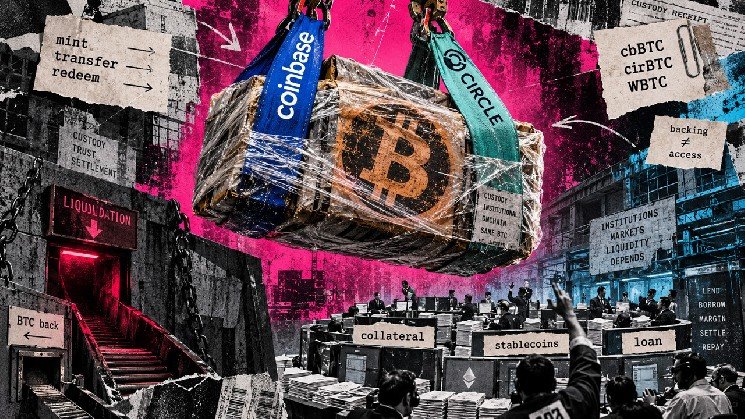
Coinbase, Circle and WBTC offer competing versions of that arrangement. Circle’s Sept. 4 explanation of its cirBTC product sets out its approach to a market already served by Coinbase’s cbBTC and the established WBTC token. Each offers a version of the same proposition: $BTC held in custody, with a transferable token issued against it.
The competition is over how useful that token can be and how dependable the arrangement is when its holder wants the Bitcoin back.
A receipt that can do more
Imagine a warehouse receipt that can pass to another owner while the goods stay in storage. Custodial Bitcoin wrappers work on a similar principle. The token can move between people while the custodian holds the Bitcoin supporting it. The product’s terms determine who can exchange the token for that backing.
Depositing $BTC into an arrangement like that works like this: once the deposit is confirmed, one corresponding token can be created on another network. That creation is called minting. Redemption reverses the process: the token is removed from circulation, or burned, and the Bitcoin is released through the provider’s procedures. BitGo describes this deposit-and-redemption process for WBTC, where approved businesses known as merchants handle the conversion with the custodian while charging a fee.
Retail buyers buy an existing token from someone else, and the trade transfers the token without requiring another $BTC to enter custody. The system still has the original Bitcoin and a token representing it; wrapping hasn’t created another coin on Bitcoin’s network.
Each token is intended to be worth one $BTC, so wrapping doesn’t protect the holder from a fall in Bitcoin’s market price. The holder keeps exposure to the same gains and losses, even though the asset they can transfer is now a token on another network.
The ability to redeem helps keep the two prices close. If a wrapped token trades below the value of its backing, an eligible trader can buy it and redeem it for $BTC, earning the difference once costs are covered. That buying can narrow the discount, but restrictions or delays can weaken the process: knowing that the Bitcoin exists isn’t the same as being able to get it back.
Once the token reaches a lending application, software can arrange the loan. A smart contract is a program that executes rules on a blockchain. It can accept wrapped Bitcoin as collateral, an asset pledged to secure a loan, and let the holder borrow dollar-linked tokens called stablecoins. The holder keeps exposure to Bitcoin’s price while taking on a debt.
The borrower must pledge more value than they borrow because Bitcoin can fall while the loan remains outstanding. If the price falls far enough, that buffer can become inadequate, and the application can liquidate collateral to reduce the debt.
The result is the risk the borrower was trying to avoid in the first place: losing some of their Bitcoin exposure without choosing to sell it.
Through this liquidation process, another participant can repay some of the debt and take collateral in return, with an incentive for doing so.
Wrapping itself pays no interest. A holder seeking income must do something further, such as lending the token to another borrower. Any return comes from that activity, which introduces risks beyond those of holding the wrapper.
The same Bitcoin, different doors
A token backed by Bitcoin is of little use to a borrower if their chosen lending application won’t accept it. Another token may be widely accepted but difficult for that particular holder to exchange for $BTC. Even when providers promise the same backing, their products can be very different to use.
WBTC’s merchant network connects exchanges and institutions to its minting and redemption process. Ordinary users usually obtain the token through exchanges. Applications that already accept WBTC give those users somewhere to borrow against it, while merchants provide the connection to the Bitcoin in custody. These relationships help make an established wrapper useful before a newcomer has built comparable access.
Coinbase makes conversion part of using an existing exchange account. Eligible customers can select a supported network when withdrawing from their Bitcoin balance and receive cbBTC on that network, and sending cbBTC back through a supported Coinbase deposit credits the account with Bitcoin. Coinbase’s conversion instructions include geographical restrictions, but for qualifying customers, much of the work is folded into an ordinary transfer.
Circle’s cirBTC offering is aimed at institutions, including trading companies and lending applications. It connects with Circle’s existing services and USDC. Circle says the underlying Bitcoin is held separately from corporate assets. It also publishes reserve addresses and uses Chainlink, a service that delivers data to blockchain applications, to make information about the backing available to software using the token.
For a borrower, that competition determines where their Bitcoin can actually be used as collateral and how easily they can turn the wrapper back into $BTC.
The commercial logic here is pretty straightforward: make the wrapper convenient for customers who already use the provider’s services, then persuade other applications to accept it. That second step requires more than a familiar name or a well-documented reserve.
Lending applications have to decide how much credit can be extended against each asset. They need a market where collateral can be sold if a borrower runs into trouble. Liquidity describes how readily that sale can happen without pushing the price down too far. A token may have ample backing but too few buyers where the application operates.
This is why actively traded wrappers have an advantage when seeking acceptance as collateral. More borrowing opportunities can, in turn, attract additional holders and traders. Newcomers to the space have to persuade lenders to accept a token that few people yet use, while persuading customers to hold a token that fewer lenders accept.
WBTC explicitly offers merchants an opportunity to earn conversion fees. For providers more broadly, a useful wrapper can draw customers toward their services, although the financial benefit depends on the business model. Unlike Treasury securities held behind some dollar stablecoins, Bitcoin in reserve doesn’t automatically generate interest. The commercial opportunity lies in what customers do with the token.
Owning the token is not the same as holding the Bitcoin
For customers, inspecting the Bitcoin backing is a good starting point. Coinbase publishes a cbBTC reserve dashboard, allowing users to compare disclosed Bitcoin holdings with outstanding tokens.
Visible Bitcoin does not establish what happens if the provider fails, however, or guarantee that every token holder can immediately redeem it. The product’s terms determine who has that right, while the redemption service must be able to deliver. Knowing that the Bitcoin exists is not the same as knowing that you can get it back.
This distinction can be easy to overlook when the token is in a personal wallet. Its owner controls the digital keys needed to transfer it, while a custodian controls the keys to the original Bitcoin. Holding the wrapper yourself still leaves another business responsible for its backing.
Using the token in a loan adds dependence on the software managing that position. The application must execute its rules correctly and obtain reliable prices to value collateral. Its users could suffer losses from a software failure even if every Bitcoin promised by the wrapper’s issuer is still in custody.
For the owner who simply wanted cash without selling Bitcoin, wrapping creates a trade-off. Their Bitcoin becomes usable in an application that otherwise couldn’t accept it, in return for fees and reliance on additional institutions and software. Whether that is worthwhile depends on what the application offers and the obligations the owner is willing to accept.
That also explains why several businesses can compete to represent the same asset. A wrapper earns its place by opening access to a loan or another financial service the holder wants to use.
The loan may start with Bitcoin, but what ultimately counts is whether the holder can get that Bitcoin back.
Source: cryptonews.net
1 Comment
Pingback: Michael Saylor Skips Bitcoin Again – xpertsstudio