


Don't want to trade it yourself?
Our desk runs DEX portfolios on profit share.
When a decision on crypto is taken in the United States, the first question is which agency was responsible in the first place. Two supervisors share the field, work under different statutes and have disagreed for years about where the border between them runs. On 20 August 2026 an advisory body of one of them convenes for the first time, staffed among others with the chief executives of Coinbase, Kraken, Gemini, Ripple and Solana Labs.
For you as an investor in Germany, two things matter here that regularly get muddled. First, neither of these agencies protects your balance: your rights come from the European MiCA regulation and are enforced by the BaFin. Second, what happens in Washington reaches you all the same, because the same companies sitting at that table also run your trading platform.
Responsibility in the US grew up historically and sits badly on digital assets. The Securities and Exchange Commission, the SEC for short, is the securities regulator and sees to it that securities are registered and that investors receive the information they need. The Commodity Futures Trading Commission, the CFTC for short, supervises commodities and the trading of derivative contracts, meaning futures, options and swaps.
A token fits neatly into neither of those drawers. It can behave like a stake as long as a team works on a network and buyers speculate on its success, and like a commodity once the network runs and nobody earns from it centrally any more. At that fault line arises the uncertainty that accompanies the US market. How long the conflict has been running is shown in our review of the rapprochement between the SEC and the CFTC on crypto regulation from March 2026.
In Europe the question does not arise with that sharpness, because MiCA created a set of rules of its own for crypto assets instead of pressing them into existing categories. Which providers are authorised under it is shown in the comparison of regulated crypto exchanges.
The CFTC supervises derivatives and treats Bitcoin as a commodity
The CFTC has long held the view that Bitcoin and Ether are commodities within the meaning of the Commodity Exchange Act. That sounds academic but has tangible consequences: it means the agency supervises above all the trading of derivatives on those assets and not the simple purchase of a coin on an exchange.

A gap follows from that: the spot market, where you buy a cryptocurrency directly and hold it, falls under ongoing supervision in the US only to a limited extent. The CFTC can act there after the fact against fraud and market manipulation, but it issues no authorisation in the proper sense. Several bills in Congress set out to change that; none is in force.
The SEC supervises securities and tests tokens with the Howey test
The SEC works with a yardstick from 1946. In SEC v. W. J. Howey Co., the US Supreme Court developed a test for when an arrangement counts as an investment contract and therefore as a security. Four features have to come together: an investment of money, a common enterprise, an expectation of profits, and the dependence of those profits on the efforts of others.
Apply that to a token sale and it becomes clear why the agency considers itself responsible: anyone buying tokens in the early phase is as a rule betting that a development team will get the network running. The dispute has turned for years on whether that classification applies permanently or whether a token can lose its character as a security once a network is sufficiently decentralised. A ruling from the highest court is still outstanding.
The Innovation Advisory Committee meets for the first time on 20 August
The date falls into this setting. On 10 August 2026 the CFTC announced that its Innovation Advisory Committee, the IAC for short, would convene for the first time on 20 August. The official notice in the Federal Register of 11 August names the window of 1 p.m. to 4 p.m. Eastern Daylight Time, meaning 7 p.m. to 10 p.m. Central European Summer Time. Members meet in person; the public can watch virtually by livestream.
One detail was reproduced incorrectly in several reports: the CFTC press release speaks of 1 p.m. EST, but in August daylight saving time, EDT, applies in Washington. What governs is the official notice, which names EDT. Written comments are possible until 27 August 2026.
The body is not a new creation but the renamed successor to the former Technology Advisory Committee; its charter was amended on 3 March 2026. The agency’s chairman, Michael S. Selig, acts as sponsor.

Regulated Crypto Exchanges Compared
Who sits on the advisory body: 43 members from Coinbase to Nasdaq
The membership list the CFTC keeps on the committee’s page runs to 43 names. Less interesting than the number is the mix, because it shows whom the agency regards as an interlocutor.
From the crypto sector, Brian Armstrong (Coinbase), Arjun Sethi (Kraken), Tyler Winklevoss (Gemini), Brad Garlinghouse (Ripple), Hayden Adams (Uniswap Labs) and Anatoly Yakovenko (Solana Labs) are among those at the table. Vlad Tenev (Robinhood) and Haider Rafique (OKX) add two names that German users are likely to know from their own app. The second half comes from classic financial infrastructure, among them Terry Duffy (CME Group), Adena Friedman (Nasdaq) and Jeff Sprecher (Intercontinental Exchange), plus financiers such as Chris Dixon (a16z crypto).
That a supervisor takes advice from the supervised is the rule with advisory bodies of this kind. What is notable is the weighting: a body advising on crypto rules is staffed in the majority with people whose companies are affected by those rules. Consumer protection organisations do not appear on the list.
Prediction markets are on the agenda and are the hardest point of contention
The notice names three subject areas for the session: crypto assets, artificial intelligence and prediction markets, along with the agency’s recent activity in those markets. The third point is likely to be the most contentious.
Prediction markets are venues where contracts on the outcome of future events can be bought, from elections to economic data. In the US these are event contracts and therefore derivatives, which is why the CFTC is responsible. With Tarek Mansour (Kalshi) and Shayne Coplan (Polymarket), the chief executives of the two best-known providers sit on the committee, alongside representatives of the sports betting industry such as Jason Robins (DraftKings) and Christian Genetski (FanDuel). How much difficulty the agency has with this field was already shown by the case in which the CFTC served Coinbase with a subpoena in the Polymarket proceedings.
For German users the field calls for caution: prediction markets do not fall under MiCA in Europe, and whether such an offering requires authorisation here depends on the individual case. No blanket statement can be made about it.
Sobriety is called for at this point. The IAC is an advisory committee under the Federal Advisory Committee Act: it can issue recommendations, adopt reports and put topics on the agenda. Legally binding rules do not arise there; that would require formal rulemaking by the commission or an act of Congress. The predecessor committee produced two reports, both position papers without legal effect. What the session delivers is a signal about which topics the agency regards as pressing and whose arguments it listens to.
The SEC, meanwhile, is stuck on its own crypto rule
The contrast with the second agency is striking. While the CFTC convenes an advisory body, the SEC is making no progress: as CryptoTicker reported on 15 August 2026, the agency cancelled a vote scheduled for 14 August on a bespoke issuance regime for crypto investment contracts on the eve of the meeting and has so far named no replacement date. The details are in the analysis of why US regulation is currently stuck on two fronts.
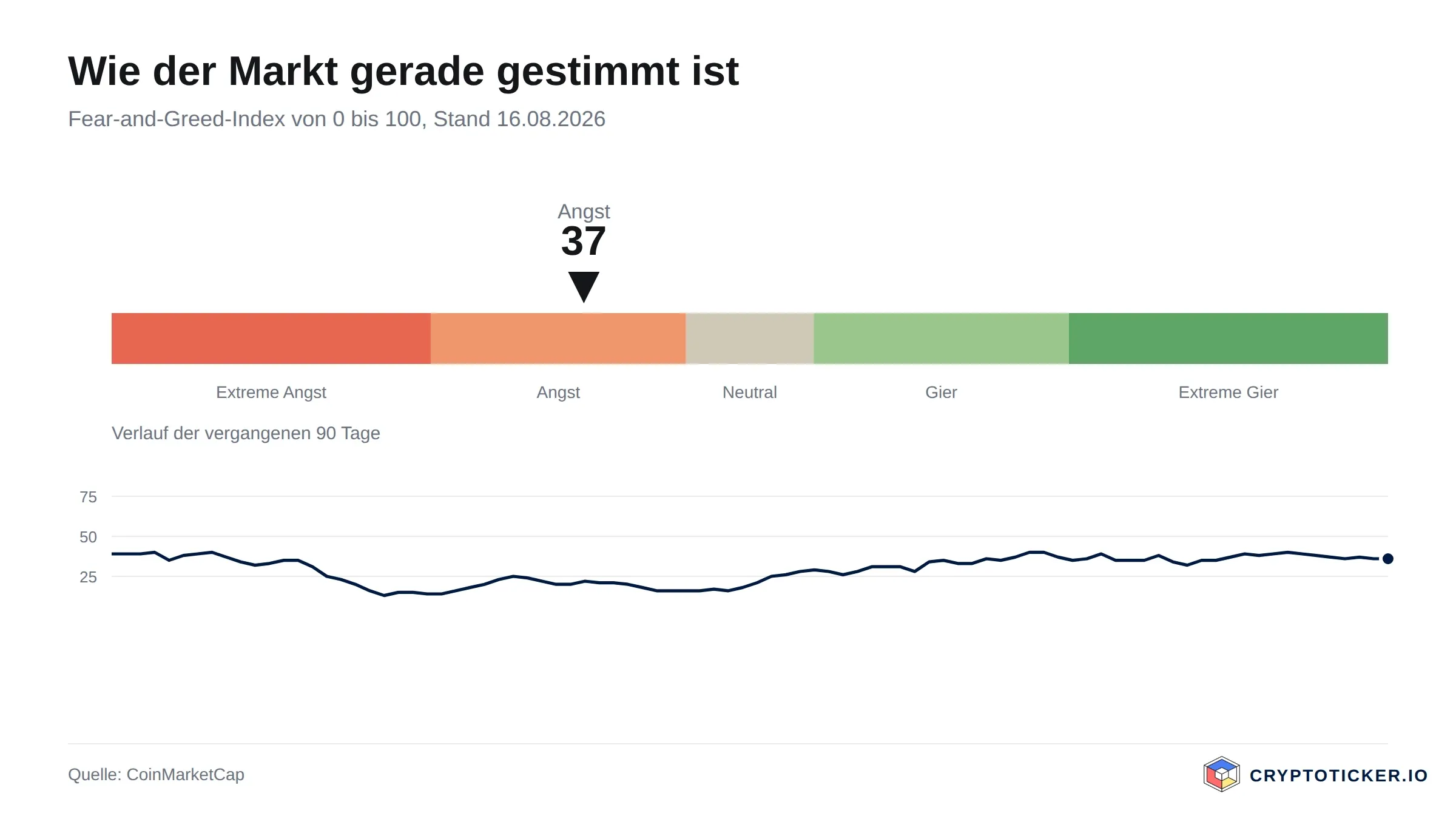
The juxtaposition describes the situation fairly precisely: one agency gathers advice, the other postpones a vote. No coordinated roadmap for the US crypto market can be read from it. For you that means announcements from Washington will keep making headlines without anything changing in your legal position.
MiCA applies to you, and your supervisor is called the BaFin
This is where most misunderstandings arise. If you live in Germany and buy from a provider authorised in the EU, protection of your assets follows the regulation on markets in crypto-assets, MiCA for short. For crypto-asset service providers it has applied since 30 December 2024 and governs, among other things, the separation of client assets from own holdings, custody and information duties.
Responsible for supervising providers authorised in Germany is the Federal Financial Supervisory Authority. Neither the SEC nor the CFTC owes you any duty of protection. If a provider is based outside the EU and accepts you as a German customer, foreign law with a foreign place of jurisdiction applies in the event of a dispute.
How to tell whether your trading platform is under EU supervision
The check takes a few minutes.
Four points you can look up
- The contracting party. What matters is not the brand name but which company appears in the terms of use and where it is based. Many providers run several group companies alongside one another.
- The authorisation status. MiCA authorisations are granted by the national supervisors and kept in public registers. Anyone advertising European regulation should be able to name the competent authority and the type of authorisation.
- The scope of the permission. An authorisation as a custodian does not automatically cover the operation of a trading platform. An analysis by CryptoTicker of 6 August 2026 on the MiCA register found that of 329 authorisations counted, only 21 went to trading platforms.
- The protection in the event of insolvency. Statutory deposit protection does not apply to crypto assets as it does to bank balances. Anyone expecting it is mistaken about their own risk.
Anyone wanting to hold their balance independently of a provider’s authorisation cannot avoid self-custody. Which devices come into question for that is shown in the hardware wallet comparison.
What US decisions set off in your portfolio all the same
It would be wrong to conclude from this that the American debate is of no relevance to you. The influence is indirect and runs along three routes.
First through the products: whether a provider launches a staking offering, an exchange-traded product or a new type of derivative is often decided first in the largest market, and what becomes permissible there surfaces with a delay in European variants. Second through the listings: if the classification of a token is disputed in the US, trading platforms take it on less often or remove it again, which feeds through to liquidity and shows up in the spread.
Third through the price. Regulatory news from Washington moves prices regardless of where you buy. Anyone trading frequently should keep an eye on the tax side; which tools help with that is shown in the comparison of crypto tax software.
Making sense of US crypto regulation: what to take away
- Place the reports correctly. The CFTC and the SEC are two agencies with two statutes and an unsettled border. The advisory session on 20 August 2026 produces a recommendation, not a rule; you can follow the livestream from 7 p.m. German time.
- Check whose supervision you are under. Look in the terms to see which company your counterpart is and what authorisation it holds. The comparison of regulated crypto exchanges is the quickest way in.
- Separate custody and trading. Holdings you want to keep for longer do not belong on a trading platform permanently. Suitable devices are in the hardware wallet comparison, and the tax documentation is handled by a tool from the comparison of crypto tax software.
Primaryst 2026 and the official notice in the Federal Register of 11 August 2026
(As of August 16, 2026. This article is not investment advice. Prices and fee structures change; check the terms with the provider before you buy.)
Transparency note: This article was produced with the assistance of artificial intelligence and reviewed by our editorial team before publication. All figures and claims were checked against the primaryI
More from CryptoTicker
Source: cryptoticker.io