

Don't want to trade it yourself?
Our desk runs DEX portfolios on profit share.
Weekly: Trump’s $5,000 Promise, OpenAI’s Solved Millennium Prize Problem, Biden Memecoin Crash, and Changes to Ethereum Transactions
Olena Kocherhina
Choose us on Google
Incrypted’s editorial team has prepared another digest of the week’s top developments in Web3 and AI. This time, the spotlight was on the launch and rapid collapse of Hunter Biden’s memecoin, Donald Trump’s promise to pay Americans $5,000 each, and OpenAI’s new moves in advancing enterprise AI and tackling one of the seven Millennium Prize Problems. We also cover shifting capital flows in bitcoin and Ethereum ETFs, Ethereum scaling, the Liquid Network incident, new USDT risks, the growth of prediction markets and Robinhood tokenization, the fight over the CLARITY Act, and other key industry events.
Top news
Bitcoin
- Market forecasts and signals for the asset
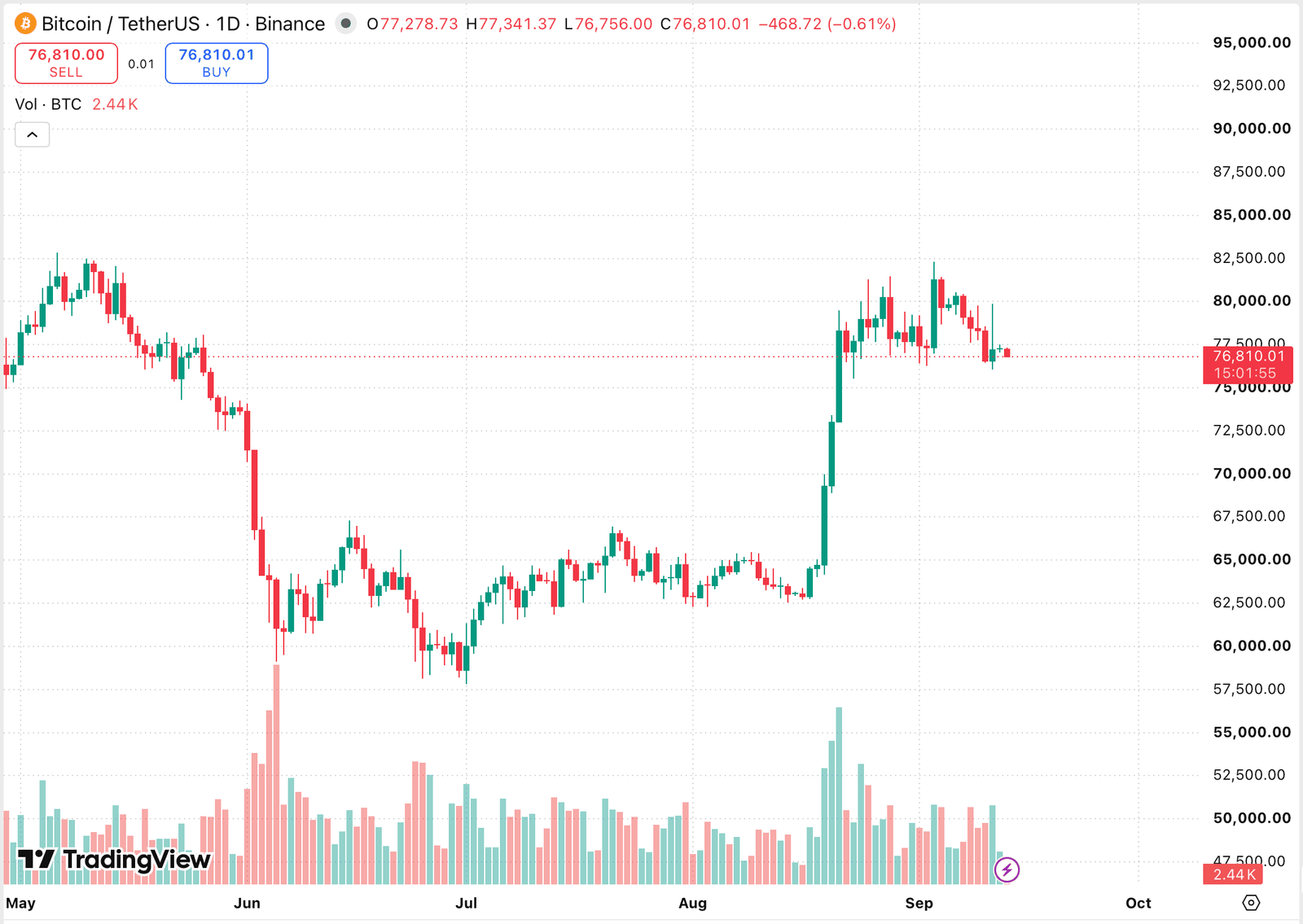
Bitcoin is maintaining a positive market structure, but analysts point to mixed signals about its next move. CryptoQuant noted that large investors continue to accumulate the asset, while a stronger spot demand is needed for a confident breakout above the $82,000–$83,000 level.
Meanwhile, Wintermute called $82,000 a key resistance level, and a drop below $72,000 — a signal to reassess the current scenario, while retail euphoria and a negative Coinbase premium create correction risk.
Against this backdrop, Arthur Hayes predicts bitcoin will rise to $250,000–$500,000 thanks to an expanding money supply in the US. At the time of writing, the leading cryptocurrency is trading at $76,810
- ETF and onchain activity: capital is changing direction
Capital flows through crypto ETFs are signaling a shift in investor sentiment: from August 31 — September 4, Bitcoin and Ethereum ETFs attracted more than $1.2 billion, with nearly $1 billion going into Bitcoin funds. However, on September 8-11, Bitcoin ETFs recorded $462.73 million in outflows, snapping a three-week inflow streak. Onchain data also paints a mixed picture: Bitcoin’s SOPRhas remained above 1 for three weeks, pointing to profit-taking, although analysts differ in their views on the next leg of the trend.
Ethereum
- The network is scaling and changing its transaction model
Ethereum is preparing to scale thanks to a new Frame Transactions format, which could allow transactions to be split into separate actions and dependencies and processed in parallel
EIP-8141 is also set to separate the account that initiates a transaction from the one that pays for gas, meaning users will no longer need to hold the asset to cover fees — they will be able to pay in stablecoins or delegate payment to an app. The proposal has already been scheduled for inclusion in the Hegota upgrade, and Buterin expects the new approach to help scale the network without sacrificing decentralization.
- Ethereum strengthens cryptography and attracts capital via ETFs
Another development track for Ethereum is tied to the use of recursive STARK proofs, which, in Buterin’s vision, could reduce the cost of post-quantum signatures, private transactions, and other cryptographic operations.
At the same time, investor interest in the asset remains high: Ethereum ETFs attracted $218.41 million in the August 31–September 4 period, despite one day of outflows. The following week, the funds brought in another $197.11 million, extending the positive trend for a fourth consecutive week.
Liquid Network Incident and Bitcoin Return
About 4,000 BTC worth roughly $320 million was withdrawn from Liquid Network reserves due to a likely consensus bug in Elements, while federation keys, according to developers, were not compromised. The party that controlled the funds called itself “ethical hackers” and, after the vulnerability was fixed, returned 3,400 BTC worth about $268 million to the federation. Around 598 BTC remained under its control, but Blockstream refused to pay a reward for their return and called the retention of the funds theft.
Trump’s Statements on US Economic Policy and Potential Payouts
US President Donald Trump urged the Fed to cut interest rates after a strong jobs report for August, saying the state of the economy allows for cheaper borrowing. At the same time, the US president threatened to revise the country’s trade policy and halt trade with states where the US runs a deficit.
Separately, Trump promised to pay $5,000 to adult Americans if Republicans win the midterm elections, which could potentially require more than $1 trillion. Some of that money, based on historical parallels, could flow into bitcoin and other risk assets.
Fraud Disguised as Crypto Investing
Law enforcement shut down a fraudulent call center in Lutsk whose staff, under the guise of investments in cryptocurrency, securities, and FX markets, scammed citizens of Ukraine and the EU. According to police, around 60 operators could have been working in the scheme simultaneously, and the organizer’s monthly profit reached $500,000. During searches, officers seized about $30,000, nearly 500 phones, and more than 1,000 units of computer equipment.
USDT Centralization Risks
Hacken identified risks tied to the concentration of administrative control over USDT on the TRON, Ethereum, and Solana blockchains, which together account for 98% of the stablecoin’s native supply. On TRON, about 91.3 billion USDT is controlled by a 2-of-3 multisig scheme, meaning that compromising two keys could potentially give an attacker privileged control over that amount. At the same time, the smart contract has no timelock or mechanism to roll back administrative changes, increasing the risks if the keys are compromised.
Robinhood Expands Tokenization and Prediction Markets
Robinhood CEO Vlad Tenev entered into a public dispute with AMC head Adam Aron over stock tokenization, saying issuers should not automatically block the creation of such financial instruments. According to him, the right to tokenize should be determined by investors’ rights, the issuer’s authority, and the principle of technological neutrality. Tenev also emphasized that Robinhood Stock Tokens are separate financial instruments backed by the underlying shares at a 1:1 ratio.
At the same time, Robinhood expanded its prediction markets vertical through a partnership with Crypto.com and OG.com, routing some contracts tied to American football events through its partners’ infrastructure. The company will also receive stakes in both entities, while in Q2 the volume of trading in event contracts on the platform reached 13.6 billion units.
Regulation
- The CLARITY Act in the crypto market
Active debates around the CLARITY Act are ongoing in the US ahead of the September 15 vote: Senator Cynthia Lummis warned that if the bill fails, the creation of clear rules for the crypto market could be pushed back to 2030.
At the same time, Coinbase CEO Brian Armstrong believes that regulatory clarity in the US will emerge regardless of the vote’s outcome. The updated version of the CLARITY Act includes more than 100 amendments from Democrats, including provisions on registering DeFi projects that only imitate decentralization.
- Macroeconomics and cryptocurrencies
Iran eased currency restrictions and allowed businesses to use cryptocurrencies more broadly — including USDT and bitcoin — for cross-border settlements and import financing amid tightening sanctions.
Meanwhile, in the US, an expanded buyback of long-term Treasuries worth $5.2 billion failed to curb the rise in their yields, which approached 5%. Investors считают the scale of the operation insufficient for the US government debt market of about $32 trillion, while additional pressure comes from oil prices, inflation risks, and the budget deficit.
In parallel, Germany is preparing a reform of crypto-asset taxation starting in 2027, which предусматривает taxing profits from the sale of bitcoin, Ethereum, and other assets regardless of the holding period.
Hunter Biden’s Memecoin and Its Crash
Hunter Biden launched the LAPTOP memecoin with a total supply of 1 billion tokens, 30% of which went to the project’s founders. In the first hours of trading, the asset posted a sharp spike, after which its price collapsed by about 98%–99%.
Following the drop, one trader who put $200,000 into LAPTOP lost about $197,000, and the value of his position fell to roughly $3,000. According to Bubblemaps, around 80% of traders took losses, with two traders losing between $100,000 and $1 million. The token’s collapse also triggered rug pull accusations and significant financial losses among its earliest buyers.
Artificial Intelligence
- OpenAI and Anthropic: competition for the future of AI
OpenAI is strengthening its presence in the enterprise sector, launching ChatGPT for Financial Services — a specialized service for financial institutions with access to data and tools for research and modeling. The product was developed in partnership with Morgan Stanley and Evercore, and in its first phase it is focused on investment banking and equity research.
At the same time, researcher Jacob Coxon left Anthropic, saying that OpenAI and Anthropic are not participating responsibly enough in the race to build self-improving superintelligence.
Anthropic, meanwhile, is trying to assess the broader implications of AI development for the economy. The company modeled three scenarios for the U.S. economy through 2030 — ranging from an impact comparable to the spread of the internet to a radical transformation in which AI performs most intellectual work.
- New AI capabilities and breakthroughs
Meta introduced Muse, a personal AI agent that can work with email, calendars, browsers, and other connected services, and carry out user tasks in the background. The company also offered a reward of up to $300,000 for finding vulnerabilities in the agent, underscoring its focus on security.
Another notable milestone was OpenAI’s statement that it had solved the Navier — Stokes existence and smoothness problem, one of the seven Millennium Prize Problems. According to the company, around 10,000 AI agents worked on the proof simultaneously, after which the result was formalized and verified in Lean. OpenAI said it is not seeking the Millennium Prize for this result.
- AI risks and safety
The use of AI is increasingly accompanied by risks related to incorrect advice and dangerous use cases. In California, three tourists ended up in danger after using Google Gemini to plan a climb of Mount Shasta, and rescuers called excessive reliance on AI a critical mistake.
Meanwhile, Michael Lines filed a lawsuit against OpenAI, claiming that ChatGPT reinforced his religious delusions during a manic episode and convinced him that he was Jesus.
A separate risk area is linked to the use of AI in dual-use biological research. Anthropic reported five cases in which Claude was used in projects involving the chikungunya virus, a
Other News:
- India set its sights on tokenizing $627 billion worth of corporate bonds
- Sam Bankman-Fried appealed his conviction to the U.S. Supreme Court and is demanding a new trial
- India’s Arya.ag will move $2 billion in agricultural assets onchain via Avalanche
- Consensys spun off MetaMask into a separate company
- pump.fun expanded the platform with tokenized stocks and a Custom Pairs feature
- Zondacrypto case: the defendant was charged over losses of 7.8 million zlotys
- a Singaporean cybercriminal pleaded guilty in a case involving the theft of $245 million in crypto
- Trezor reported a breach of a third-party email provider amid a phishing attack
- Osmosis froze 22.65 BTC after the Nomic exploit
- in Uzbekistan, authorities launched a pilot project using the HUMO stablecoin to pay for goods and services
- in Mexico, authorities found a crypto farm with 300 GPUs: officials suspect electricity theft.
What’s New at Incrypted?
Articles
The Incrypted editorial team broke down why traders have been blending stocks with memecoins, and how to profit from it. You can read more here:
The team also tested Marble, a 3D world generator by World Labs:
In addition, readers can check out a Robinhood review in the Cryptobase section:
What’s more, you can read about where and how to promote a memecoin in 2026:
Meanwhile, readers can access a piece on where and how to safely store bitcoin and other cryptocurrencies in 2026:
You can also learn about AML blocks on crypto exchanges and ways to unblock USDT:
On our YouTube channel, a trader released a video analyzing the crypto market, and on the website you can find materials on algorithmic trading and footprint charts:
In Addition…
- We have put together in one piece the key investments in blockchain and crypto assets from the beginning of September.
- We regularly update the Incrypted crypto calendar, where you will find plenty of interesting events and announcements.
Source: incrypted.com