

Don't want to trade it yourself?
Our desk runs DEX portfolios on profit share.
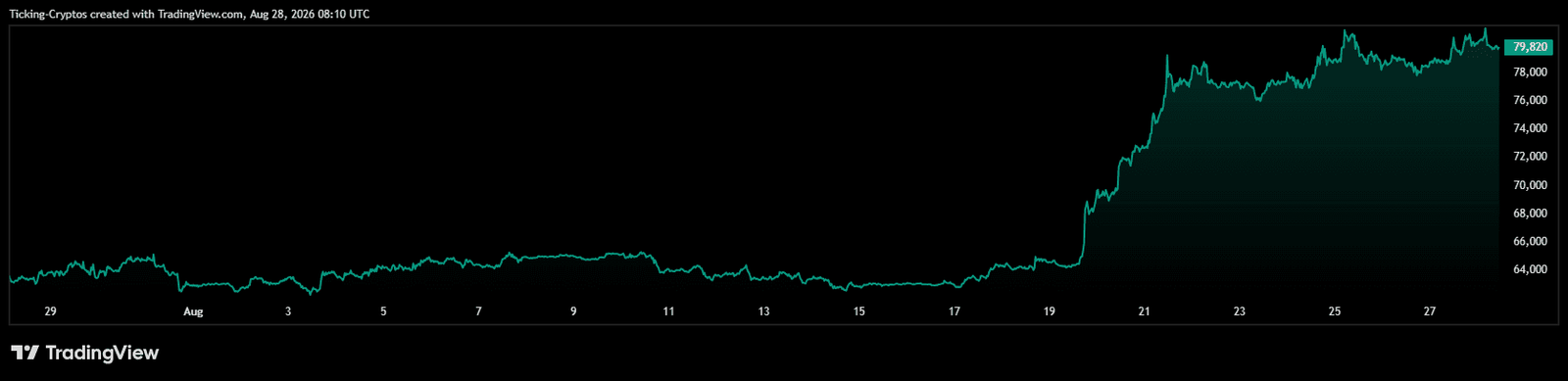
Bitcoin is holding just above $80,000 after climbing from the low $60,000s earlier this month. That is a gain of about 23% in August, putting it on track for its best August since 2017, in a month whose median historical return is actually negative 7%. The total crypto market sits near $2.75 trillion.
Almost all of it comes down to three things. Notably, only one of them has anything to do with crypto itself.

Top 3 Reasons Why <a href="https://xpertsstudio.com/crypto-price-analysis-august/” title=”Crypto Price Analysis August”>Crypto Prices Are Up
1. The Treasury pushed liquidity into the system
This is the trigger, and it is the one most people are underweighting.
The rally started when the US Treasury expanded its bond buyback operations, which pushed long-term yields and the dollar lower. Cheaper money and a weaker dollar send capital toward risk assets, and crypto sits at the far end of that curve. Adding to it are reports that the Treasury could draw on its cash account of nearly $1 trillion, which would put more money into financial markets still.
Samir Kerbage, CIO at Hashdex, described the move as mostly a liquidity event. That is the cleanest summary available. $Bitcoin did not rally because something changed about Bitcoin. It rallied because the cost of money changed.
Worth knowing: the Fed has held its benchmark rate at 3.50% to 3.75%, and three policymakers voted for a quarter-point increase in July. Traders currently price September rate-hike odds at roughly one in three. This is not a market with confirmed monetary support behind it.
2. ETF inflows came back, and they are large
US spot Bitcoin ETFs pulled in $2.72 billion during August, taking total assets under management to $98.56 billion and within reach of the $100 billion mark. BlackRock’s IBIT alone accounted for $1.33 billion of weekly inflows, and total ETF turnover hit $22.1 billion last week.
That matters because ETF flows were negative for part of 2026. Their return means the institutional bid is back rather than merely holding steady. CryptoQuant data shows capital in the Bitcoin market rising from $20.6 billion to $24.9 billion.
This is the most durable of the three reasons, because it reflects allocation decisions rather than positioning. It is also the slowest to reverse.
Please accept marketing cookies to view X (Twitter) embeds.
3. Short sellers were forced out
The third reason amplified the first two rather than causing anything.
Traders positioned for further downside after Bitcoin’s June low near $59,300 were caught badly. Billions of dollars in short positions were force-closed as the price climbed, and each liquidation becomes a forced buy order. That is what turns a steady rise into a vertical one, and it explains why the sharpest part of the move came in a single week rather than spread across the month.
Squeeze-driven gains are the least reliable kind. Once the shorts are gone, that particular buying pressure is gone with them. The Crypto Greed index has climbed to 74 out of 100, its highest in nearly 11 months, which tells you the positioning that fuelled this move has already flipped to the other side.
Will Crypto Prices stay UP?
Two things decide the near term. Fed Chair Kevin Warsh delivers his first Jackson Hole keynote today at 10am ET, and he has given markets very little forward guidance since taking office in May. He described the speech in July as a blank piece of paper. That leaves unusually wide room for a surprise in either direction.
The levels traders are watching are $82,800 on the upside and the $74,000 to $75,000 zone on the downside. Losing the latter would put the move in question.
The honest framing is this: a rally built primarily on liquidity conditions lasts exactly as long as those conditions do. The ETF flows are real and the on-chain activity is real, but neither started this, and neither is large enough to hold it up alone if the macro picture turns.
More from CryptoTicker
Source: cryptoticker.io