

Don't want to trade it yourself?
Our desk runs DEX portfolios on profit share.
Check back soon for the audio version, or subscribe to the audio feed in your podcast app.
The day before a cloture vote scheduled for Tuesday, September 15, Senate Republicans have released a final draft of the Clarity Act cryptocurrency market structure bill: an industry-drafted attempt to deregulate the sector even further and strip away what little oversight existed. One of the biggest sticking points throughout negotiations has been an ethics regime meant to rein in President Trump’s personal crypto ventures, which brought in $1.4 billion last year alone.a Senators should vote no on cloture tomorrow: the supposedly “unprecedented” ethics restrictions, tacked on at the last minute, are riddled with loopholes to protect Trump’s grift.
Republicans tried and failed to pass off weak ethics language as a meaningful concession back in July [I107], with laughable provisions including prohibitions on officeholders issuing tokens with enforcement left only to a Department of Justice staffed by Trump-appointed loyalists. Under that revision, any violations would have resulted in a fine capped at $500,000 — less than 0.04% of Trump’s crypto income last year — and the ethics language was set to expire upon Trump’s exit from office in 2029, preventing any future, less-captured DOJ from prosecuting him.
After weeks of silence on subsequent ethics proposals, the White House indicated on September 14 — the day before the scheduled vote — that they would agree to “a significant portion” of the newest ethics proposal proposal. And while the new draft language blessed by the White House appears to address some of the Democrats’ objections, they shouldn’t be fooled by ethics language that appears tailor-made to allow the president to continue his grift. While the new draft removes the sunset provision and increases penalties beyond the $500,000 cap, it leaves clear paths for Trump to dodge any enforcement in the first place.
Citation Neededis an independent publication, entirely supported by readers like you. Consider signing up for a pay-what-you-want subscription — it really helps me to keep doing this work.
Republican negotiators claim the new draft gives state attorneys general a “meaningful role” in enforcement.1 It does not. State attorneys general still can’t bring enforcement actions against the president or other officials who violate the prohibitions — under the new draft, they can only bring action against the Attorney General to try to obtain injunctive relief.2 And if the Office of Government Ethics — led by Trump loyalist Keith Sonderling — decides the activity is not prohibited, that’s the end of the state AGs’ ability to intervene.
(A) ISSUANCE; SPONSORSHIP.—No action may be brought under paragraph (1)(A) if the supervising ethics office, with respect to a potential violation of paragraph (1) or (2) of section 13152(a), provides a legal opinion that an activity is not prohibited.
Clarity Act, p. 631
Most enforcement falls to the Attorney General3 — currently Todd Blanche, a former personal lawyer to Trump. In April 2025, Blanche dismantled the Department of Justice’s National Cryptocurrency Enforcement Team, directed the agency’s Market Integrity and Major Frauds Unit to “cease cryptocurrency enforcement”, and directed prosecutors not to charge various crimes in crypto cases [I81].
As for what’s prohibited: “covered individuals”, including the president,4 will be barred from issuing or sponsoring digital assets, or “maintain[ing] a significant financial interest” in cryptocurrency companies.5 While this sounds like it should apply Trump’s multitudinous crypto ventures, the definitions are carefully drafted — almost as if to intentionally exclude the president’s ventures. Corey Frayer, the Director of Investor Protection at the Consumer Federation of America and former crypto adviser at the SEC during the Biden administration, wrote: “The way this section is written makes it clear that whoever wrote it knows Trump’s crypto businesses inside and out. And then they made sure Trump’s crypto businesses would remain outside and not in.”6
World Liberty Financial brought in over $800 million for businesses tied to Trump and his family last year via $WLFI token sales, interest on the $USD1 stablecoin reserves, and equity sales to the United Arab Emirates. Thanks to the president’s web of shell companies, he owns a 69% stake in a shell company which in turn holds a 38.25% stake in a holding company that holds the sole membership interest in World Liberty Financial. Though Trump and his family receive 75% of token revenues, the ownership structure means that this likely would not be considered a “significant financial interest” in the business under the Clarity Act’s definitions.
Most of that money, I should note, is already in the bank. Trump’s crypto ventures were structured to frontload cash to Trump, rather than generate recurring revenue — an ideal structure for someone concerned that future legislation, or a stronger Democratic wing of Congress, could limit his ability to profit from private ventures while in office. The $500 million sale of World Liberty Financial equity to the United Arab Emirates, for example, is done and dusted; Trump pocketed his share of the proceeds last year [I83, 87, 93, 94]. The bulk of profits from new token launches also tend to come early — particularly with memecoins like $TRUMP, which almost unilaterally crash precipitously after an initial mania. That’s about $1.2 billion of Trump’s $1.4 billion right there; token revenue in future financial disclosures was likely to be significantly lower regardless of any limits on his grift. So when Senators boast of “unprecedented” limits on the president, it’s worth remembering that they can only contain the future damage — the biggest paydays are already in Trump’s pocket and won’t be clawed back under these supposedly “historic” provisions.
The Clarity Act now also prohibits “sponsorship”: agreements “including any licensing, revenue-sharing, transaction fee, or similar arrangement”. But the provision applies specifically to crypto tokens, not crypto companies. And it requires that those agreements be explicitly in exchange for public endorsement or naming licenses, allowing Trump and other officeholders to dodge the provision with careful drafting.
(7) SPONSOR.—The term ‘sponsor’ means to enter into an agreement (including any licensing, revenue-sharing, transaction fee, or similar arrangement) to—
- organize or publicly endorse or advocate for the creation, launch, or express promotion of a specific digital asset; or
- authorize the use of one’s name, image, likeness, office, or official position in connection with the creation, launch, or express promotion of a specific digital asset.
Clarity Act, p. 622
A later provision makes the carveout for Trump’s ventures explicit. The sponsorship prohibition applies only to digital assets issued or sponsored “after the effective date of this division” — anywhere from two months to a year after the bill is passed.7 Trump’s revenue sharing arrangement with World Liberty and his licensing agreement with the $TRUMP memecoin are grandfathered in. (That memecoin earned Trump more than $635 million last year, as investors lost billions [I109].)
Yet another weakness of the Clarity Act’s ethics provisions: they’re narrowly scoped to issuing crypto tokens, and do not prohibit any of the wide universe of crypto-related activities beyond token sales. Even if Trump establishes a new financial interest in a crypto company, it will remain permissible so long as a “plurality” of its revenue does not come from issuing crypto tokens.8 Trading fees, crypto custody, lending and borrowing fees, crypto mining, and a whole slew of other crypto activities could make up the remaining revenue and put Trump in the clear.
And even if these prohibitions applied to Trump’s crypto businesses, they would still not stop him from profiting from crypto firms as he deregulates the sector. The only requirement under the current draft is that Trump move his investments into a “qualifying blind trust” (again, as determined by the Trump loyalist-led OGE).9 This would, of course, not erase Trump’s memories of his former crypto businesses, and he could continue pushing through industry-written regulations that he knows would bolster his and his family’s net worth.
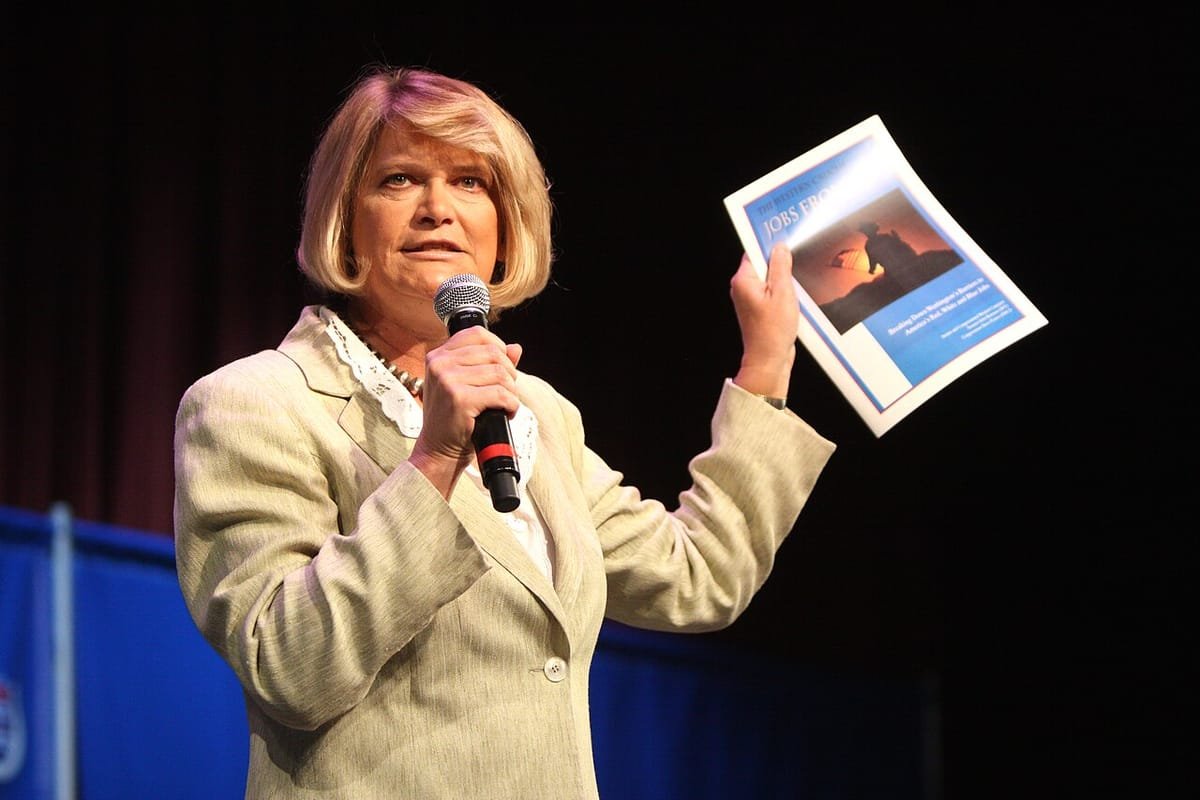
Senator Lummis is claiming that, in this latest draft, “President Trump voluntarily agreed to unprecedented ethics restrictions, holding every federally elected official, judge, and their spouses to some of the toughest ethics restrictions in U.S. history.”1 This echoes her attempts earlier this summer to sell the previous “compromise” as a “historic ethics agreement”10 — a compromise that Democrats unanimously dismissed as an “unserious offer” [I107].
The bill’s proponents describe the Clarity Act as providing “clear rules of the road” for digital assets, painting Democrats who oppose to a bill as inexplicably standing in the way of clear guardrails for crypto. “A no vote tomorrow kills the toughest ethics reform this country has ever put on the books, kills consumer protections for every American holding digital assets, and hands the future of this industry to our foreign competitors,” threatened Senator Lummis on Twitter.11
But regulations were previously, if belatedly, being enforced in the crypto sector by the SEC, which applied laws that cover a broad range of financial assets that fit the definition of an investment contract. Courts repeatedly upheld this application to the crypto sector — much to the chagrin of deep-pocketed crypto firms like Coinbase, Ripple, and Gemini, who responded with hundreds of millions in lobbying and saw their cases dropped under Trump [Quid pro quo]. Facing what they viewed as an existential threat from an SEC demanding they play by the same rules as other industries, the crypto sector spent hundreds of millions of dollars lobbying for the Clarity Act and electing lawmakers who would let them write their own rules. The result is not “clear rules of the road”, it’s industry-drafted deregulation with a loophole-ridden ethics section bolted on only after Republicans realized that even the pro-crypto Democrats installed with the help of $130 million in industry spending wouldn’t sign off on a bill placing no limits on Trump’s historic grift.
Democrats considering a vote for cloture should understand what they’re endorsing: a bill that grandfathers in the crypto ventures that netted Trump $1.4 billion as investors were ruined, and leaves enforcement to Trump loyalists who have already dismantled crypto oversight and enabled some of the president’s worst abuses.
The crypto industry spent $130 million in 2024 installing lawmakers who would let them write their own rules. They’ve poured hundreds of millions more into lobbying for the Clarity Act and installing even more pro-crypto members of Congress in the midterms.
Republicans are trying to disguise this industry capture and deregulation as consumer protection, painting Democrats who oppose the bill as anti-innovation obstructionists. Democrats should not give them the bipartisan cover they seek.
A vote for cloture tomorrow by any Senator — Democrat or Republican — is a vote to legitimize the most brazen self-dealing in presidential history and pave the road for yet more future abuses.
Have information? Send tips (no PR) to molly0xfff.07 on Signal or molly@mollywhite.net (PGP).
I have disclosures for my work and writing pertaining to cryptocurrencies.
Footnotes
-
That figure doesn’t include what his sons, who are also heavily invested in crypto, have profited from the sector their father is pushing to deregulate. ↩
References
-
“Lummis, Boozman, Scott Release Final Clarity Act Text”, press release by Senator Lummis. ↩
-
Clarity Act draft, pp. 629–630. ↩
-
Clarity Act draft, pp. 628–629. ↩
-
Clarity Act draft, p. 620. ↩
-
Clarity Act draft, pp. 622–623. ↩
-
“CLARITY Act Update – Ethics Schmethics”, Consumer Federation of America. ↩
-
Clarity Act draft, pp. 634–635. ↩
-
Clarity Act draft, pp. 621–622. ↩
-
Clarity Act draft, pp. 631–632. ↩
Social share image is “Cynthia Lummis (6266107864)” (Gage Skidmore, CC BY-SA 2.0).
Source: www.citationneeded.news
1 Comment
Pingback: Bitcoin rally stalls as optimism about US crypto bill wanes – xpertsstudio