


Don't want to trade it yourself?
Our desk runs DEX portfolios on profit share.
Currencies38934
Market Cap$ 2.71T-0.13%
24h Spot Volume$ 21.55B-48.3%
DominanceBTC57.61%+0.42%ETH10.87%+0.44%
ETH Gas0.05 Gwei
MarketAltcoinTop StoriesStablecoinCrypto Regulation
Aug 29, 2026
3min read
byRupam Roy
forThe Coin Republic

In late August 2026 the Bank for International Settlements warned stablecoins are not ready for everyday crypto payments at scale, citing weak interoperability, inconsistent anti-money-laundering controls, threats to bank funding, and risks to monetary sovereignty. The BIS urged tougher oversight of non-bank issuers — limiting lending, staking and custody activities — highlighted tokenized bank deposits as a safer pathway for digital payments, and warned dollar‑pegged stablecoins could raise bank funding costs and spur digital dollarization.
See what traders are focused on
Key Insights:
- BIS comments on stablecoin news, noting that they lack the compatibility needed for everyday payments.
- Tougher stablecoin regulations could expand control of non-bank issuers.
- Dollar stablecoins may raise bank funding costs and weaken monetary sovereignty.
Stablecoin News has shifted toward the limits of digital-dollar adoption after the Bank for International Settlements warned that stablecoins are not yet suited for everyday payments at scale.
BIS General Manager Pablo Hernández de Cos pointed to weak interoperability, inconsistent anti-money-laundering controls, and risks to bank funding while arguing that tokenized deposits offer a more direct route to digital payments.
His comments come as regulators also examine how stablecoin issuers should operate. It’s particularly when non-bank companies expand beyond issuing and redeeming tokens.
The debate on stablecoin news now extends beyond whether stablecoins can maintain their value. Instead, policymakers are examining what happens when these assets move deeper into payments, banking, and national monetary systems.
Stablecoin Regulations Focus on Issuers and Their Activities
BIS has highlighted a regulatory divide between banks and non-bank stablecoin issuers. Current stablecoin regulations center on issuance, redemption, and reserve management. Banks can receive greater flexibility because they already operate under prudential supervision.
However, non-bank issuers may face tighter limits on activities such as lending, staking, and custody. That’s because those businesses can add financial risks beyond the stablecoin itself.
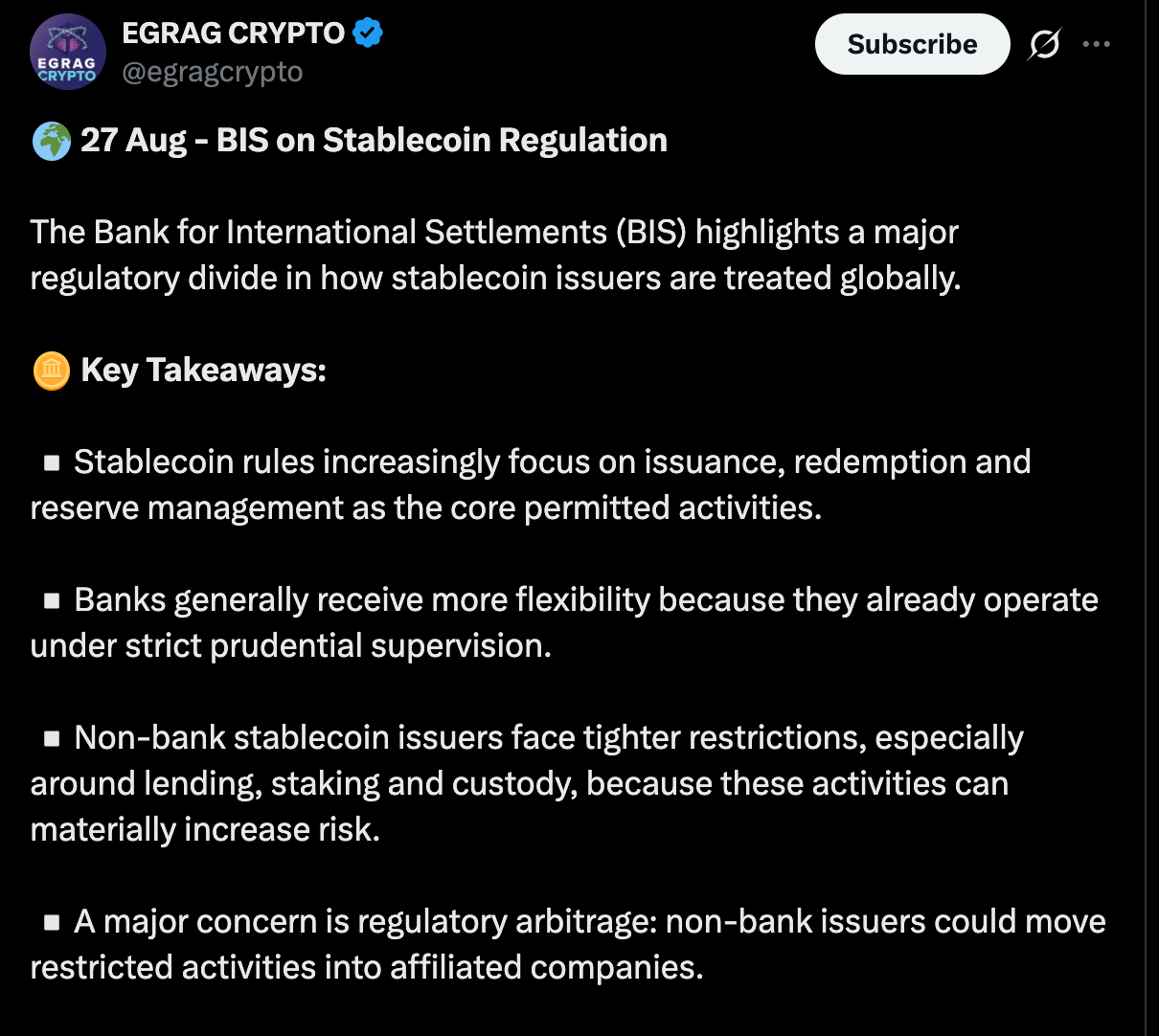
Regulators also face another challenge. A non-bank issuer could place restricted activities inside an affiliated company rather than conduct them through the issuing entity.
That possibility in the stablecoin news has drawn attention to group-wide supervision. That would allow regulators to assess risks across affiliated businesses rather than examining only the company that issues the stablecoin.
BIS Questions Stablecoins for Everyday Crypto Payments
For crypto payments, De Cos identified interoperability as one of the main obstacles to wider adoption of stablecoins. He said stablecoins can undermine the “singleness” of money because users cannot always move between different products without selling one asset and buying another.
Stablecoin platforms also lack genuine interoperability. Meanwhile, anti-money-laundering controls remain difficult to apply consistently across systems.
Those limitations on stablecoin news could become major as stablecoins expand into routine transactions. De Cos instead described tokenized bank deposits as a more direct way to use tokenization while preserving existing monetary foundations.
However, he also acknowledged that tokenized deposits still face challenges involving interoperability, governance, legal frameworks, and settlement.
Stablecoin News Raises Bank Funding Concerns
The expected effect on banks adds another layer to the debate. U.S. Treasury Secretary Scott Bessent has argued that stablecoins could strengthen the dollar’s international position while creating trillions of dollars in additional Treasury demand. De Cos acknowledged that increased Treasury purchases could reduce sovereign borrowing costs.
However, he warned that the same shift could create costs elsewhere. If customers move deposits from banks into stablecoins, lenders could lose a relatively inexpensiveconditions and increase borrowing costs for households and businesses
Dollar Stablecoins Put Monetary Sovereignty in Focus
De Cos also raised concerns about “digital dollarization” as dollar-pegged stablecoins circulated outside the United States. Heavy adoption could reduce monetary power in some jurisdictions if households and businesses tend to use dollar-based stablecoins instead of domestic currencies.
That shift could reduce the effectiveness of local monetary policy while making domestic financial conditions more dependent on external policy decisions.
De Cos cited Wyoming’s Frontier Stable Token, or FRNT, as an example of public-sector experimentation with digital assets, while emphasizing gradual experimentation.
The BIS position does not rule out a future role for stablecoins. De Cos said they could become more relevant if issuers improve redeemability, cross-chain interoperability, and integrity controls.
Source: cryptorank.io