



Don't want to trade it yourself?
Our desk runs DEX portfolios on profit share.
Currencies38647
Market Cap$ 2.66T+6.81%
24h Spot Volume$ 60.79B+13%
DominanceBTC57.42%+2.23%ETH10.80%-0.99%
ETH Gas0.25 Gwei
MarketEditor’s PickBlockchainSolana (SOL) News
Aug 21, 2026
3min read
byPhil Haunhorst
forBeInCrypto
Solana has begun halving block time from 400 ms toward 200 ms, starting with a 50 ms cut at epoch 1020 in a four-step Agave rollout that will double blocks per minute from ~144 to 300; 96.7% of stake is running the required software across 690 validators with 435 million SOL in active stake. Shorter, smaller blocks keep total throughput steady and pair with the Alpenglow consensus work to target faster finality, boosting protocol updates and adoption prospects for crypto DeFi projects and exchange integrations. Traders pushed SOL up 5.8% to about $89 (market cap $52.3B), but security and reliability risks remain after an August routing fault that knocked 28.83% of staked SOL offline and earlier slow patch adoption.
See what traders are focused on
In Brief
- Solana begins halving its block time, moving from 400ms toward 200ms.
- The network will make 300 blocks a minute, up from 144 today.
- SOL trades near $89 after a 5.8% daily gain, ranked seventh.
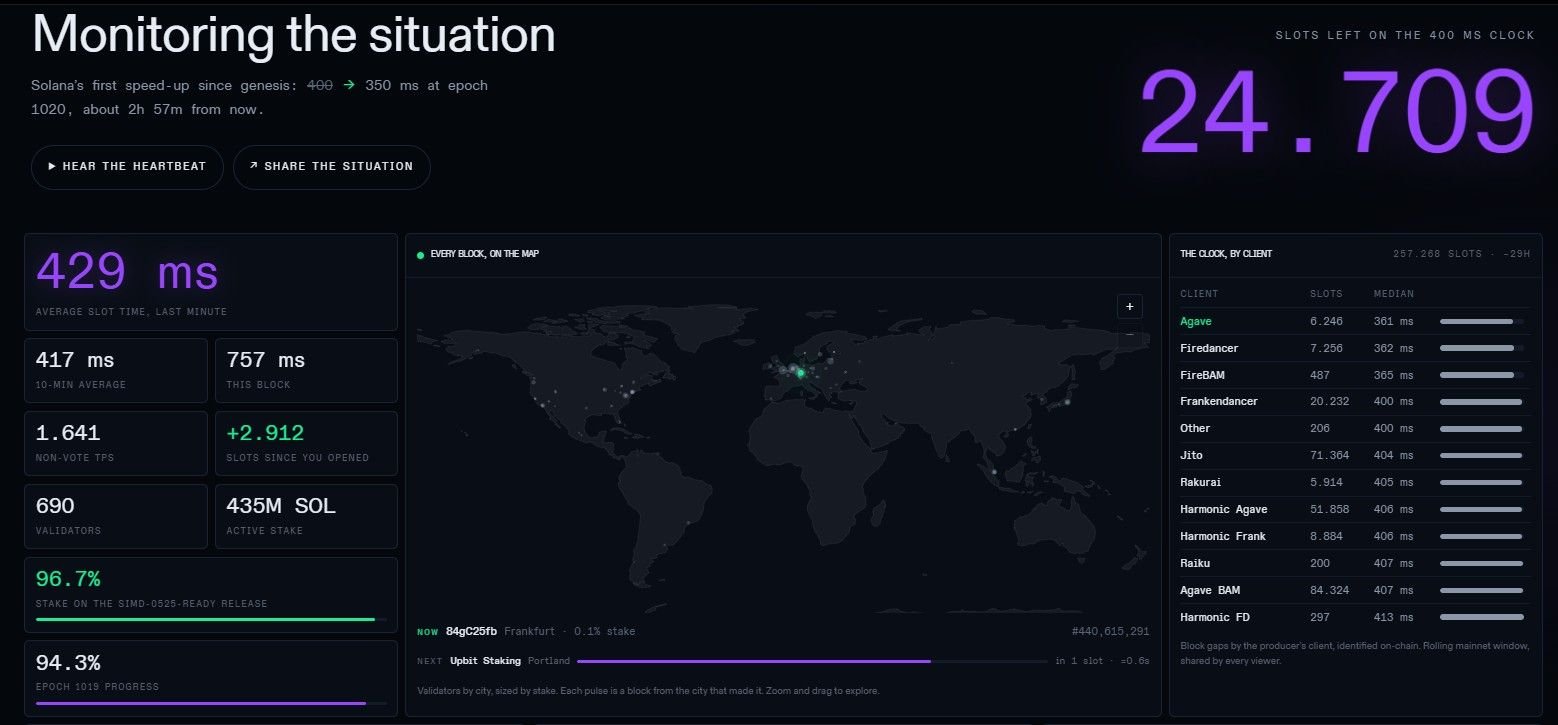
Solana started halving its block time, taking the first step from 400 milliseconds down toward 200. The first cut lands at epoch 1020, one of the roughly two-day windows the network uses to schedule changes.
Anza’s Agave software carries all four steps, and each one switches on separately. Solana will end up producing a new block every fifth of a second.
Solana Doubles Its Blocks Per Second
Today Solana makes about 144 blocks per minute, or roughly two and a half every second. At 200ms that rate doubles to 300 blocks a minute.
Faster does not mean bigger. Each block shrinks in step with the clock, so the network carries the same total load. Blocks simply arrive twice as often in smaller pieces.
The rollout runs in four steps of 50 milliseconds each. Validators can pause the sequence at any point if too many blocks start getting skipped. Anza has called its timetable tentative for that reason.
Thelive tracker at solana.com/200ms showed 96.7% of stake already running the required software. Meanwhile, 690 validators and 435 million SOL in active stake sat behind the upgrade.
Reliability stays the open question. Solana came within reach of a network halt in August after a routing fault knocked 28.83% of staked SOL offline. Validators were also slow to adopt an urgent patch earlier in 2026.
https://x.com/solana/status/2090569709636690152
How Solana Stacks Up Against Bitcoin and Ethereum
Bitcoin produces one block every 10 minutes. Solana at 200ms would turn out 3,000 blocks in that same window.
Ethereum runs closer to 12 seconds per block. Solana already ticks roughly 29 times faster, and the gap widens to 60 times at the final stage.
Those numbers flatter Solana, yet finality tells a different story. Solana needs about 13 seconds to settle a transaction for good. Ethereum takes closer to 13 minutes, while Bitcoin asks for about an hour.
Alpenglow, a consensus overhaul targeting 150ms finality, attacks that second gap. Anza has penciled in the third quarter for its first phase, carried by the Agave 4.3 release. Shorter blocks and faster settlement therefore solve different halves of the same problem.
Traders Reward the Speed Push
Co-founder Anatoly Yakovenko, who posts as toly, framed the pace against an earlier cut.
It took 2 days to go from 800ms to 400ms
That comparison sets a rough expectation for the remaining stages. However, Anza has committed to no firm dates.
SOL traded near $89 after a 5.8% daily gain. The move holds the token seventh by market cap at $52.3 billion. A dormant whale that banked $20 million in 2023 also returned to buy SOL on Tuesday.
The token rode a wider meme coin rally worth $3 billion in a single day. Grayscale separately named the network among altcoins positioned to benefit from new US token rules. Faster blocks strengthen that pitch, provided Solana keeps its skip rate steady.
Source: cryptorank.io