

Don't want to trade it yourself?
Our desk runs DEX portfolios on profit share.
- BTC-USD
- HOOD35566-USD
- CL=F
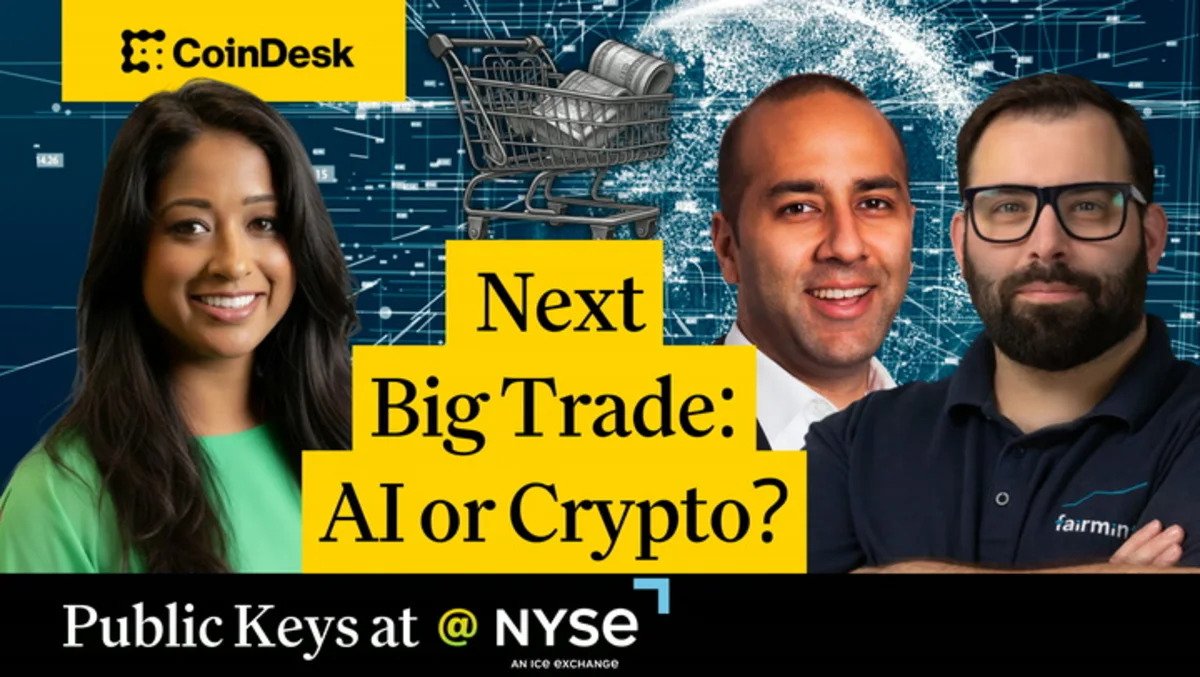
On this episode of CoinDesk’s Public Keys from the New York Stock Exchange, host Jennifer Sanasie is joined by Ram Ahluwalia, CEO and Founder of Lumida, who makes a non-consensus case that the Fed will hold rather than hike at its September meeting, and argues that AI has more room to run than crypto as capital rotates between the two. Then Joris Delanoue, CEO of Fairmint, breaks down the SEC’s proposed overhaul of transfer-agent rules, the first in decades, which could let a blockchain serve as the official record of securities ownership. He unpacks the three models of tokenized equities, the AMC–Robinhood stock-token dispute, and why a single source of truth matters for the issuer-shareholder relationship. Plus, a look at ETF flows, with bitcoin ETFs posting their worst week since July and ether ETFs drawing net inflows.
On today’s public keys from the New York Stock Exchange, the Fed may be about to pull the trigger on the first rate hike in years. Should your money be in crypto or AI, and the SEC proposes the biggest overhaul of transfer agent rules in decades. I’m Jennai. Let’s get into it.Happy Monday everyone. Crypto is in the green this morning. One of the few bright spots as global AI stocks fell off after anthropic CEO Dario Omede used a weekend essay to call for slowing AI development. Oil is also higher after Saudi Arabia shut a pipeline that bypasses the Strait of Hormuz, extending a rally that pushed US crude above $100 a barrel last week for the first time since May. Here to take a look at the macro picture is Limita, CEO and founder Ram Ahluwalia. Hey.What a day to come back to the markets. I just mentioned a bunch in my intro there, but I just, you know, I like to start off with this question. What are you watching as we get into the week?
So I’m watching what happens with the rates this week. The FOMC Markets are implying an 86% chance of a rate hike. That’s 12, anthropic CEO came out over the weekend saying we need to slow down AI. Elon Musk and Sal Altman agreed that’s led to a semis sell-off today.And third are midterms, policy, policy, policy.
Well, let’s talk about that. Markets are expecting a 25 basis point rate hike on the 16th. Talk to me about what we can expect to happen should that rate hike come. How do you expect to see crypto perform? And then let’s talk about some of those AI equities.
So my view is nonconsensus. I actually don’t think you’re going to see a rate hike, and if that doesn’t happen, markets are going to rally sharply.So the 86% probability implied by the CME Fed fund futures, it means that a lot of this risk has already been priced in. It’s rear view mirror risk. So the asymmetry is actually the upside if we don’t see rate hikes. It’s hard for me to see Kevin Warshch, who was selected by Trump on a campaign of we got to lower rates, and don’t forget Kevin Warsh is talking about the productivity gains from AI.That’s what he spent 45 minutes of his Jackson Hole speech talking about. It’s hard for me to see rate hikeshappening.
OK, you have the contrarian take. I mean, what’s the market getting wrong here?
I think the market’s looking at inflation. It’s looking at oil prices are high. It’s looking at the 10 year approaching 5%, and Wars has said in his first FOMC presser that the Fed needs to reestablish credibility, that the Fed has missed its inflation target for 5 years and running, and he’s correct about that. But I don’t think you’re going to see a rate hike just before midterm elections.
OK, no rate hike before midterm elections. I would assume that means no rate hike this year then.
I don’t think this year either. The oil prices are transient. Oil prices will come down again. The 10 years is probably going to top out around where it is now at 5%, just like it topped out in 2023.And I think if you’re looking at rate sensitive names and names that have sold off because oil prices have gone higher like airlines and cruise lines, I think you can set up for a really nice year in Raleigh owning those kinds of exposures.
All right, let’s, uh, I want to get back to that, but let’s talk about the AI news. We talked a little bit about anthropic, the anthropic CEO coming out over the weekend with that essay. Other AI executives and leaders saying we need to kind of slow down development. We saw a little bit of a sell-off in AI equities this morning.Uh, talk to me about your view on AI as we move to the end of the year, of course, a lot of concerns, um, coming to light and affecting some of these companies.
It’s a nothing burger. It creates an opportunity to buy semiconductors, and the reason why is there’s a story behind the story. Anthropic is going to release their S-1 filing imminently, probably this week, and they’ve got to shift from grow at all costs to making money and profitability, and their CE spending obligations are significant. So what they’re really guiding towards.Is setting up a raise rate beat dynamic, that’s what public markets expect. Private markets are about revenue at all costs, public markets are about discipline.So I think that’s what the bigger story isabout.
Well, let’s talk about AI and crypto. We saw a lot of capital flow from crypto into the AI trade. Some of it’s starting to come back as we get into Q4 Q4. What is your perspective when you look at what’s going on in the AI sector, when you look at the crypto market starting to wake up, what should investors be looking at?
So I don’t expect Clarity Act will pass.The bigger opportunities are in AI. There’s a lot of talent that’s flowing from crypto to AI, and AI is still in the early innings. We’re transitioning from a phase where we had AI infrastructure, the birth of the neo clouds, and the growth in semis and compute, and now we’re entering the AI application phase. Look at the traction around instinct, granola. Meta just rolled out Muse, a personal assistant.Google is rolling out Spark, another personal assistant. Apple just revamped Siri, so it actually works now. So the next phase is going to be AI application layer, and the demand for compute intelligence is only going to go higher. I think that’s where people should be focused.
It’s funny you say Siri actually works now. Last night I was saying to myself, like with all this advancement in AI, Siri is still like not really getting it for me, not really getting it
for me. I think they’re going to crack the code. I was testing it earlier and it’s, it’s actually impressive, so.Americans are skeptical about AI. About 38%, according to a Pew survey, like AI.That’s because they haven’t seen the benefits, and they’ve been told a lot of boomerism stories, but now they’re going to start to see real value, and small businesses that are using AI are already seeing gains. We just saw a non-farm payroll report.That showed job growth. So we’re not entering a world of job displacement. We’re entering a world of greater productivity growth. We’re entering a world where businesses can move at the speed of willpower. If you’re a founder, owner, or creator, there’s never been a better time to be alive.
It’s interesting you say Americans haven’t really seen the value of AI yet. Still early innings. It’s kind of a similar story we hear on.Crypto side, right? Americans haven’t really seen the value of crypto. We’ve, we’ve seen other regions that have financial systems that aren’t as good as they are here in the United States see the value a lot earlier than over here. Talk to me about about the parallels there because what you’re saying reminds me a lot of what tokenization is doing for crypto.
That’s an excellent, excellent point. So on the.AI skepticism, a lot of that’s driven by one, our political leaders on both sides are talking about utility bills going up.Uh, 2, the leaders of anthropic and open AI aren’t the best spokesmen for AI. And third, there are credible reports of other states like China using US-based social media to undermine confidence in AI. In China, public support for AI is around 85%, and that’s where it needs to be.You know, in the US on crypto, the opportunity, to your point, Jen, it is around tokenization, it is around decentralized finance, but we need to show the end user value, and the industry hasn’t delivered against that. In my view, there’s not much value in tokenizing.Liquid traded stocks, it’s one of the most efficient markets in the world. What’s the tangible end user benefit that’s missing? And what about DeFi? It’s not in the clarity Act. DeFi is an incredible innovation where you and I can transact. We can borrow and lend without a third party bank in the middle. We get rid of the middleman, but that’s not in the clarity Act.So that’s why I believe AI actually has more room to run and substantially more, and now you’re starting to see governments adopt and get behind AI. There’s no better customer in the world than the US government. Now they’re starting to spend money on this.
What are the attractive AI plays for you?
So I think owning the leaders.Nvidia, Taiwan Semiconductor, they are nice picks and shovels play. Within memory, applied materials is another one. Having exposure to micron or SK Heinch, that also makes sense to me.So I think there are a lot of ways to play it, but I do like the semiconductor supplychain.
And quickly before we go, you mentioned midterms are coming up. Talk to me about the important outcomes from market’s perspective heading into November.
I expect that most of this midterm pricing risk will be fully discounted.Before the end of the month, that’s statistically what happens in other midterm cycles. We’re halfway through that already. I think a lot of this risk has been pulled forward. Most hedge funds are underinvested in the market, they already hedged, so now is the time we should be looking for opportunities.
All right, Ron, we’ve got to leave it there. It’s always a pleasure having you on. Thank you.
Thank you again.
That was Lamita, CEO and founder Ram Ahluwalia. We are going to take a quick break. When we come back, more on the crypto markets from the floor of the New York Stock Exchange.Coin desk widgets are coming your way. Life prices, top gainers, and the latest news right on your home screen. Stay on top of every cycle. Update the Coin desk app and add yours today. Welcome back to Coindesk’s public keys from the New York Stock Exchange. The SEC just proposed the most significant overhaul of transfer agent rules in decades, and it could finally let blockchain.The official ownership record for securities. Doris Dela has been building towards this movement. He’s the CEO of Fairmint, and SEC registered on chain transfer agent, now administering more than $1.6 billion in equity across 180 issuers. Doris, welcome.
how are you doing?
I’m super excited to be here today.
I’mexcited to have you on the show. Happy Monday.To you two lay a foundation for us. I mean this is a big movement. Like I said, the biggest movement we’ve seen in decades. Talk to me about the SEC’s proposal. What doesthis mean?
Well, I think it’s a big unlock, to be honest, because over the last 40 years, the rule for transfer agent was prepared for papers in a filing cabinet.And finally, the SEC is saying it can be a database, and that database can be the blockchain. So for us it’s a big unlock. It’s a proof that everything that we’ve been fighting for over the years as blockchain as a better form of database is finally happening and it’s coming directly from the regulator.
I mean you’ve been at this for a while. 40 years sounds like a long time. I know regulation, legislation moves slowly, but why has it takenso long? Well,
I think, I think before there was no need, but the problem of tokenization right now is.mimicking mimicking the paper crisis that we saw 60 years ago. Remember at that time people were used to custody their shares in paper, but when the industry started to boom, the New York Stock Exchange had to close every Wednesday to be able to reconciliate everything.And that’s when they decided to fix that by creating a centralized entity that would custody all those paper shares and that evolved, but now with the tokenization evolving, booming, we start seeing tokenized stocks all over the place, right? Well, because of that, I think we have a unique chance.Now to alleviate the risk that comes with this booming of tokens, and I think the is precisely focusing on making sure that they fix the problem before itexists.
There are 3 different models, I guess when you look at tokenized equities.What does this unlock for each one of the models?
Well, so let’s talk about the one that we see a lot today. So we hear a lot about token wrappers. So it’s like you take a stocks, you create a token out of it, and then you put it on any cryptoexchange,
and it has nothing to do with the issuer exactly.
And it’s not bad in a way, but it just poses the question like who owns what.And then you have like the second level, which is like let’s do an SPV. So in that case, the SPV is created. It’s a special vehicle where people pool their money, and that vehicle will go and purchase, supposedly purchase the shares. And then the people, what do they own? Well, they think that they own the Tesla share or the the the the Amazon share, but the reality is they own a stake in the SPV itself. And finally, the third model is with the PRP. So it’s like.Done and build for the traders and crypto traders particularly um and in that case it needs to move fast and there is a lot of leverage so the three models are interesting, but the three points to the same single problem where is the source of truth? If it is somewhere else at one point you need to reconciliate the system.And that’s when the problem can happen. Like are you effectively owning your shares? Did you buy something and think that it was a Tesla stock, but the reality is you have no right, no rights in terms of financing directly to the capital, but also in terms of voting.And I think the SEC is precisely working right now to make that very clear so that investor protection remains and the investor knows what they buy when they decide to buy it.
Let’s talk about investor protection and consumer education. I mean, you’ve just outlined the three different types. You talked a little bit about the problem of investors understanding what they purchased. Do you think they understand today what do you think needs to bedone?
Well, I think we need to continue and educate them what are they truly understanding of what they buy.The problem is that today if you live in Filipina, how do you access the Tesla stocks? You cannot. So when the demand is huge and you build distribution for 10 years like Kraken, Coinbase, uh, or even Robinhood, and you have this demand that really wants to own those assets, well, you find the the the the way to provide them that, but the uh the investor needs to understand that he’s not exposed directly to the cap table.And it poses the second problem, and that was one of the discussion of last week, um, between the the CEO of AMC and the CEO of Robinhood, like, did they authorize that? And when it’s not authorized, then it poses the question of like, what do the company want to sell to an investor.
What did you make of the CEO of AMC’s argument? Well,
Ithink both were right. Like Vlad Tenev is right in the sense that he has a demand. He’s here with a tech and a stack that is proposing a stock that people want. And on the other hand, AMC wants to know who owns what in their company. So I think the only good answer to that is let’s make sure that we build a system where both can operate in the same way.We don’t need to give voting power to people in Filipina or in Africa or in Europe or in Asia, um, but they want the financial upside. Let’s build what they want. But what’s very important, I think, is really making sure that the issuer knows exactly who owns what and when. And you know one of the biggest frustrations for the CEOs comes from the moment they go private to public.When you’re a private company, you know who are your investors. You can reach out to them, you can do things with them, but the moment that you go public, someone else knows, but you don’t, and this is one of the biggest systemic problems that we need to fix today.By making sure that one single source of truth exists where both the record keeping, like who owns what, and the liquidity where all the movement of the market is happening, can be on the same rail, this is precisely what we are focusing on.At Fairmin for the last 8 years
we’ve discussed this a little bit on the show. You know, a lot of people talk about 24/7 markets and they talk about tokenized equities, but there’s a really big unlock when it comes to the issuers shareholder relationship. I’m so curious to hear about how you’re seeing tokenization transform the issuers shareholder relationship and how you’relooking at that.
I think tokenization is the fantastic way of making the market being more 24/7.Which is exactly what people want. But like I said, the, um, the moment that you stop at the tokenization layer, you are missing the biggest component, which is the infrastructure behind.Where do we reconciliate the the the the stocks? Where do we know exactly who owns what? Can we provide a system where in a few clicks the CEO can click and say, oh, that’s my shareholders, and oh, this person sold yesterday. Maybe it would be interesting to know why, why did this person and this group of people that are.Same are selling now. Or if you want to build a loyalty program like you are Apple, for example, and you have tons of shareholders, but what if tomorrow you have a system of loyalty points that will allow your shareholder to get a discount when they check out? That’s the kind of thing that can be unlocked with the blockchain.But only if we go way beyond the tokenization. Tokenization is just a very thin layer. It will more and more become a commodity with low margin in the next years, but the plumbing behind the entire infrastructure, that is where we need to put the effort as an industry, building it as open as possible.
We talked about shareholder education just a moment ago. Do you think there’s still education needed? I mean, on the back of this AMC story for CEOs and CFOs when it comes to what tokenization really unlocks for their companies?
Absolutely. I think there is a huge lack today on.What are the capabilities of blockchain technology for the CEOs of all the public companies and also for the private ones, because the private market kept being bigger and bigger over the last 10 years. We saw SpaceX going public super high, but we see now all the AI companies, if we start educate well all those CEOs, I think they will just come back with better solutions.Better leveraging for their own capital, better solution for the investors as well.
What kindsof questions are you hearing from your clients and the institutions you work with? Well,
I would call maybe even more like a request. They are very frustrated by the ancillary model of transfer agent. Like they would love to click on a button and get all their all their like in a minute.And today when they want to do that, they have to ask to an intermediary that might ask to another intermediary. It can take days, weeks, even months before they get a snapshot, and this is one of the things that we focus on the most. It’s called the master securities holder file, and that is something that should be live, and we are at the internet era.Every data is moving super, super fast. We see the token moving 24/7. It’s not normal that people have to wait 45 days to know exactly who owns what in their company, so we, we should put the effort on that. All right,
Doris, we’re going to have to leave it there. Thank you so much for joining me today.
Thanks a lot.
That was George Dela CEO of Fairmin before we go, let’s take a quick look at ETF flows. Bitcoin ETFs saw their worst week since July around $463 million in net outflows. Not a single day of positive inflows for Bitcoin products last week coming out of the holiday long weekend. What’s sped investors while the macro story shifted Golden.flipped its recall on September 11th, reversing course after a hotter than expected core CPI data to forecast a 25 basis point hike at the Fed’s September meeting. That’s boomed risk assets broadly. Bitcoin, which has been trading near $80,000 slipped towards $78,000 as profit takers hit the exits following August’s strong rally. On the flip side.ETFs had a positive week, pulling in $197 million and helping push ET above $2600 on September 11th, its highest level since January. We’ll keep watching the stories that matter, so follow along on Coin desk.com, and that is a wrap for this week’s public keys at the New York Stock Exchange. Thanks for watching. I’m Jennassi. We’ll see you next week.
Source: finance.yahoo.com
2 Comments
Pingback: Coinbase Drops 6%, Strategy Slides 5%, MARA Holdings Slips 1% as Clarity Act Anxiety Builds – xpertsstudio
Pingback: Kalshi Promo Code SBWIRE – xpertsstudio