


Don't want to trade it yourself?
Our desk runs DEX portfolios on profit share.
Currencies38693
Market Cap$ 2.72T+1.65%
24h Spot Volume$ 72.69B+3.00%
DominanceBTC56.88%-1.03%ETH10.78%+0.83%
ETH Gas0.09 Gwei
AnalysisFeaturedTradingPolitics
Aug 22, 2026
7min read
byAndjela Radmilac
forCryptoSlate
See what traders are focused on
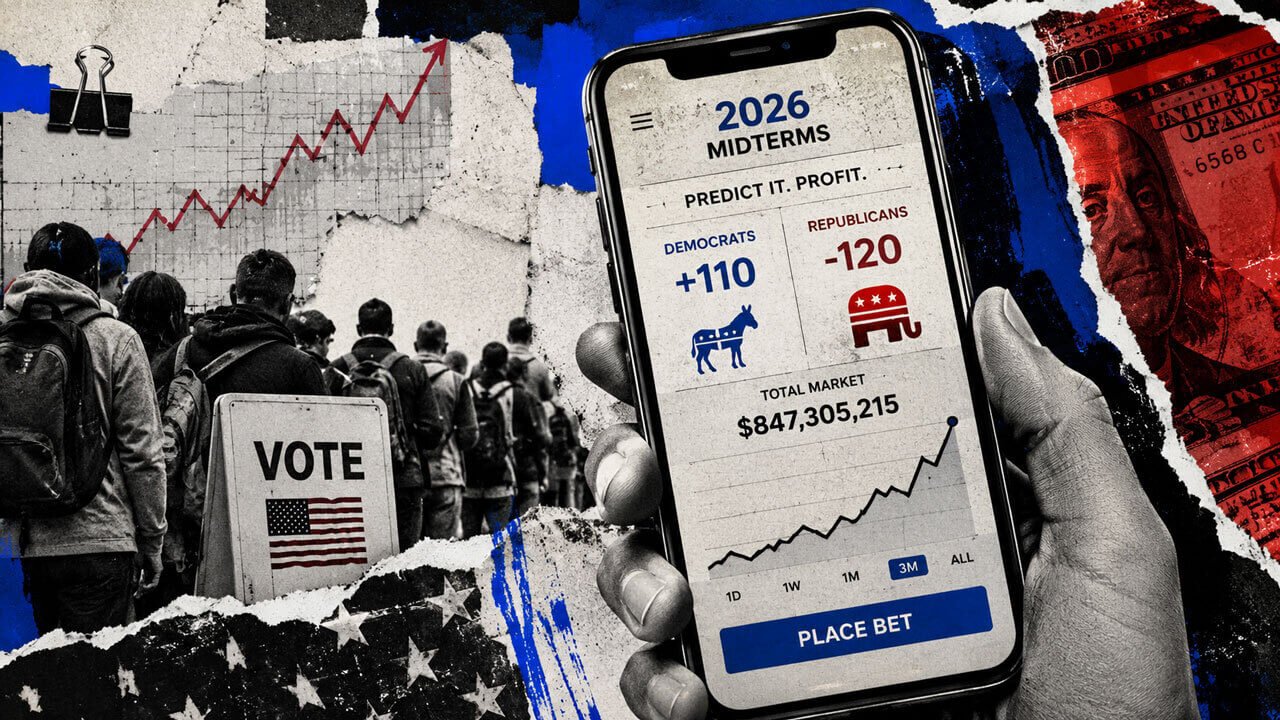
The Nov. 3 midterm election is less than 11 weeks away, and its betting market had already surpassed the full 2024 congressional cycle in the latest comparable data.
Traders had placed at least $133 million across markets tied to House and Senate races by Aug. 10, compared with $92.4 million during all of 2024. The menu expanded from 464 comparable congressional markets to 7,466, covering primaries, vote shares, turnout, endorsements, candidate remarks, and winners.
The top-line volume makes election betting look huge, but the participation data shows something narrower. On Polymarket Global, the top 1% of wallets account for 68% of congressional volume. Ten wallets alone produce 17% and have traded contracts touching 426 of the 470 seats on the ballot.
Prediction markets are becoming part of how everyone from campaigns and donors to media outlets interpret elections before the people vote. They’re reaching that role while a small pool of capital still sets much of the displayed probability, and enforcement expands one case at a time.
The resulting risk is easy to see. A concentrated market can produce an accurate price, but it can also produce a number that looks like mass opinion even when very few people supplied it.
The market count expanded faster than the audience
The Anti-Corruption Data Collective analyzed 7,466 markets across Kalshi, Polymarket, and Polymarket US, using data current through Aug. 10. Its comparison with 2024 shows expansion on almost every measure.
| Congressional betting measure | 2024 cycle | 2026 as of Aug. 10 |
|---|---|---|
| Total volume | $92.4 million | $133 million |
| Comparable markets | 464 | 7,466 |
| Time left before Election Day | Complete | Nearly three months |
| Projected full-cycle volume | Actual: $92.4 million | $1.4 billion to $1.6 billion, conditional |
The upper projection is conditional. At the same point in 2024, only 8% of final volume had arrived. If 2026 repeats that late acceleration, ACDC calculates that the total could reach $1.6 billion. Its lower path is $1.4 billion. The research dashboard will update as Nov. 3 approaches.
But it seems that breadth has outrun depth. Texas, Maine, and Michigan Senate contracts, plus Kentucky’s 4th Congressional District, account for 67% of state-level volume. Eighty percent of Polymarket’s congressional markets have fewer than 100 participating wallets. Only 10 have crossed 1,000, roughly the respondent count in many political polls.
Across 39,820 Polymarket wallets, 87% of markets are either below $10,000 in volume or have high volume held by very few traders. In a thin contract, one well-funded order can move the displayed probability even if nothing about the race has moved.
The jump from one headline contest to thousands of granular contracts just compounds that problem. A national presidential winner market can attract deep liquidity and constant arbitrage. A contract on a House primary, endorsement, or phrase in a speech may attract a small group whose information and motives are hard for outsiders to evaluate.
A price and a poll measure different things
A poll tries to estimate opinion in a population. Researchers sample respondents, weight the sample, and then publish a margin of error. On the other hand, prediction markets find the price at which traders will exchange a contract that pays $1 if an event occurs.
That price carries information about probability, incentives, and available capital. Dollars weight influence, so a trader with $100,000 can move the number more than one with $10. A person can also trade repeatedly, hedge across races, or provide liquidity without expressing a sincere political belief.
These mechanics can still produce useful prices. Money can force participants to defend their view, and an incorrect price creates an opening for better-informed traders. Concentrated specialists can outperform a large uninformed crowd. The 68% number alone can’t show that 2026 odds are wrong or manipulated.
The concentration data define what the number represents. The market price is the clearing level produced by its current traders, under its own liquidity and participation constraints, but a representative vote-intention measure comes from a different method.
That distinction becomes more consequential when market prices leave the trading venue. Television graphics, campaign posts, and social feeds turn a contract into a public probability. Donors may use it to assesslls, and candidates can cite favorable odds as proof of momentum
The loop then runs in both directions. Traders price politics, media outlets distribute the price, and political actors react to the coverage. Their reaction gives traders new information to price. Prediction markets become part of the election’s information system.
CryptoSlate has tracked how Polymarket and Kalshi are being valued partly as commercial probability feeds with media and financial uses. It has also covered proposals that would put event-market exposure inside brokerage products. Each new distribution channel gives the number more authority, even when the underlying contract is thin.
The CFTC is moving from cases to contract rules
Election outcomes decided by millions of public ballots carry less direct insider risk than an event decided inside a campaign office. The expanding contract menu includes both.
The CFTC’s February advisory described two Kalshi cases. In one, a political candidate traded on his own candidacy. In another, a YouTube editor traded on advance knowledge of unpublished videos. The CFTC said misuse of confidential information, fraud, manipulation, and other prohibited practices on designated contract markets fall within its enforcement authority.
Kalshi said it opened 200 investigations over the preceding year and had more than a dozen active cases as of February. It froze the two accounts, imposed financial penalties, and suspended the traders. Those actions demonstrate a functioning surveillance program. They also show how labor-intensive policing thousands of contracts can become.
Polymarket presents a separate enforcement structure, including pseudonymous wallets on its global venue. Public transactions make unusual success visible, but a wallet address alone rarely identifies a campaign employee, pollster, or government official. Establishing the person, duty, and information behind a trade takes more than on-chain monitoring.
ACDC’s earlier study of settled Polymarket political markets found the highest warning indicators in outcomes controlled by small groups, especially military and defense decisions. It defined a longshot as a trade of at least $2,500 at 35 cents or less. Fifty-two percent of qualifying military and defense longshots landed on the winning outcome, compared with 14% across all categories.
ACDC extended that work on Aug. 20 across 78,496 longshot bets from 12,355 wallets. It identified 152 highly specialized wallets active in military markets that had won more than $8 million. Those wallets won at least 75% of their longshot bets by the study’s definition and earned an average return of 132%, compared with losses of 2% for high-volume traders and 1% for semi-automated accounts. More than half placed their first longshot within two days of account creation.
The wallet pattern does not establish who placed the trades or prove use of classified information. It does narrow the enforcement problem. A pseudonymous market can make an unusual trade public in real time while leaving the trader’s identity hidden behind an exchange, routing wallet, or pooled account.
The same research found public-outcome markets such as elections at the low end of its insider-risk measures. That nuance is essential: a bet on who wins a statewide vote is different from a bet on whether a candidate drops out next week, secures an endorsement, or uses a specific phrase. The second group can be settled by decisions known to a small circle before the public sees them.
The CFTC has now put a rulemaking path behind that distinction. In Aug. 20 remarks, Chair Michael Selig said the Commission expects to propose amendments to Parts 38 and 40 of its regulations covering event-contract listing rules, consumer protection, product governance, market design and incentive programs.
He also defended the agency’s exclusive federal jurisdiction over designated contract markets and its proposal to define the public-interest criteria applied to war, terrorism, assassination, gaming and illegal-activity contracts.
Those rules could give regulated exchanges clearer duties around contract design and retail safeguards. They would not make a 68%-concentrated market representative or identify the person behind a global Polymarket wallet. Platforms still have to monitor thousands of thin contracts and explain why users should trust a probability heavily shaped by a few accounts.
Source: cryptorank.io