

Don't want to trade it yourself?
Our desk runs DEX portfolios on profit share.
<a href="https://www.google.com/preferences/source?q=finance.biggo.com” rel=”nofollow noopener” target=”_blank”>Add preferred source1
JPMorgan analysts led by Nikolaos Panigirtzoglou say Bitcoin could gain more support than gold if investors reduce hedging positions in spot Bitcoin ETFs. While both Bitcoin and gold ETFs saw inflows after the Fed’s July meeting as the debasement trade returned, gold ETFs have fully recovered their 2026 outflows while Bitcoin ETFs have reclaimed only about half. Short interest in BlackRock’s iShares Bitcoin Trust remains near yearly highs, while short interest in the SPDR Gold Shares ETF sits below its historical average. The put-to-call open interest ratio is also higher for the Bitcoin fund. The bank says this more skeptical positioning backdrop around Bitcoin could translate into stronger upside if hedging demand falls and those protective positions are unwound.
Key Elements
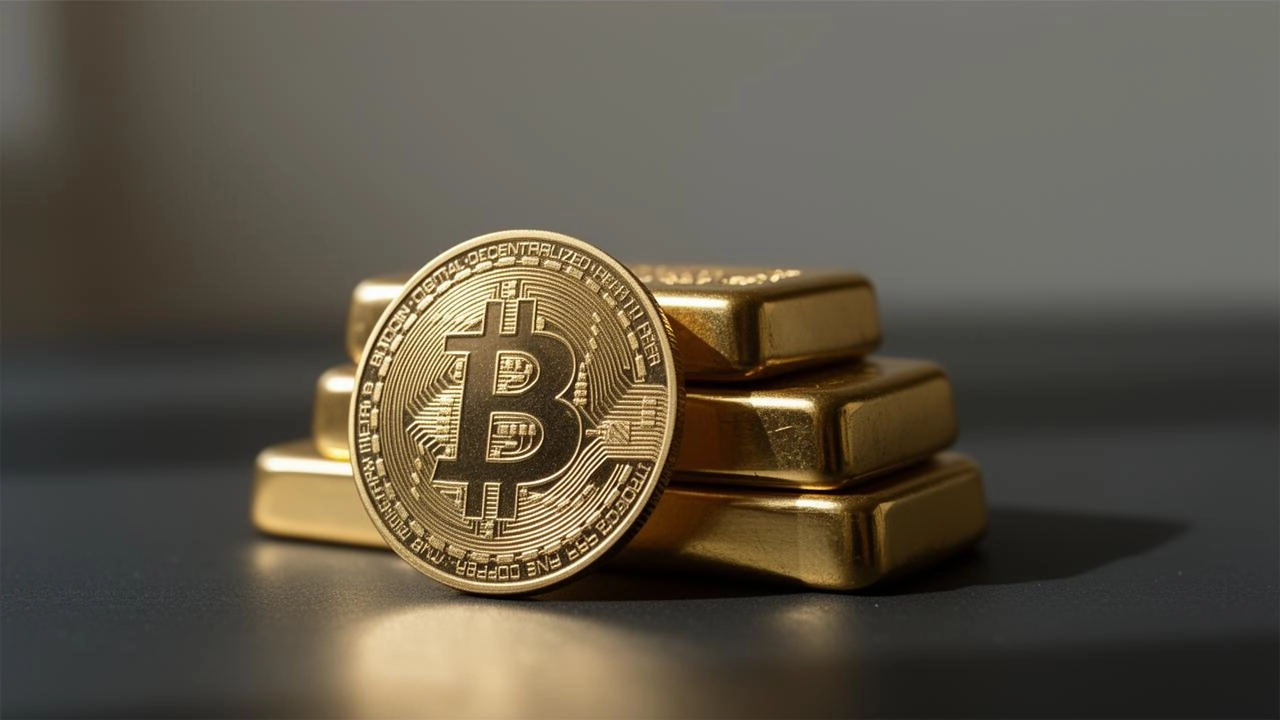
Bitcoin could receive a stronger tailwind than gold if investors begin dismantling the defensive positions they have built up in exchange-traded funds tied to the cryptocurrency, according to a new analysis from JPMorgan Chase & Co (JPM).
The report, published Wednesday and led by Nikolaos Panigirtzoglou, the bank’s global head of research, argues that the unusually heavy hedging activity surrounding spot Bitcoin ETFs – particularly BlackRock’s iShares Bitcoin Trust (IBIT) – represents a reservoir of potential buying pressure that gold’s primary ETF simply does not have.
Both asset classes saw renewed inflows after the Federal Reserve’s late-July policy meeting as investors revived the so-called debasement trade, a strategy of buying scarce assets to protect against currency devaluation, rising public debt, and inflation. But that momentum has cooled over the past week. Real bond yields, which account for inflation expectations, moved higher, and the Senate failed to advance the CLARITY Act, a bill that would have established a regulatory framework for digital asset markets.
The recovery in gold ETF demand has been notably stronger than in Bitcoin products. Gold ETFs have fully replenished the capital that fled earlier in 2026, while Bitcoin ETFs have clawed back only about half of their prior outflows, according to the bank’s research. Weekly data from SoSoValue paint a similarly uneven picture: Bitcoin ETFs recorded net inflows of roughly $4.23 billion between July 31 and September 4, but that stretch included two significant outflow weeks. Demand weakened further in September, with net outflows of $462.73 million for the week ended September 11 and $586.27 million in the most recent reading.
JPMorgan interprets this divergence as a potential opportunity rather than a warning sign. Because Bitcoin ETF demand has pulled back more sharply than gold, there is more room for a rebound if the news cycle turns favorable.
Futures positioning in both Bitcoin and gold remains elevated, indicating that institutional investors have not abandoned either trade. The real distinction lies in how those investors are protecting themselves against downside risk.
Short interest in IBIT, the largest spot Bitcoin ETF, is hovering near its highest level of the year. By contrast, short interest in the SPDR Gold Shares ETF (GLD), the dominant gold fund, sits below its historical average. The options market tells the same story: the put-to-call open interest ratio for IBIT is higher than for GLD, meaning Bitcoin ETF holders are paying more aggressively for insurance against a price decline.
“This contrast suggests that Bitcoin still faces an overall more skeptical positioning backdrop than gold,” the analysts wrote. The elevated hedging activity likely reflects Bitcoin’s higher volatility and its historical tendency to trade more like the Nasdaq 100 than a traditional safe haven.
The mechanics of hedge unwinding explain why this matters. When an investor closes a short position in an ETF, they must buy back the shares they borrowed. That purchase supports the fund’s price even though the investor’s underlying long position has not grown. Put options are less direct – when investors reduce put holdings, market makers may adjust their own hedges, but that does not automatically translate into equivalent ETF buying. Still, a large pool of shorts and puts can create a sharper upward response when sentiment improves and investors stop defending against the same downside risk.
JPMorgan acknowledged that other factors will influence the trajectory of both assets. A rapid rise in Treasury yields or a strengthening dollar could overwhelm the positioning argument, since Bitcoin has historically behaved differently across tightening cycles – sometimes as a scarcity hedge, at other times as a risk asset sensitive to liquidity conditions. But from a positioning standpoint alone, the bank concluded that “if hedging demand falls, it could give Bitcoin more support than gold from current levels.”
The analysis arrives as a prominent ETF watcher is making an even bolder claim about the long-term relationship between the two assets. Bloomberg senior ETF analyst Eric Balchunas said in a video posted on X that Bitcoin ETFs will eventually triple gold ETFs in total assets, a forecast he attributes to generational wealth transfer and growing institutional comfort as Bitcoin’s volatility declines.
“As the younger investors get more money and grow up with Bitcoin as their store of value, I do believe that Bitcoin ETFs will triple gold in assets,” Balchunas said. He acknowledged that large institutional money still favors gold today because of Bitcoin’s higher volatility and its tendency to move alongside the Nasdaq 100. But he sees an inflection point approaching as those correlations weaken.
“Bitcoin is like gold as a teenager,” he added. “Gold is 5,000 years old. Bitcoin is 17 years old.”
JPMorgan’s own stance on digital assets has evolved over the course of 2026. Early in the year, Panigirtzoglou’s team expressed optimism for the crypto market, estimating Bitcoin’s production cost at around $77,000 – down from the start of the year – and reiterating a volatility-adjusted long-term valuation of $266,000 compared to gold. By June, the tone had shifted as Bitcoin traded below its estimated production cost for five consecutive months and legislative deadlines for the CLARITY Act approached without resolution.
The data points in the latest report do not provide a live reading of every position in the market, and short-interest figures are reported with a delay that obscures the motivation behind each trade. Their value emerges when read alongside ETF flows, options activity, and macroeconomic conditions.
The most persuasive setup for Bitcoin, according to the analysis, would combine steady ETF demand with evidence that investors are becoming less defensive: positive spot ETF flows, declining IBIT short interest, a lower put-to-call ratio, continued gold ETF demand to rule out a simple rotation, and stable yields and dollar conditions that do not offset favorable positioning.
For now, the contrast in hedging behavior between the two largest commodity-linked ETFs suggests that Bitcoin has more defensive exposure to unwind if sentiment improves. Whether that unwinding materializes depends on forces that extend well beyond the ETF market itself.
Once added, BigGo Finance appears first in Google Search Top Stories, so you get the broadest, most up-to-the-minute, and most comprehensive global financial news first.
Source: finance.biggo.com