

Don't want to trade it yourself?
Our desk runs DEX portfolios on profit share.
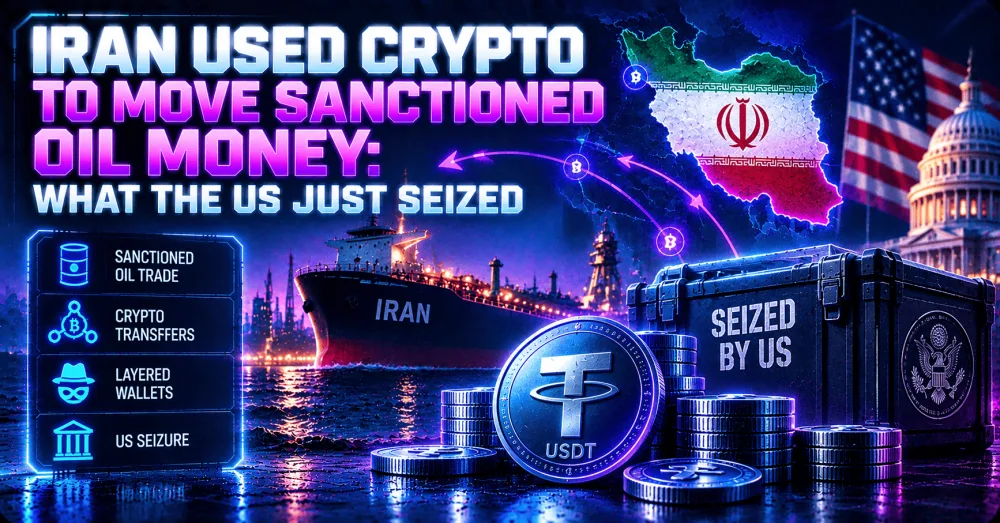
The latest Iran cryptocurrency sanctions case is another illustration of how financial proceeds from oil sales could enter the banking system. US prosecutors are investigating $61 million in crypto tied to sanctioned Iranian oil sales.
The complaint connects Chinese companies, Binance accounts, and a wider $1.5 billion transaction trail.
DOJ Targets $61 Million in Crypto Linked to Iranian Oil Sales
What the US Government Says It Seized
Prosecutors are targeting $61 million in crypto assets, alleging that they represent proceeds of unlawful trade in petroleum products. The seized property is said to have passed through multiple accounts to finance Iranian government and military entities.
In this DOJ crypto seizure Iran case, the government is not seeking criminal charges against the assets’ previous owners. Instead, the authorities are attempting to establish a direct link between the crypto and alleged unlawful activities.
Where the $61 Million Came From
The complained-of transfers stem from black market oil sales. Buyers and intermediaries allegedly converted some of the proceeds into <a href="https://xpertsstudio.com/the-house-advanced-a-crypto-tax-bill-38-to-5-what-the-digital-asset-tax-certainty-act-changes-for-bitcoin-holders/” title=”The House Advanced a Crypto Tax Bill 38 to 5. What the Digital Asset Tax Certainty Act Changes for Bitcoin Holders.”>digital assets and moved them through various addresses.
The $61 million Iranian crypto figure is only a fraction of all illicit payments. Prosecutors are linking it to a much broader scheme of Iran oil sanctions evasion.
How Iranian Oil Money Moved Through Crypto
The $1.5 Billion Crypto Trail
Investigators are following interconnected addresses that received and further transferred over $1.5 billion in cryptocurrency payments. This transaction trail is part of the $61 million crypto seizure case, illustrating why Iranian oil money crypto transfers could be challenging to follow.
While the movement of funds through multiple addresses makes it more difficult to connect blockchain payments to real-world entities, any on-chain transfers are publicly available. Investigative analysts can use this information to identify patterns and group wallets.
The Role of Binance Accounts
Prosecutors allege that crypto trading platforms helped move some of the proceeds. In particular, investigators are looking at Binance accounts that have facilitated transfers of funds.
Iran Binance transactions are therefore at the center of this DOJ case, as the exchange’s services have been used to receive, convert, and send digital assets. Binance is not accused of facilitating sanctions violations in this forfeiture proceeding.
How Chinese Companies Entered the Scheme
The complaint highlights several Chinese firms that allegedly played a role in the trade. They are said to have processed payments_instructions for Iranian oil buyers, with some intermediaries converting fiat into crypto.
Chinese demand is critical to understanding how Iran continues to sell its oil despite US sanctions. By utilizing crypto, buyers can participate in trade while using another form of settlement.
| Element | Role in the Alleged Scheme | Why It Matters |
|---|---|---|
| Iranian oil sales | Generated proceeds from sanctioned crude oil and petroleum products | Created the funds targeted by US sanctions enforcement |
| Chinese buyers | Purchased Iranian petroleum through cross-border trade networks | Connected physical oil sales with overseas payment channels |
| Blessed Trust | Allegedly converted fiat payments into cryptocurrency and transferred proceeds | Served as an alleged crypto on-ramp for oil money |
| Hexa Whale | Allegedly helped process and move Iranian oil proceeds | Added another intermediary between buyers and Iran-linked recipients |
| Binance accounts | Allegedly handled parts of the cryptocurrency flow | Provided exchange infrastructure for receiving and transferring assets |
| Unhosted wallets | Moved funds between addresses outside centralized exchange custody | Added layers between the original payments and final recipients |
| Entity A addresses | Allegedly received and distributed more than $1.5 billion | Formed the broader crypto network identified by investigators |
| Iran-linked recipients | Allegedly received cryptocurrency through exchanges, businesses, and IRGC-linked wallets | Represented the claimed destination of parts of the oil proceeds |
| Targeted crypto | Approximately $61 million | Assets now subject to the US civil forfeiture case |
Blessed Trust and Hexa Whale: The Companies Named by DOJ
What Blessed Trust Allegedly Did
The complaint alleges that this company positioned itself as a wealth management and digital asset services provider. Prosecutors are accusing it of facilitating the conversion of fiat to crypto, which allegedly makes it a participant in Iran oil sanctions evasion.
That role is significant, as the company is reportedly helping move money from traditional financial markets to digital assets. Prosecutors can therefore connect bank transfers to crypto wallet deposits, establishing a direct link between payments and sanctions violations.
How Hexa Whale Allegedly Moved Iranian Oil Proceeds
This company is accused of acting as a commodity trading counterparty while facilitating the movement of Iranian oil funds. Hexa Whale allegedly worked in coordination with Blessed Trust and other intermediaries to obscure the trail of money.
Authorities are alleging that Hexa Whale’s payments made it more challenging to determine the beneficial owners of the crypto payments. Similar claims are made against other entities involved in the Iranian oil sanctions evasion scheme.
Why Chinese Oil Buyers Matter
As mentioned, China is a willing buyer of Iranian petroleum products. This demand is what makes Chinese intermediaries critical to the Iran oil crypto sanctions evasion scheme.
These buyers are connecting physical oil trade with digital asset transactions. As such, Iranian oil crypto payments could originate from trade invoices and be converted into crypto several times before being deposited into exchange wallets.
How Crypto Was Used to Bypass US Sanctions
From Black-Market Oil Sales to Cryptocurrency
The alleged Iranian oil sanctions evasion scheme begins with black-market petroleum product sales. Some of the proceeds are then converted into digital assets and moved through crypto wallets.
This way, the initial bank transfers facilitating oil trade are separated from subsequent crypto transactions. While the conversion from fiat to crypto is one step, moving funds through multiple addresses makes it more challenging to connect the final payments to their origin.
How Funds Were Routed to Iran
Prosecutors are alleging that crypto transactions have been used to move value to Iran. Multiple addresses have allegedly participated in this process, with some of the proceeds being directed at military and government entities.
The Role of Unhosted Crypto Wallets
Unhosted crypto wallets provide users with greater privacy compared to exchange-based addresses. By using such services, fund transfer instructions can be made without relying on a single counterparty to facilitate movements.
However, investigators are noting that these wallets are still visible on the blockchain, which makes it possible to connect transactions and identify patterns.
How the Transactions Were Obfuscated
Investigators are looking at multiple factors that contribute to transaction obfuscation. In particular, they are highlighting the use of multiple addresses to make it more challenging to determine the beneficial owners of the crypto payments.
Where the Money Was Allegedly Sent
Iranian Government and IRGC-Linked Wallets
US prosecutors are accusing multiple entities of facilitating payments to the Iranian government and IRGC. If proven guilty, the companies could face severe penalties, with crypto funds being subject to seizure.
The government must establish a direct link between these wallets and the alleged Iranian oil sanctions evasion scheme. At the same time, it is important to recognize that the blockchain evidence may not be sufficient to prove beneficial ownership.
Iranian Crypto Exchanges and Money Services Businesses
The complaint highlights several local exchanges and MSBs that have received crypto payments. These businesses are playing a critical role in the Iranian oil sanctions evasion scheme by providing liquidity to local counterparties.
The Alleged Military and Terror-Financing Connection
The complaint highlights that some of the Iranian oil proceeds have been used to fund military expenses and terror financing. By doing so, the accused entities are taking part in Iran’s efforts to evade sanctions.
It is important to note that the DOJ is alleging that the companies are facilitating not only economic but also national security violations. As such, the consequences could extend beyond economic penalties.
Why Binance Is at the Center of the Case
What DOJ Alleges About Binance Accounts
The DOJ complaint notes that Binance accounts have been used to facilitate the transfers of Iranian oil funds. In particular, investigators are looking at Blessed Trust and Hexa Whale accounts, which have processed crypto deposits and withdrawals.
This way, Binance is integral to the Iranian oil sanctions evasion scheme, even as the exchange itself is not accused of facilitating prohibited transactions.
Binance Says It Was Not Accused of Wrongdoing
While Binance is being investigated, the DOJ complaint does not explicitly accuse the exchange of violating any laws. This nuance is critical, as it determines whether Binance will face additional scrutiny in the future.
As a centralized exchange, Binance has millions of customers, which means that its compliance teams are reviewing transactions on the platform. The company is therefore relying on these measures to ensure that its services are not being used for illicit purposes.
Binance’s Previous $4.3 Billion US Settlement
The crypto exchange is currently in the process of settling a $4.3 billion US legal action. This matter pertains to Binance’s past AML and sanctions compliance practices, which have failed to meet regulatory requirements.
The new Iran crypto sanctions case adds to the ongoing scrutiny of Binance’s operations. At the same time, it is important to remember that the latest DOJ filing does not accuse the exchange of violating any laws.
What Happened After Binance Compliance Teams Flagged the Transactions
Compliance teams at Binance reportedly took action after reviewing the transactions in question. This illustrates the importance of the exchange’s internal controls, which have enabled investigators to identify additional evidence.
When Binance suspended the accounts in question, law enforcement could utilize the information to conduct further research into the Iranian oil sanctions evasion scheme.
What Happens to the $61 Million Now?
How Civil Crypto Forfeiture Works
Civil forfeiture proceedings enable the government to take control of crypto assets, even when the owner is not explicitly accused of criminal conduct. This type of proceeding is common in cases where the government wants to prevent the use of illicit funds.
For crypto transactions, investigators are relying on blockchain analytics to establish continuity of control. The evidence can then be used to file a complaint with a court, which would rule on whether the funds should be transferred to the government.
Why the DOJ Must Prove Its Case in Court
A complaint filed by the DOJ is only the first step in the process. The government will have to provide evidence illustrating why the $61 million in crypto should be subject to forfeiture.
Even though the blockchain records show continuity of control, the potential claimant should be able to challenge these findings in court.
When the US Can Seize Crypto Linked to Sanctions Violations
It is essential to understand that the US government can initiate such proceedings when there is evidence of sanctions violations, money laundering, or other prohibited activities. As mentioned, the DOJ filing is not a final determination.
The key issue is whether the evidence presented by the government is sufficient to prove the alleged violations. These findings are critical in determining whether the crypto funds will be transferred to the government.
What the Iran Crypto Case Means for Sanctions Enforcement
Can Crypto Still Be Used to Evade Sanctions?
Cryptocurrencies can be used as a medium of exchange to move value from one jurisdiction to another. This characteristic makes it possible for bad actors to use digital assets to evade sanctions.
The US government is accusing Iran of engaging in such conduct, which illustrates the extent of concerns about crypto’s role in sanctions enforcement. At the same time, it is important to remember that blockchain transactions are publicly available, which is why investigators can follow the trail of funds.
How Blockchain Transactions Help US Investigators Trace Funds
Crypto investigators are relying on publicly available on-chain data to identify patterns. They can be used to group transactions, which is crucial in determining whether illicit payments are taking place.
In particular, blockchain transactions can help link addresses to exchanges, counterparties, and even real-world entities. This way, investigators can identify weaknesses in the sanctions evasion scheme and utilize this information for further enforcement actions.
Why Stablecoins and Centralized Exchanges Matter
Stablecoins enable instantaneous payment settlement, which is why they are frequently used in international transactions. At the same time, centralized exchanges hold users’ deposits, which means that they play a critical role in money laundering schemes.
These characteristics highlight why the US government is concerned about the role of crypto in sanctions enforcement. In particular, stablecoins and centralized exchanges enable bad actors to move money across borders, which is why investigators are scrutinizing their role in the Iranian oil sanctions evasion scheme.
China, Iran and the Future of Sanctions-Evasion Networks
Why Chinese Companies Are Important to Iran’s Oil Trade
Chinese buyers are playing a critical role in facilitating Iran’s oil trade despite US sanctions. In particular, they are helping sellers and buyers separate their transactions from the traditional banking system.
This way, Chinese intermediaries are removing the direct link between the entities involved in the trade, which makes it more challenging to detect and prosecute sanctions violations.
Crypto’s Growing Role in Cross-Border Payments
Digital assets enable fast and near-instant payment settlement, which is why they are frequently used in cross-border transactions. In particular, cryptocurrencies are advantageous in international commerce due to their availability 24/7.
The same attributes contribute to their appeal for bad actors, including states that wish to evade sanctions. At the same time, these characteristics are also advantageous for investigators who are tasked with enforcing existing regulations.
Will US Authorities Target More Crypto Wallets?
Crypto investigators are likely to follow the trail of funds and take enforcement actions against other wallets holding illicit proceeds. In particular, they will look at transactions facilitating trade in goods and services while evading sanctions.
Authorities will be analyzing the blockchain data to determine whether other addresses are playing a role in the scheme. As mentioned, the evidence can take months to gather, which is why the future cases against Iran-linked crypto wallets are hard to predict.
What This Case Means for Binance and the Crypto Industry
Stronger KYC and Sanctions Screening
Crypto exchanges are the first line of defense when it comes to preventing illicit transactions. The industry is being pushed to adopt stricter KYC procedures and ensure that their services are not being abused.
However, these measures can only be effective if exchanges implement enhanced screening procedures, including automated tools. This way, crypto platforms can detect suspicious activity and respond accordingly, minimizing their exposure to regulatory risks.
The Growing Risk of Crypto Forfeiture
Crypto wallets enable self-custody of digital assets, which has long been advocated by privacy enthusiasts. However, it is crucial to recognize that these instruments can also be used to facilitate sanctions violations.
Authorities are taking action against individuals and entities utilizing crypto to evade sanctions. As a result, it is essential to consult with qualified professionals when dealing with such matters.
Why On-Chain Transparency Is Becoming a Law Enforcement Tool
Blockchain transactions are advantageous in sanctions enforcement since they cannot be easily modified. This characteristic is what makes them appealing to law enforcement officials worldwide.
In particular, investigators can utilize on-chain data to establish continuity of control over illicit proceeds. The ability to track these transactions is what makes crypto both a risk and an opportunity for the financial industry.
Why Did the US Seize $61 Million in Crypto From Iran?
Prosecutors allege that the $61 million in crypto was proceeds of unlawful trade in petroleum products. This claim is still subject to court proceedings, which will determine whether the assets will be subject to forfeiture.
How Did Iran Move Sanctioned Oil Money Through Crypto?
Authorities allege that Iran facilitated black market oil sales and used crypto to move the proceeds. These funds were reportedly transferred through multiple addresses in an effort to obscure the trail of money.
What Crypto Did the US Seize From Iran?
The US is seeking to seize roughly $61 million in crypto in this particular case. It is important to note that this figure only represents a small fraction of all illicit payments.
How Did Iran Use Crypto to Evade US Sanctions?
Authorities allege that Iran is using digital assets to move value outside of the conventional banking system. This way, the country is attempting to obscure the trail of money while still being able to benefit from oil sales.
What Does the Search Phrase US Seizes Crypto Iran Refer to?
This search term likely refers to the US government’s recent action targeting roughly $61 million in crypto. The funds are allegedly facilitating trade in goods while evading sanctions.
Does This Mean Binance Broke the Law in This Case?
No, the current complaint does not accuse Binance of violating any laws. However, regulators may scrutinize the exchange’s services more closely because they have been used to facilitate payments.
Source: bitcoinfoundation.org