

Don't want to trade it yourself?
Our desk runs DEX portfolios on profit share.
$XRP has posted a sharper decline than most major cryptocurrencies over the past 24 hours, with its price falling below the $1.30 threshold.
The broader crypto market also came under heavy selling pressure after the U.S. Senate failed to advance the Digital Asset Market Clarity Act, commonly known as the CLARITY Act.
$XRP Records the Largest Drop Among Top Cryptocurrencies
The Senate’s final cloture vote on the motion to proceed to the CLARITY Act (H.R. 3633) ended with 49 senators voting in favor and 50 voting against. As a result, the bill failed to secure the 60 votes needed to move forward to formal debate.
$XRP sold off alongside the broader market following the vote. However, the token’s decline was considerably steeper than that of several other leading cryptocurrencies. Among the top 10 cryptocurrencies by market cap, $XRP recorded the largest 24-hour decline, falling 7.71%. Solana followed, down 3.91% over the same period.
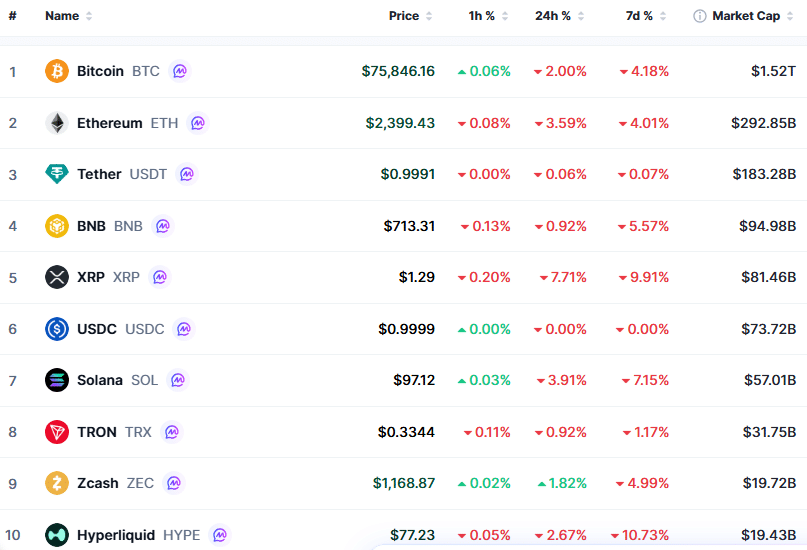
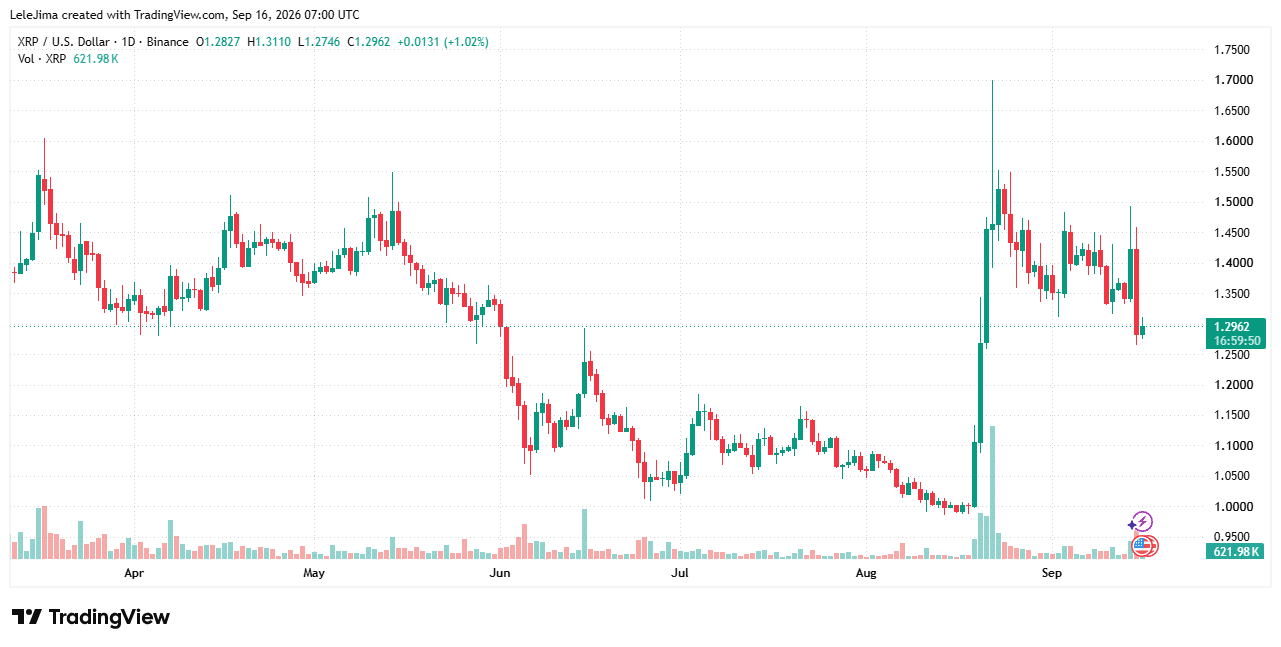
Before the Senate vote, $XRP traded at around $1.40. The token later fell to $1.29, leaving it with a market cap of roughly $81.34 billion and making it the fifth-largest cryptocurrency by market value.
$XRP Already Has Significant Legal Clarity
$XRP’s sharper decline has sparked debate across the crypto community, particularly because the token already enjoys significant legal clarity in the United States.
During the SEC v. Ripple lawsuit, a federal court determined that $XRP itself is not a security. Therefore, $XRP does not necessarily rely on the CLARITY Act to settle the basic question of whether the token itself constitutes a security.
That distinction raises an important question: If $XRP already has substantial legal clarity, why did its price fall more sharply after the Senate blocked the legislation?
Why $XRP Dropped Sharply
One possible explanation is that $XRP could still benefit significantly from broader crypto legislation, even without needing the bill to establish its own legal status.
The CLARITY Act aims to create a wider regulatory framework for digital assets in the United States. Its potential impact, therefore, goes beyond determining whether individual cryptocurrencies qualify as securities.
For $XRP, clearer rules across the broader digital-asset market could reduce uncertainty for institutions and financial companies entering the sector. This is relevant as institutional interest in $XRP and its underlying technology continues to grow.
The dynamic could help explain $XRP’s larger immediate decline compared with several other major cryptocurrencies. Investors may have anticipated that comprehensive U.S. crypto legislation would improve the regulatory environment for digital assets and make it easier for institutions to participate in the market.
Consequently, the Senate setback may have removed, at least temporarily, a potential catalyst for broader institutional participation. That could have contributed to the heavier selling pressure seen in $XRP.
What Happens If the CLARITY Act Advances Later?
The latest decline does not, by itself, determine how $XRP will respond if the CLARITY Act advances in the future.
Nonetheless, the reaction highlights the distinction between legal clarity for $XRP itself and regulatory clarity for the broader crypto market. If lawmakers eventually advance the legislation and it provides the regulatory certainty sought by investors and institutions, $XRP could benefit from an improved market environment.
However, this remains speculative, as $XRP’s performance will depend on broader market conditions, investor positioning, institutional demand, and other factors.
Source: cryptonews.net