


Don't want to trade it yourself?
Our desk runs DEX portfolios on profit share.
Currencies39206
Market Cap$ 2.67T-1.76%
24h Spot Volume$ 43.88B+0.87%
DominanceBTC57.05%+0.40%ETH10.96%-1.30%
ETH Gas0.07 Gwei
MarketCLARITY ActBlockchainSECUnited StatesCFTCU.SCrypto RulesCrypto Michael
Sep 16, 2026
3min read
byLakshya Baskar
forTheNewsCrypto
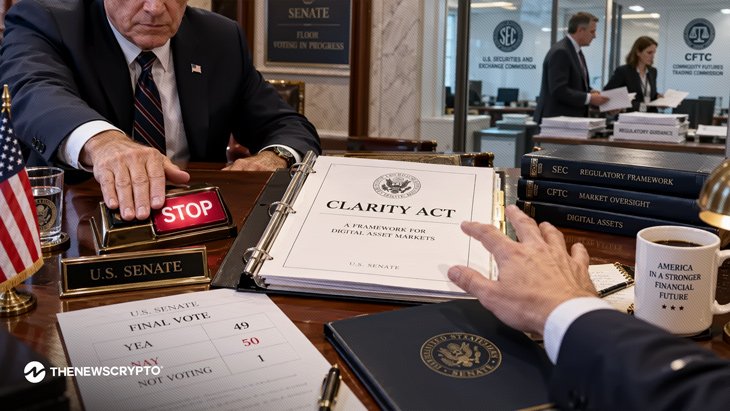
After the Senate failed a cloture vote 49-50 on September 15, 2026, blocking the CLARITY Act, former CFTC chair J. Christopher Giancarlo said U.S. crypto innovation will continue and the focus has shifted to agency rulemaking. The SEC under Paul Atkins proposed Regulation Crypto Assets in August and CFTC chair Michael Selig has ordered staff to draft market-structure rules, while industry leaders including Coinbase CEO Brian Armstrong and Ripple CEO Brad Garlinghouse urge regulator-led clarity for crypto, DeFi, DEX/CEX operations, token launches, fundraising and security.
See what traders are focused on
- The Former CFTC says SEC and CFTC efforts may still proceed following the CLARITY Act defeat.
- Following the Senate’s 49-50 cloture vote, the focus now shifts to agency rulemaking and future congressional efforts.
According to the former chairman of the CFTC, J. Christopher Giancarlo, the failure of the Senate’s CLARITY Act does not mean that innovation in crypto will be stopped in the United States. In an interview with Eleanor Terrett, Giancarlo mentioned that the regulators will still work on creating frameworks for digital assets using their existing powers. The former chairman specifically named Paul Atkins, the chairman of the SEC, and Michael Selig, the chairman of the CFTC.
Shift in Focus Post-Senate Vote to Regulators
On September 15, the Senate voted 49-50 against cloture, failing to reach the 60-vote threshold. Four Republicans voted alongside Democrats in opposition, while Senator Thom Tillis voted no as a procedural move for reconsideration purposes.
The CLARITY Act aimed at allocating the regulatory responsibilities regarding digital assets between the SEC and CFTC. The act also contained registration requirements for exchanges, brokers, and dealers. It comprised provisions pertaining to ethics limitations and Treasury powers related to the outflows of deposits by stablecoins. The Republicans introduced a new version of the bill prior to voting, stating that it was the final version. They claimed that the bill included 126 modifications suggested by the Democrats.
Industry Demands Regulation from Agencies
In response to the bill failing in the Senate, Coinbase CEO Brian Armstrong said, “We can’t wait on Congress anymore.” The chief executive explained that the SEC and CFTC currently have enough authority to formulate regulations for digital assets. In addition, Brad Garlinghouse, CEO of Ripple, called on Atkins and Selig to regulate digital assets amid Congress’s failure.
https://x.com/brian_armstrong/status/2100001040062128191
Tim Scott, the chairman of the Senate Banking Committee, separately stated that the SEC and CFTC need to create rules for digital assets until Congress passes a bill. At the same time, Senator Cynthia Lummis condemned Democrats for opposing the bill and its proposed restrictions on cryptocurrency investing by politicians.
SEC and CFTC Proceed with Individual Rules
The SEC and CFTC have already embarked on individual regulatory projects. In August, the SEC proposed Regulation Crypto Assets, which provides an individual regime for specific crypto-based investment contracts. According to Atkins, the SEC will continue its activities regardless of any legislation adopted by Congress.
Separately, Selig ordered the CFTC staff to work on market structure rules for crypto based on current CFTC powers. For months, Giancarlo has been saying that regulators can pursue U.S. crypto policies independently of Congress. The Senate vote brings additional focus to this process as Congress ponders its next step.
Highlighted Crypto News:
Robert Kiyosaki Warns Global Market Crash Has Started Amid Rising Risks
Source: cryptorank.io