

Don't want to trade it yourself?
Our desk runs DEX portfolios on profit share.
TradingKeyAuthorBlock Tao
Aug 30, 2026 3:00 PM
View all comments(0)
Over the past five years, Dogecoin experienced two bull-bear cycles, peaking at $0.73 in May 2021, driven primarily by social media buzz and celebrity endorsements. Moving forward, the asset faces short-term downward correction risks due to its lack of ecosystem applications, macroeconomic pressures, and an inflationary model adding 5 billion tokens annually. While reaching $10 over the next five years remains highly improbable given the required $1.55 trillion market cap, a potential rally to $1 by 2030 is plausible if supported by Federal Reserve monetary easing or deep integration into payment platforms.
How Has Dogecoin’s Price Performed Over the Past Five Years?
TradingKey – From 2021 to 2025, Dogecoin (DOGE) prices have experienced four stages over the past 5 years: a feverish surge, a deep bottoming out, a recovery alongside the broader <a href="https://xpertsstudio.com/bitcoin-crypto-market-pumps-on-spot-demand/” title=”Bitcoin: Crypto Market Pumps on Spot Demand”>crypto market, and another bottoming out, transitioning through two typical bull-bear cycles.
In early 2021, DOGE’s price was only around $0.005–$0.01; by May, DOGE hit an all-time high, peaking at approximately $0.73, with its total market cap briefly surpassing $80 billion. Subsequently, DOGE’s price quickly peaked and fell back, closing near $0.17 at the end of the year. From 2022 to 2023, DOGE traded sideways in a low range of $0.05–$0.10 for an extended period.
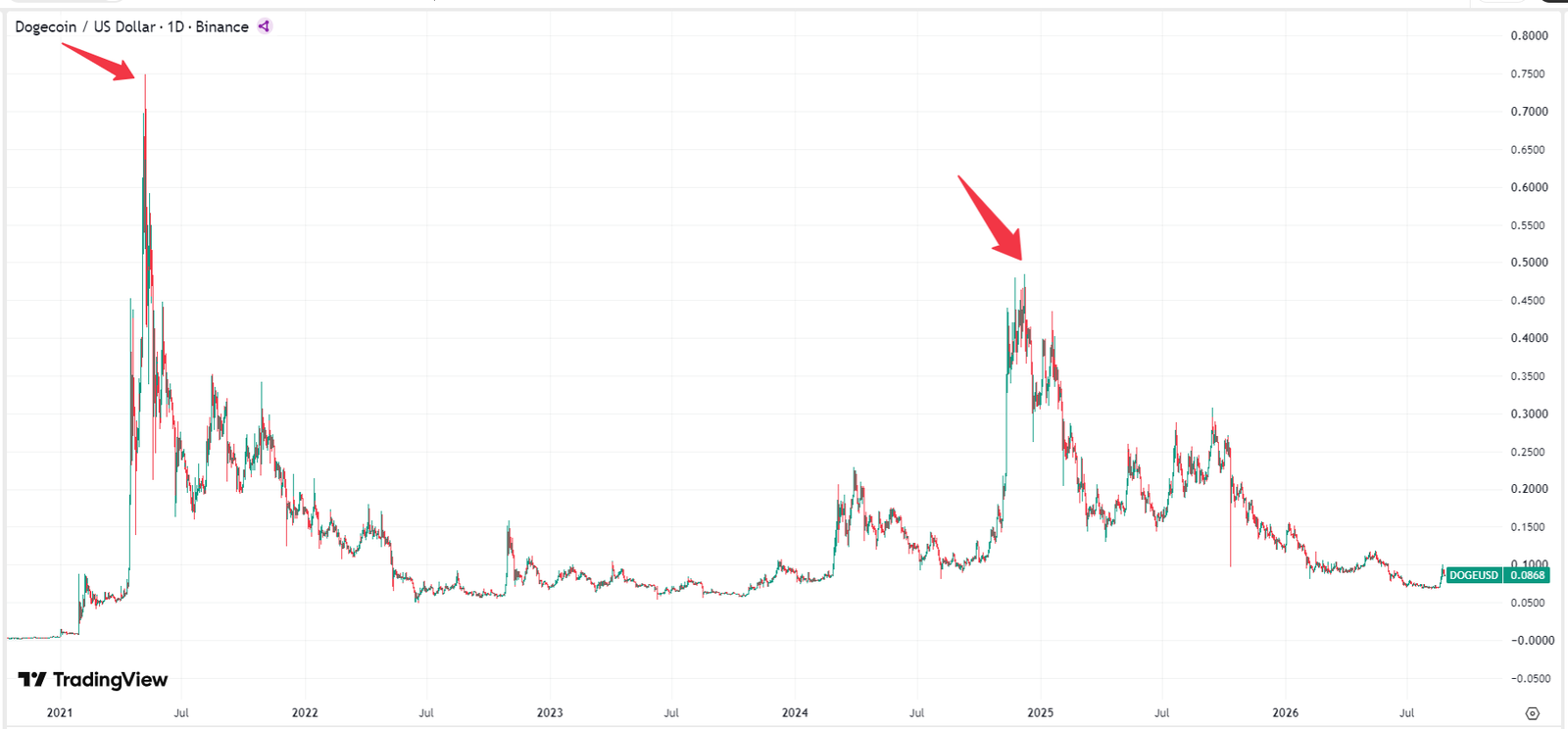
Dogecoin price chart, Source: TradingView
In 2024, the approval of Bitcoin spot ETFs and the halving effect drove a recovery across the crypto market. As the leading meme coin, DOGE rebounded to break past $0.22 at one point in the first half of 2024 before pulling back and weakening to $0.08; late in the year, it erupted again, with its price rising to near $0.5 to set a periodic high, though it failed to break the record set in 2021.
What Factors Drive Dogecoin Price Changes?
Dogecoin’s price fluctuations are primarily driven by five core factors: celebrity influence and social media buzz, practical adoption in commercial payments, broader cryptocurrency market trends, tokenomics (infinite supply), and regulation and financial products (such as ETFs).
|
The WallStreetBets frenzy intensified, combined with Elon Musk beginning to frequently tweet support. |
Surged 800% within 24 hours, breaking above $0.07. |
|
|
The hype surrounding Coinbase’s listing fueled bull market sentiment, with Musk calling DOGE the “people’s currency”. |
Soared 400% in a single week, crossing $0.45 for the first time. |
|
|
Musk appeared on SNL and called DOGE a “hustle” |
Crashed in a single day, triggering a long-term bear market correction. |
|
|
SpaceX announced it would accept DOGE to fund a lunar mission. |
Hit an all-time high of $0.7376 |
|
|
Twitter temporarily replaced its official website blue bird logo with Dogecoin’s Shiba Inu icon. |
Prices spiked about 30% intraday. |
|
|
Tesla enabled DOGE payments for select merchandise; chatter around the “Department of Government Efficiency (D.O.G.E.)” heated up after the U.S. election. |
Will Dogecoin Prices Fall Further This Year?
Dogecoin faces significant risk of downward corrections and volatile declines for the remainder of 2026, primarily determined by its asset characteristics and structural pain points. As demonstrated above, Dogecoin itself lacks ecosystem applications and relies heavily on community sentiment, Musk’s comments, and payment expectations on the X platform. Once fresh hype topics are lacking or the launch of real-world applications is delayed, speculative capital will quickly exit, causing prices to fall in a stepwise fashion.
Even more critically, Dogecoin employs a mechanism of fixed annual issuance additions of approximately 5 billion tokens. In the absence of sustained, explosive inflows of new capital, continuous selling pressure from miners will constantly dilute token value, serving as the main driver of its long-term decline. In addition, as a meme coin, when the overall cryptocurrency market faces macroeconomic pressure that causes liquidity to contract, Dogecoin’s decline is often magnified. To date, the Federal Reserve has not yet signaled rate cuts, while geopolitical conflicts support high oil prices, keeping inflation elevated and reducing the likelihood of rate cuts.
Dogecoin Price Prediction: Surge to $10 in Next Five Years Highly Unlikely
According to CoinMarketCap data, Dogecoin’s current circulating supply is approximately 155.6 billion tokens. Reaching $10 would mean its market cap needs to reach $1.55 trillion, which is equivalent to Bitcoin’s current total market cap and even surpasses the standalone market capitalization of most global tech giants, such as Tesla (TSLA), Micron Technology (MU), Meta (META), among others. However, Dogecoin’s current market cap is under $14 billion, meaning that over $1.5 trillion in net global capital would have to be injected and locked in DOGE, which is virtually impossible from a macroeconomic liquidity perspective.
In addition, Dogecoin utilizes a fixed inflation model, adding a fixed amount of over 5 billion DOGE annually. Five years from now, DOGE’s circulating supply will increase to approximately 181 billion tokens, at which point the required total market cap will further swell to $1.81 trillion, making the likelihood of its price rising to $10 even slimmer. However, the probability of Dogecoin rising to $1 by 2030 is higher, as it only needs to break its 2021 high. The conditions for this could be global central banks re-entering a massive rate-cut and quantitative easing cycle, or Elon Musk’s X platform deeply integrating DOGE as an official settlement tool for tips, subscriptions, or micropayments.
Conclusion
Over the past five years, Dogecoin has gone through two bull-and-bear cycles, driven by celebrity endorsement and community hype, and once reached an all-time high of $0.73. Due to an inflationary mechanism featuring a fixed annual issuance of 5 billion coins and the lack of a real-world ecosystem, it faces short-term pullback pressure. Constrained by the physical limits of market capitalization, reaching $10 over the next five years is extremely difficult, but a push toward $1 remains highly possible, which could be driven by Federal Reserve rate cuts and monetary easing or payment integration on the X platform.
This content was translated using AI and reviewed for clarity. It is for informational purposes only.
View OriginalDisclaimer: The content of this article solely represents the author’s personal opinions and does not reflect the official stance of Tradingkey. It should not be considered as investment advice. The article is intended for reference purposes only, and readers should not base any investment decisions solely on its content. Tradingkey bears no responsibility for any trading outcomes resulting from reliance on this article. Furthermore, Tradingkey cannot guarantee the accuracy of the article’s content. Before making any investment decisions, it is advisable to consult an independent financial advisor to fully understand the associated risks.
Like
Source: www.tradingkey.com