

Don't want to trade it yourself?
Our desk runs DEX portfolios on profit share.
Add to Google Preferred Sources
Dogecoin traded below $0.10 for most of 2026 and recently dipped under $0.07, a 90% decline from its all-time high. Yet analysts argue the token still faces significant downside risk due to weak adoption as a payment method, absence of a utility layer, and an unlimited supply that grows by 5 billion coins annually. That issuance implies roughly 3% annual dilution, which could push prices from $0.084 to $0.081 over the next year and potentially halve them over three decades. In contrast, Bitcoin‘s hard cap of 21 million coins underpins its case as a store of value, especially amid rising U.S. federal debt above $40 trillion. The structural differences between the two assets highlight why a depressed price does not necessarily make Dogecoin a bargain.
Key Elements
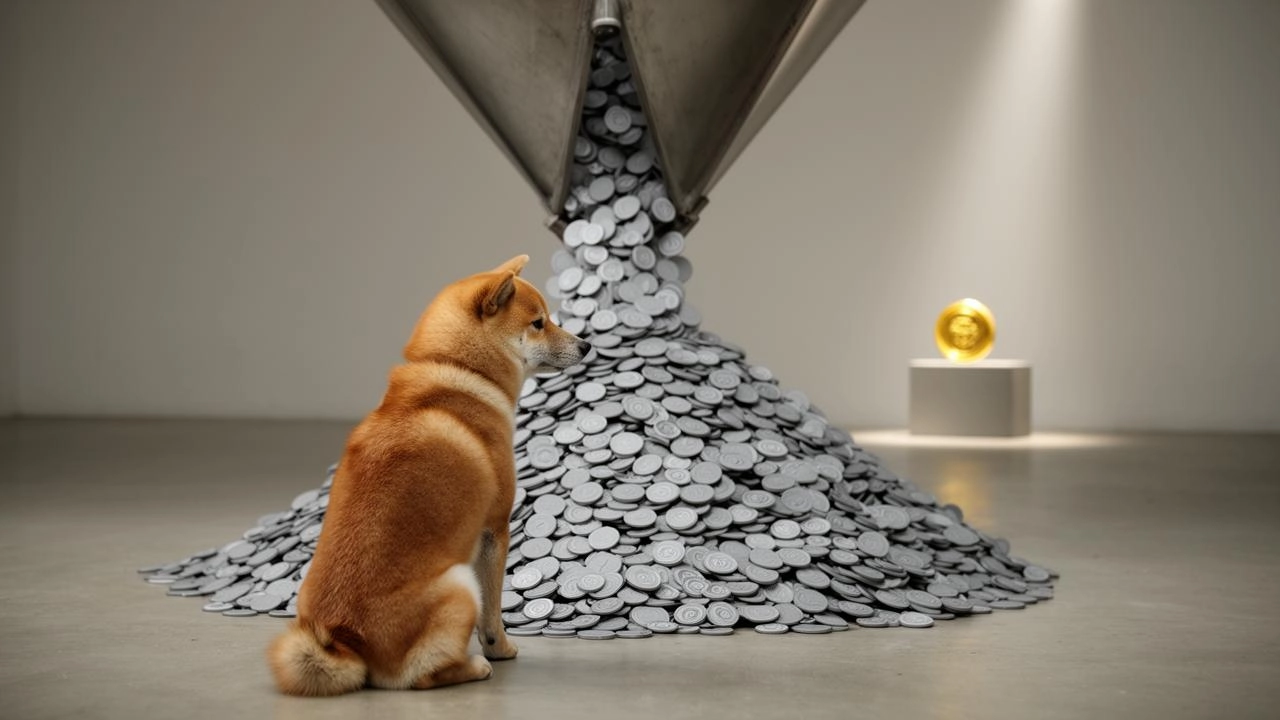
Dogecoin has spent most of 2026 trading below $0.10, recently dipping under $0.07 for the first time since 2023. That level represents a 90% discount from the meme coin’s all-time high of $0.73 set five years ago. But a beaten-down price does not automatically make a cryptocurrency cheap, and investors should think carefully before piling in.
The token was created in 2013 by two friends who thought the crypto industry was taking itself too seriously at a time when many enthusiasts believed Bitcoin was on the verge of transforming global finance. Dogecoin, by contrast, was designed with no real purpose in mind. Any upside that followed was driven almost entirely by speculation, which helps explain the steep losses that came after.
With no obvious catalysts on the horizon to support the token’s value, buying below $0.10 could still result in painful losses.
Failing as both a payment mechanism and a store of value
For any asset to appreciate over time, it needs a sustainable source of demand. Real estate prices rise because people need homes. Stocks rise because underlying companies grow revenue and earnings. Even within crypto, some projects generate genuine utility: XRP facilitates international transfers through the Ripple Payments network, while Ethereum and Solana host decentralized applications. Bitcoin, meanwhile, draws demand from investors who view it as a legitimate store of value, a kind of digital gold.
Dogecoin can technically be used for payments, but adoption remains sparse. According to crypto tracking site Cryptwerk, just 2,314 businesses worldwide accept it in exchange for goods and services. If consumers cannot spend the token at their preferred merchants, they have little reason to hold it. Unlike Ethereum and Solana, it is not tied to any platform where decentralized applications are built. And having failed to set a new all-time high in more than five years, it hardly qualifies as a reliable store of value, which rules out demand from the investment community.
Those factors alone explain why the token has struggled to trend sustainably higher. But there is another structural problem that may be even more damaging over the long run.
An infinite supply that keeps growing
Scarcity is a cornerstone of value for many assets. Gold produces nothing and has limited industrial uses, yet its price has climbed consistently over time. A major reason is limited supply: only about 220,700 tons have been extracted throughout human history, and eventually there will be none left to mine. That gives governments, central banks, and investors confidence in its ability to hold value.
Bitcoin is similarly scarce. New coins are issued through mining, a process in which computers solve complex mathematical problems to validate transactions on the blockchain. Miners are rewarded in Bitcoin, which incentivizes continued participation. Although the supply grows over time, there is a hard cap of 21 million coins that cannot be changed, making it a finite asset.
Dogecoin also uses mining to issue new coins, but it has no hard supply limit. Each year, 5 billion new coins can be mined, and there is no end date. The circulating supply will grow forever. Investment-grade assets with unlimited supply rarely, if ever, sustain long-term price appreciation.
Dogecoin currently has a circulating supply of roughly 155.6 billion coins. Adding 5 billion over the next 12 months translates to dilution of about 3%. In theory, the price per coin would need to decline by the same percentage just to keep the market capitalization flat, a plausible outcome given the lack of organic demand.
At the Aug. 21 price of $0.084, that dilution alone could push the token to around $0.081 over the next year. The longer-term picture is even starker. If 5 billion coins are mined annually, the circulating supply will double over the next 31 years, which could halve the price per coin to roughly $0.04 over the same period.
The contrast with Bitcoin is instructive. Bitcoin is trading about 41% off its peak as of Aug. 22, with sentiment depressed by concerns over quantum computing threats and a higher-for-longer interest rate environment. Yet its fixed supply of 21 million coins underpins the bull case for it as a decentralized, predictable monetary network that could challenge fiat currencies with unlimited supply. The U.S. federal debt has now surpassed $40 trillion, reinforcing the appeal of assets with hard supply caps.
| Asset | Supply Mechanism | Hard Cap | Key Demand Driver |
|---|---|---|---|
| Bitcoin | Mining | 21 million coins | Store of value |
| Dogecoin | Mining | None (5 billion new coins per year) | Speculation, limited payment use |
| Ethereum | Staking | None (fee-burning mechanism) | Decentralized applications |
| Solana | Staking | None | Decentralized applications |
| XRP | Pre-mined | 100 billion tokens | Cross-border payments |
Note: Supply figures reflect protocol designs as of August 2026.
Investors who buy Dogecoin below $0.10 should understand that an already 90% drawdown from peak does not eliminate downside risk. The combination of weak adoption, no utility layer, and perpetual supply growth creates a structural headwind that even a speculative rally may struggle to overcome in the long term.
For those looking to deploy capital into crypto in the second half of 2026, the established network effects and hard supply cap of Bitcoin present a fundamentally different risk profile. Dollar-cost averaging, such as investing $100 monthly over five months, can help manage the volatility that defines this asset class. But for Dogecoin, the math of infinite supply remains an unforgiving reality.
Once added, BigGo Finance appears first in Google Search Top Stories, so you get the broadest, most up-to-the-minute, and most comprehensive global financial news first.
Source: finance.biggo.com