


Don't want to trade it yourself?
Our desk runs DEX portfolios on profit share.
Bitcoin traded at $78,500 on September 8, 2026, after failing — again — to hold above $80,000. The $82,000 resistance level has rejected price action three times in two weeks. Five economic events are now stacking up in a nine-day window that could break the ceiling or crash through the floor.
This isn’t a typical “watch these dates” analysis. The events between September 10 and 18 aresequentially dependent— each changes the probability of what follows. Think of them as dominoes: PPI → CPI → CLARITY Act → Fed → Bank of Japan.
The Setup: Why Bitcoin Can’t Get Past $80,000
Bitcoinralliedroughly 25% in August, climbing from $63,000 to $82,000. Then it stalled. The reason isn’t technical — it’s macro.
August’s jobs report came in shockingly strong:162,000 new jobs versus 55,000 expected, with unemployment at 4.1%. A hot economy gives the Fed justification to raise interest rates — the one thing that consistently pressures risk assets like Bitcoin.
Before that jobs data, September rate hike probability sat at 34.8%. By September 8,CME FedWatch datashowed60.5%. That swing — from “probably not” to “probably yes” — is what’s keeping Bitcoin pinned below $80K.
Domino 1: PPI — September 10
What it is:The Producer Price Index measures wholesale inflation — what businesses pay for goods before they reach consumers. It’s the preview reel for CPI.
Expected:+0.3% monthly (up from 0.0% prior), with core PPI at +0.2%.
Why it matters for crypto:PPI doesn’t move markets alone, but it sets the tone. If wholesale prices come in hot, traders will price in a hotter CPI the next day. Initial jobless claims also drop September 10 (expected: 209,000 vs. 205,000 prior) — adding context to labor market strength.
Domino 2: CPI — September 11
What it is:The Consumer Price Index measures inflation at the consumer level — the number the Fed watches most closely for rate decisions.
Expected:3.4% year-over-year headline (unchanged from July). Core CPI (excluding food and energy) forecast to decline slightly to 2.4% from 2.5%.
Why this is the most important date:CPI is the last major inflation reading before the FOMC votes September 16. If headline CPI exceeds 3.4%, it virtually guarantees a rate hike. If core drops to 2.4% or below, the Fed has room to pause.
What happens to Bitcoin:According toBitfinex Alpha research, a hot CPI could push BTC to the $76,350 True Market Mean or the 200-day EMA at $72,327. A soft print opens the door to $85,000. For traders whofollow candlestick patterns, the $77,000–$82,000 range is forming a symmetrical triangle — CPI is the most likely breakout catalyst.
Domino 3: CLARITY Act Vote — September 15
This one isn’t about inflation — it’s about regulation. The CLARITY Act is the most comprehensive crypto regulatory bill to reach the Senate floor. If passed, it establishes jurisdictional rules between the SEC and CFTC, creates disclosure requirements for crypto issuers, and provides a legal framework the industry has demanded for years.
The September 15 vote is acloture motion— a procedural step requiring 60 votes just to proceed with debate. It’s not final passage. Butif cloture fails, the bill is effectively dead for 2026.
https://x.com/BSCNews/status/2097366965698363514
Market impact:Successful cloture would be bullish for the entire crypto sector, particularly US-based exchanges andtokens in staking and DeFi categories. Failure maintains the regulatory ambiguity driving crypto companies offshore.
Contentious provisions include DeFi regulations, stablecoin yield rules, and ethics restrictions on officials with crypto holdings. Senator Cynthia Lummis has incorporated over 100 compromises, but the 60-vote threshold makes passage uncertain.
Domino 4: FOMC Rate Decision — September 16
Market pricing:60.5% probability of a 25-basis-point hike to 3.75%–4.00%.
The Fed’s decision will be directly informed by CPI data from five days earlier. Fed Governor Christopher Waller has stated that “hot” inflation readings would support a hike, while continued disinflation would justify holding steady.
Why crypto cares:Higher rates increase the opportunity cost of holding non-yielding assets like Bitcoin. When Treasury bills pay 4%+, the argument for parking capital in crypto weakens. A rate hold or dovish guidance would relieve pressure on risk assets.
Here’s my personal read: the market is pricing this as a coin-flip. That uncertainty typically meanssuppressedvolatility before andexplosivevolatility after. Don’t be surprised if Bitcoin trades in a tight $78,000–$80,000 band through the weekend, then moves 5–10% within hours of the announcement. The waygeopolitical events have moved crypto in 2026— sometimes rationally, sometimes not — we should expect the unexpected.
Domino 5: Bank of Japan Rate Decision — September 18
The BOJ is expected to raise rates, with consensus probability at roughly 99%. A hike would strengthen the yen — historically correlated with risk-off moves in global markets.
This matters because of theyen carry trade. When Japanese rates are low, investors borrow yen cheaply to invest in higher-yielding assets, including crypto. As rates rise, that trade unwinds, pulling capital from risk assets. The July 2024 BOJ hike contributed to a broad crypto sell-off, and a similar move could repeat.
What the Smart Money Is Doing
Despite the uncertainty, institutional behavior tells an interesting story.Spot Bitcoin ETFs absorbed $987 millionin net inflows last week — the third consecutive positive week, with three-week totals reaching $3.8 billion. BlackRock’s IBIT alone attracted $3.575 billion over 30 days.
This isn’t retail FOMO. These are ETF flows from financial advisors and institutional allocators systematically adding Bitcoin exposure. Some flows may represent momentum-chasing — but the volume suggests institutional conviction hasn’t wavered despite the $80K rejection.
MicroStrategy (now Strategy) also bought 4,603 BTC at an average cost of $80,318 — currently underwater by about 2.4%. The company’s total holding of 845,050 BTC sits at roughly 4% profit.Michael Saylor’s “We’re Back” postsignaled another buy was coming, and the company delivered.
Three Scenarios for Bitcoin by September 19
Bear case ($72,000–$76,000):Hot CPI, confirmed rate hike, CLARITY Act cloture fails, BOJ hikes. Bitcoin gets hit from every direction — monetary tightening, regulatory disappointment, yen carry unwind. The 200-day EMA at $72,327 becomes next support.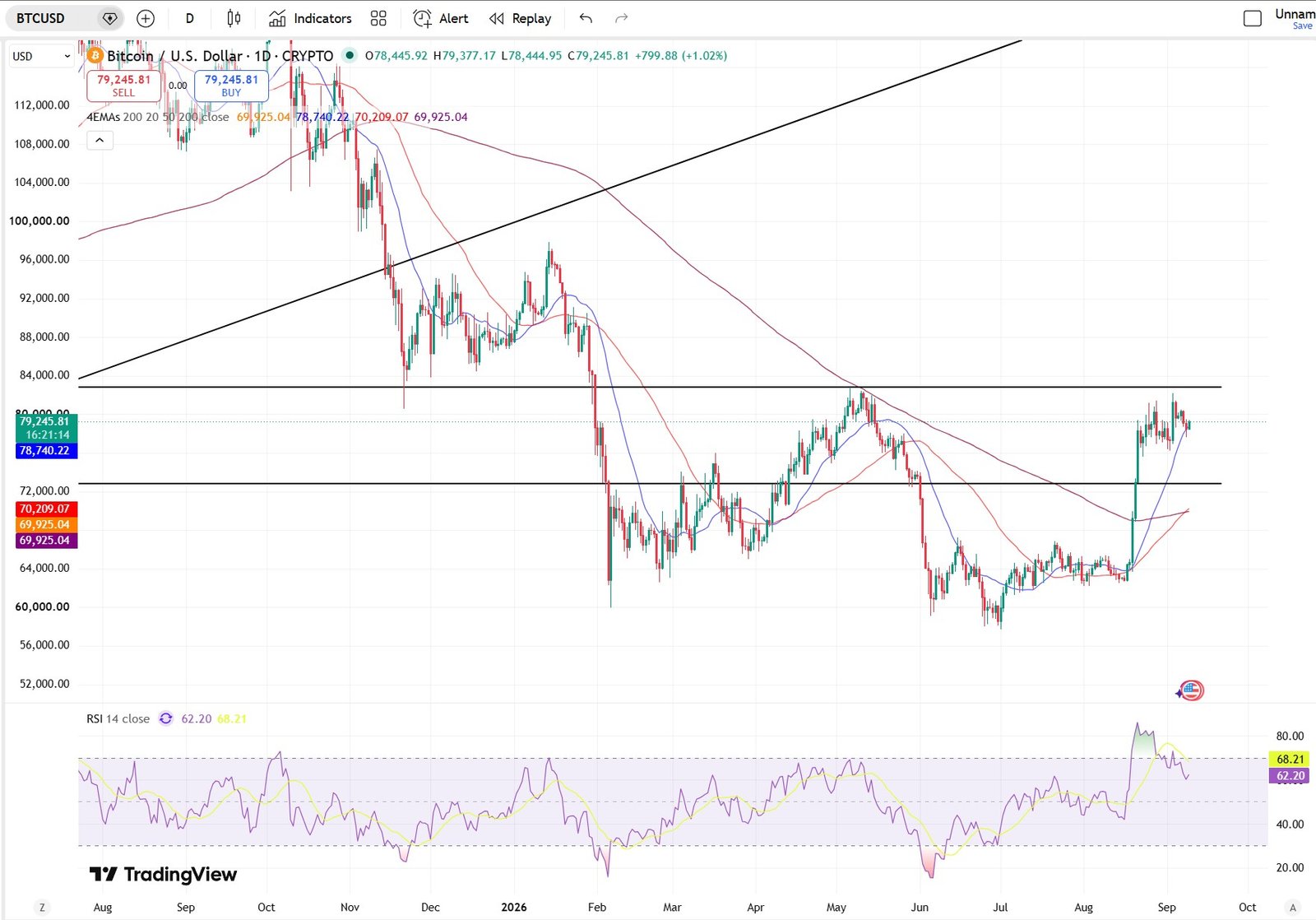
Base case ($77,000–$82,000):Mixed data. CPI at expectations, Fed hikes 25bps but signals a pause, CLARITY Act passes cloture. Bitcoin stays range-bound, with the real breakout pushed to Q4.
Bull case ($85,000–$90,000):CPI declines, Fed holds, CLARITY Act advances, BOJ holds (the 1% surprise). This would release pressure building since August, potentially triggering a move toward $90K.
My honest assessment: the base case is most likely. Markets rarely get a clean sweep of bullish or bearish catalysts. But sentiment can shift fast — we saw it withthe $2.5 trillion move after Jackson Hole— so positioning for the tails matters more than betting on the middle.
What does a Fed rate hike mean for altcoins like Ethereum and XRP?
Rate hikes pressure all risk assets, but altcoins typically drop harder than Bitcoin during tightening cycles. Ethereum traded at $2,470 on September 8, and XRP at $1.39. Both are more sensitive to liquidity conditions because they lack Bitcoin’s institutional ETF backstop.
How does the CLARITY Act affect regular crypto holders?
If passed, the CLARITY Act would establish clear rules for how cryptocurrencies are classified and regulated, reducing the risk of sudden enforcement actions. For regular holders, this means more certainty about taxes, staking rewards, and which platforms are legally compliant. It wouldn’t change how you buy or sell crypto day-to-day, but it would reduce the regulatory risk that’s hung over the market since 2022.
Is it a good time to buy Bitcoin at $78,000?
We don’t give investment advice — but we can share context. Bitcoin is down from its August peak but still up significantly for 2026. The risk-reward changes dramatically depending on this week’s data. Waiting for CPI clarity on September 11 before making moves removes one layer of uncertainty.
What are Bitcoin spot ETF inflows, and why do they matter?
Spot Bitcoin ETFs let investors buy Bitcoin exposure through traditional brokerage accounts without holding actual crypto. When ETF inflows are positive, it means new money is entering the market — typically from institutional investors and financial advisors. The $987 million in weekly inflows signals that large-money investors see current prices as attractive despite macro headwinds.
Could a single CPI report really move Bitcoin 10%?
Yes. In March 2026, a cooler-than-expected CPI triggered a 7% BTC rally in 48 hours. In June, a hot reading caused a 6% drop. With Bitcoin consolidating near resistance and a coin-flip rate hike probability, CPI has outsized power to tip sentiment either way.
Source: memeburn.com
2 Comments
Pingback: XRP ETFs Continue to See Significant New Inflows. Does That Make XRP a Buy Right Now? – xpertsstudio
Pingback: Check It Before You Buy – xpertsstudio