

Don't want to trade it yourself?
Our desk runs DEX portfolios on profit share.
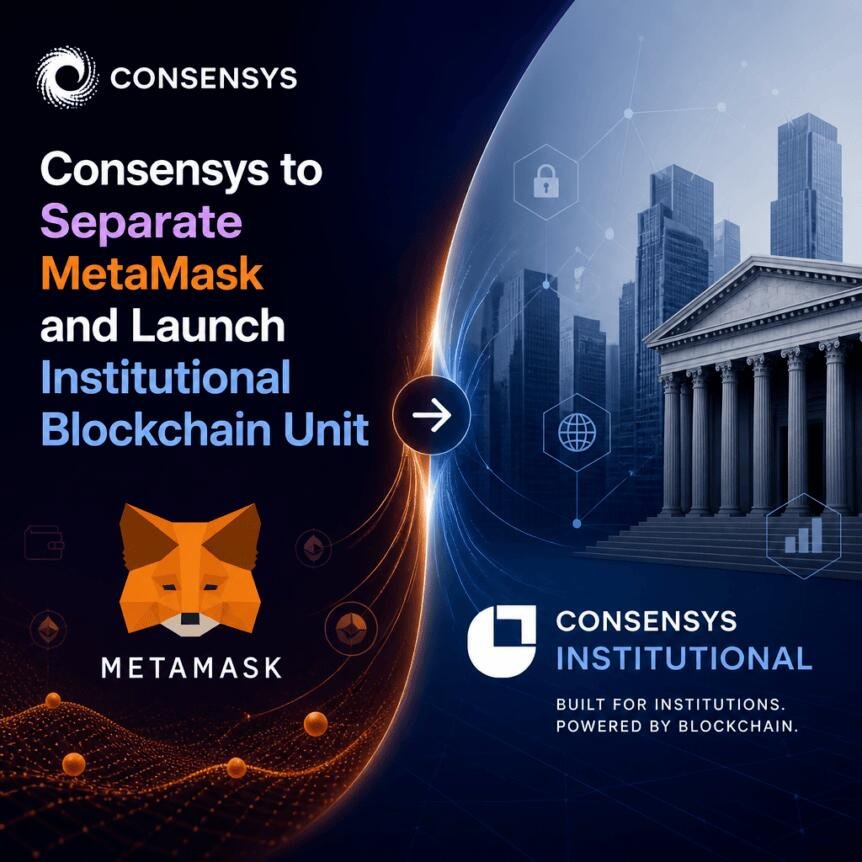
Consensys Software Inc., the <a href="https://coinstats.app/coins/<a href="https://xpertsstudio.com/xrp-outperforms-bitcoin-<a href="https://xpertsstudio.com/one-company-holds-4-9-of-ethereum-as-pepeto-takes-center-stage/” title=”One Company Holds 4.9% of Ethereum as Pepeto Takes Center Stage”>ethereum-and-solana-in-daily-crypto-etf-flows/” title=”XRP outperforms bitcoin, ethereum and solana in daily crypto ETF flows”>ethereum/” rel=”nofollow noopener” target=”_blank”>Ethereum-focused firm behind MetaMask, plans to restructure by splitting its consumer-oriented business from its institutional blockchain infrastructure operations. The company says the separation is expected to be completed by the end of 2026, creating two independent companies with distinct leadership and strategic priorities.
According to a Business Wire announcement, Joe Lubin will serve as chairman and CEO of MetaMask while also taking the role of executive chairman of the new Consensys. The institutional business—focused on Ethereum protocols and infrastructure—will be led by Mike Kriak as CEO, with David Cunningham as president.
Key takeaways
- Consensys will separate into two independent firms by the end of 2026: MetaMask (consumer self-custody) and a new Consensys (Ethereum protocols and institutional infrastructure).
- The new Consensys will house Consensys’ protocol and infrastructure portfolio, including Linea, Besu, and Teku.
- MetaMask is positioned to broaden beyond a wallet into payments, savings, investing, and other traditional financial products.
- Consensys says MetaMask has surpassed 100 million downloads across about 190 countries and supported “trillions of dollars” in transaction volume.
From one umbrella to two focused companies
The planned reorganization reflects what the company describes as increasingly different objectives between its consumer-facing and institutional-facing teams. In the announcement, Consensys frames the split as a way to allow each business to pursue its own roadmap without competing for shared priorities.
Under the new structure, MetaMask will remain the centerpiece of the consumer division, with an emphasis on self-custody. Consensys also outlined that MetaMask’s expansion is not limited to crypto holdings and decentralized app access; it is intended to extend into areas such as payments, savings, and investing, as well as “traditional financial products.”
Meanwhile, the institutional infrastructure company will consolidate Consensys’ Ethereum protocol and infrastructure activities. The company says this entity will focus on Ethereum infrastructure while supporting financial institutions looking to deploy blockchain technology for tokenization, stablecoins, and other onchain financial services.
What will live under “MetaMask” vs. “the new Consensys”
Consensys’ announcement is explicit about the portfolio split. The new Consensys entity will house the company’s protocols and institutional infrastructure businesses, including Linea, Besu, and Teku.
While the announcement does not detail whether these products will change in scope after the separation, the strategic direction is clear: an infrastructure-first company designed to work with institutions, where the customer is more likely to value deployment, reliability, and enterprise integration over consumer growth metrics.
In contrast, MetaMask’s mandate centers on consumer self-custody and product-led expansion into finance-adjacent services. The company’s messaging suggests that the consumer operation will continue to evolve from a browser extension into a broader interface for onchain and finance-related experiences, including functionality connected to stablecoins and yield strategies—while remaining within a self-custody framework.
Consensys says MetaMask has been downloaded more than 100 million times across roughly 190 countries and facilitated trillions of dollars in transaction volume.
MetaMask’s push into consumer finance features
Part of the logic behind the split appears tied to how MetaMask has expanded beyond its original “wallet for decentralized applications” role. Launched in 2016 as an Ethereum browser extension, MetaMask has added new product lines over the past year, including tools associated with payments, yield, and access to tokenized real-world assets.
In June, Consensys said MetaMask launched Money Account, which it describes as allowing users to earn up to 4% variable APY on eligible mUSD stablecoin balances. The company also stated that the yield is generated through decentralized finance lending strategies rather than interest paid by MetaMask or by the stablecoin issuer.
Earlier in the year, MetaMask added access to tokenized financial products for certain users. In February, Consensys reported support for 200 tokenized US stocks, exchange-traded funds, and commoditiesnited States
That same month, MetaMask rolled out a Mastercard-enabled spending card across 49 US states. Consensys said the card expanded a previously available product that had already reached markets including Europe, Canada, Mexico, Brazil, and Argentina.
Taken together, these updates help explain why a consumer-first business might benefit from separation: MetaMask’s expanding feature set increasingly resembles a consumer finance platform—while the institutional protocols business is oriented toward deployment infrastructure for enterprise and regulated use cases.
Why the split matters for builders and investors
Restructuring a major Ethereum software provider can matter beyond internal operations, because it shapes where rere unit may allow teams behind Linea, Besu, and Teku to focus more narrowly on scaling, tooling, and integration work relevant to financial institutions and enterprise networks
For investors and market participants, the split also provides clearer lines of accountability: MetaMask’s leadership and product execution can be assessed primarily through consumer adoption and the rollout of finance features, while the new Consensys can be evaluated on the delivery of Ethereum infrastructure services and institutional deployment outcomes.
At the same time, Consensys’ own framing highlights that the separation is not simply organizational—it is strategic. The company says the consumer and institutional businesses have “increasingly different priorities,” and the timeline suggests it expects those differences to become more consequential as each unit pursues its own growth and partnerships.
Readers should watch how Consensys handles continuity during the transition, especially how MetaMask’s expanded financial features and the institutional protocols roadmap will evolve up to the end-of-2026 completion target.
With the split planned but not yet finalized, the key near-term question is whether the product lines will remain consistent for users while each company sharpens its focus—particularly as MetaMask continues moving into payments and tokenized asset access, and the institutional unit deepens its work supporting stablecoin and tokenization initiatives.
This article was originally published as Consensys to Separate MetaMask and Launch Institutional Blockchain Unit on Crypto Breaking News – your trusted
Source: www.kucoin.com
2 Comments
Pingback: VerifiedX Raises $15 Million To Build Out Institutional Bitcoin Infrastructure – xpertsstudio
Pingback: Corn launches private members club for digital asset holders after Bitcoin L2 pivot – xpertsstudio