


Don't want to trade it yourself?
Our desk runs DEX portfolios on profit share.
Currencies38666
Market Cap$ 2.69T+5.97%
24h Spot Volume$ 68.37B+27.1%
DominanceBTC57.56%+1.63%ETH10.66%-1.87%
ETH Gas0.40 Gwei
MarketRegulationAltcoinSECCFTCTop StoriesCrypto Regulation
Aug 21, 2026
4min read
byRupam Roy
forThe Coin Republic

CFTC Chair Michael Selig warned the agency will advance crypto rulemaking under existing Commodity Exchange Act authority if Congress stalls on the Digital Asset Market CLARITY Act, and he directed staff to examine leveraged/margined trading and onchain developer compliance that would affect exchanges, DEXs, DeFi protocols and token treatment. The House passed H.R. 3633 on July 17, 2025 (294–134) and the Senate set cloture for Sept. 15, 2026, while the SEC separately proposed Regulation Crypto Assets on Aug. 18, 2026, creating near-term regulatory uncertainty that could increase compliance costs and fragment markets.
See what traders are focused on
Key Insights:
- CFTC crypto rules could advance if Congress fails to pass CLARITY.
- Michael Selig ordered staff to examine leveraged crypto trading rules.
- Senate cloture on H.R. 3633 was scheduled for Sept. 15, 2026.
Commodity Futures Trading Commission Chair Michael Selig said CFTC crypto rules could advance without new legislation. He made the remarks on Thursday during the agency’s inaugural Innovation Advisory Committee meeting in Washington.
The warning mattered because Congress had not completed the Digital Asset Market Clarity Act. Selig framed agency rulemaking as a fallback if lawmakers failed to finish the bill. That split affects exchange registration, token treatment, and developer obligations.
CFTC Crypto Rules Could Move Without CLARITY Act
Selig said the CFTC would use existing authority if the CLARITY Act continued to stall. He said staff had already begun exploring a separate framework for crypto market structures.
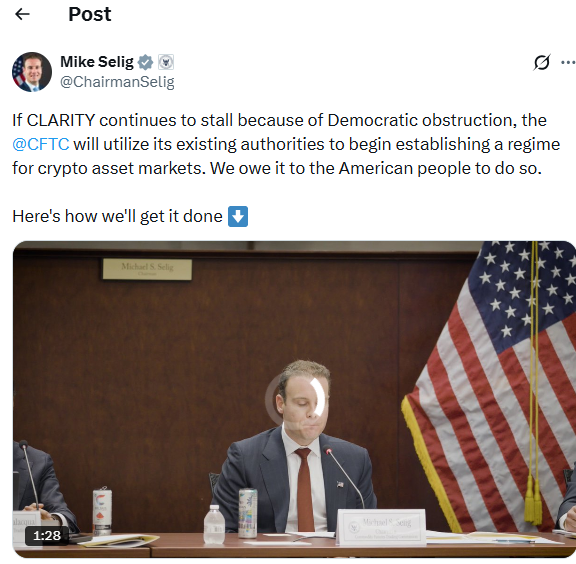
The chairman said that the framework could cover registered firms and currently unregistered crypto exchanges. Those platforms could seek designation as crypto asset markets under the CFTC’s designated contract market structure.
Selig also directed staff to examine leveraged or margined crypto trading under tailored CFTC rules. He separately asked staff to engage developers of onchain finance protocols about legal compliance routes.
The CFTC remarks stopped short of announcing a proposed rule. Selig instead described preparatory work that could produce formal proposals if congressional negotiations failed.
His comments followed a broader agency push into digital assets, artificial intelligence, and prediction markets. The CFTC established an Innovation Task Force in March to develop regulatory frameworks across those areas.
CLARITY Act Faces a Senate Procedural Test
Senate records showed Majority Leader John Thune filed cloture on H.R. 3633 on Aug. 8, 2026. The filing covered a motion to proceed to the CLARITY Act.
A cloture motion does not pass legislation by itself. It initiates the Senate process to limit debate and move toward further consideration.
Under Senate Rule XXII, cloture on most legislation requires three-fifths of senators duly chosen and sworn. With 100 Senate seats, that threshold normally equals 60 votes.
The House had already passed H.R. 3633 on July 17, 2025. House Clerk records showed 294 lawmakers supported the measure, while 134 opposed it.
Congress.gov showed the Senate received the House-passed bill on Sept. 18, 2025. The chamber referred it to the Senate Banking, Housing, and Urban Affairs Committee.
The bill would divide oversight responsibilities between the CFTC and the Securities and Exchange Commission. It also creates registration rules for digital commodity exchanges, brokers, and dealers.
The House-passed text gives the CFTC jurisdiction over covered digital commodity transactions. It also contains provisions addressing decentralized finance activities and certain blockchain developers.
Agency Authority Creates a Parallel Regulatory Path
Selig’s approach relied on powers already contained in the Commodity Exchange Act. He said those authorities could support a CFTC framework before Congress enacted broader market structure legislation.
That route would remain narrower than legislation passed by both chambers. Congress can define statutory jurisdiction and bind future regulators more directly than agency-level rulemaking.
The CLARITY Act would also require joint and separate rulemaking from federal market regulators. Its text sets deadlines for the agencies to implement multiple sections after enactment.
The Securities and Exchange Commission had already moved on a parallel track. On Aug. 18, 2026, the SEC proposedRegulation Crypto Assets under Chair Paul Atkins.
The SEC said the proposal would create exemptions for certain investment contracts involving crypto assets. It followed the commission’s March interpretation of federal securities law for digital asset transactions.
That approach showed both market regulators were developing rules while Congress debated legislation. However, neither agency proposal could replicate all statutory provisions in H.R. 3633.
CFTC Crypto Rules Now Hinge on September Senate Action
The Senate’s published schedule set the next CLARITY procedural test for Sept. 15, 2026. The cloture motion on H.R. 3633 was scheduled to ripen at 2:15 p.m.
Senate cloture records already list H.R. 3633 among pending motions filed by Thune. A successful cloture vote would allow the Senate to advance consideration of the House measure.
Any Senate amendments could send the legislation back to the House before presidential action. An unchanged Senate passage could instead move the bill directly toward the White House.
Selig said he would give CLARITY time for a vote before directing staff forward. Sept. 15, 2026, therefore, marks the next verifiable test for Congress and the CFTC.
Source: cryptorank.io