


Don't want to trade it yourself?
Our desk runs DEX portfolios on profit share.
<img src="https://xpertsstudio.com/wp-content/uploads/2026/09/image-72.png" alt="<a href="https://xpertsstudio.com/ripple-exec-says-xrp-could-flip-<a href="https://xpertsstudio.com/bitcoin-support-breaks-as-dollar-weakness-persists/” title=”Bitcoin support breaks as dollar weakness persists”>bitcoin-how-could-it-happen/” title=”Ripple Exec Says XRP Could 'Flip' Bitcoin: How Could It Happen?”>Bitcoin price reacts to August 2026 PPI” loading=”lazy”>
Bitcoin came under renewed pressure on Thursday after the latest U.S. Producer Price Index (PPI) report showed that wholesale inflation remained elevated ahead of the Federal Reserve’s September meeting.
The August PPI increased 0.4% month over month, matching economists’ expectations. However, annual producer-price inflation accelerated to 5.4% from 4.8% in July, slightly above the 5.3% consensus estimate. Core PPI, excluding food and energy, increased 0.2% month over month, while the annual rate reached 4.6%.
The market reaction was initially negative for risk assets. Bitcoin slipped toward $77,000, while U.S. Treasury yields moved higher and U.S. equities weakened.
More importantly, markets sharply increased their expectations for a Federal Reserve rate hike next week.
Bitcoin Falls as Fed Rate-Hike Odds Jump
Before the PPI release, markets were pricing roughly a 62% probability of a 25-basis-point Fed rate hike at the September meeting.
After the report, that probability jumped to around 74%, according to market pricing cited by Barron’s. The probability of at least one rate hike by October also rose to roughly 82%.
That shift matters for Bitcoin because higher interest-rate expectations can strengthen the dollar and push Treasury yields higher, reducing the appeal of riskier assets.
Bitcoin has already been struggling to reclaim the $80,000 level after briefly moving above $82,000 earlier in September. The latest macro repricing therefore adds another obstacle for bulls.
Related:US jobs report sends Bitcoin lower as Fed rate hike bets return
The PPI has now reinforced that pressure.
PPI Was Mixed, But Inflation Remains a Problem
The headline monthly number was not worse than expected.
A 0.4% increase matched the consensus forecast, meaning the report did not deliver the type of upside monthly surprise that would normally trigger an immediate inflation shock.
However, the annual figure is harder for markets to ignore.
Producer prices increased 5.4% over the past year, accelerating from 4.8% in July and exceeding the 5.3% expectation. Energy prices were a major contributor, rising 4.2% during August, while final-demand goods prices increased 1.1%.
Core PPI provided some relief. Prices excluding food and energy increased 0.2% in August, matching expectations and showing less monthly pressure than the 0.3% consensus cited ahead of the report.
That combination makes the report more complicated than simply calling it “hot.”
The monthly headline reading was in line, core inflation was relatively contained, but the annual inflation rate accelerated significantly.
Treasury Yields Are the Key Bitcoin Signal
The reaction in Treasury markets helps explain why Bitcoin struggled after the release.
The U.S. 10-year Treasury yield climbed toward 4.9%, with the yield reaching roughly 4.914% intraday, its highest level since October 2023.
Higher yields can make traditional fixed-income assets more attractive relative to speculative assets such as Bitcoin. They can also tighten financial conditions and strengthen the dollar when investors expect the Fed to keep policy restrictive.
Bitcoin consequently remains sensitive to the interaction between inflation data, Treasury yields and Fed expectations.
There was some relief later in the session as Treasury yields pulled back from their highs. The 10-year yield was reported around 4.79%, roughly five basis points lower, suggesting some bond traders viewed the PPI report as insufficient to force a more aggressive tightening outlook.
This divergence is important. It means the initial Bitcoin reaction should not automatically be treated as a lasting bearish signal.
Bitcoin Remains Trapped Below $80,000
The latest PPI data arrived while Bitcoin was already trading inside a relatively narrow range.
Before the release, BTC was hovering around $78,000, with traders focused on the $77,000-$79,000 area. Earlier in the week, Bitcoin had fallen as low as roughly $77,600 before recovering.
Technical levels remain important because the macro data has not yet produced a decisive breakout.
Bitcoin’s immediate challenge is to reclaim the $79,500 – $80,000 region. A sustained move above that area would improve short-term momentum and potentially reopen the path toward the recent $82,000 – $82,300 zone.
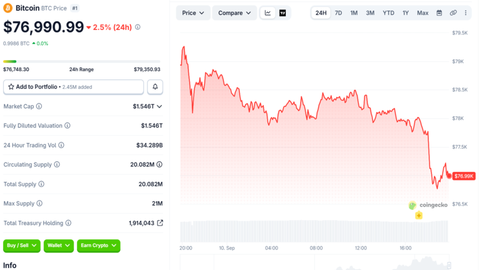
On the downside, the $77,000 – $77,600 area remains an important support region. Losing that zone could expose Bitcoin to another leg lower toward the mid-$76,000 area.
That makes Friday’s CPI release particularly important.
Friday’s CPI Could Reverse the PPI Move
The PPI report is only the first major inflation test this week.
The Bureau of Labor Statistics is scheduled to release August CPI on Friday, September 11, at 8:30 a.m. ET. The report is the more important inflation reading for markets heading into the Federal Reserve’s September 15-16 meeting.
A cooler-than-expected CPI could undermine some of the rate-hike repricing triggered by the jobs and PPI data.
If Treasury yields decline and the dollar weakens alongside softer consumer inflation, Bitcoin could regain momentum and challenge $80,000 again.
A hotter CPI would have the opposite effect.
If both PPI and CPI point toward persistent inflation, markets could further increase expectations for a September rate hike. That would create another headwind for Bitcoin and could push BTC below its current support range.
What Does the PPI Report Mean for Bitcoin?
The immediate message from the PPI report is cautious rather than decisively bearish.
Bitcoin is under pressure because annual producer inflation accelerated and Fed rate-hike expectations jumped. However, the headline monthly reading matched forecasts, core PPI rose only 0.2%, and Treasury yields later pulled back from their post-report highs.
That means Bitcoin’s next major move is likely to depend more on the combined signal from CPI, Treasury yields and Fed expectations than on PPI alone.
For now, the technical picture remains clear: $80,000 is the key upside threshold, while $77,000-$77,600 is the important downside zone.
A clean reclaim of $80,000 after CPI would suggest buyers are absorbing the macro pressure. A break below $77,000 would indicate that the inflation and rate-hike narrative is gaining control.
With the Federal Reserve meeting only days away, Bitcoin’s September recovery is entering a much more important test.
Source: www.altcoinbuzz.io