


Don't want to trade it yourself?
Our desk runs DEX portfolios on profit share.
From ‘Digital Gold’ to $10,000: Bloomberg Strategist Flags Crucial <a href="https://xpertsstudio.com/<a href="https://xpertsstudio.com/michael-saylor-emphasizes-bitcoin-as-a-global-reserve-asset/” title=”Michael Saylor Emphasizes Bitcoin as a Global Reserve Asset”>bitcoin-wallet-keys-emerge-from-radioactive-decay/” title=”Bitcoin wallet keys emerge from radioactive decay”>Bitcoin Sell Signals
Bitcoin is rapidly losing its status as independent digital gold and turning into an ordinary stock market puppet, Bloomberg Intelligence senior macro strategist Mike McGlone warns in a new review. In his assessment, its rigid correlation with U.S. equities and the inevitable tightening of Federal Reserve policy have created critical downside signals for the leading cryptocurrency, potentially sending the asset to a multiyear low.
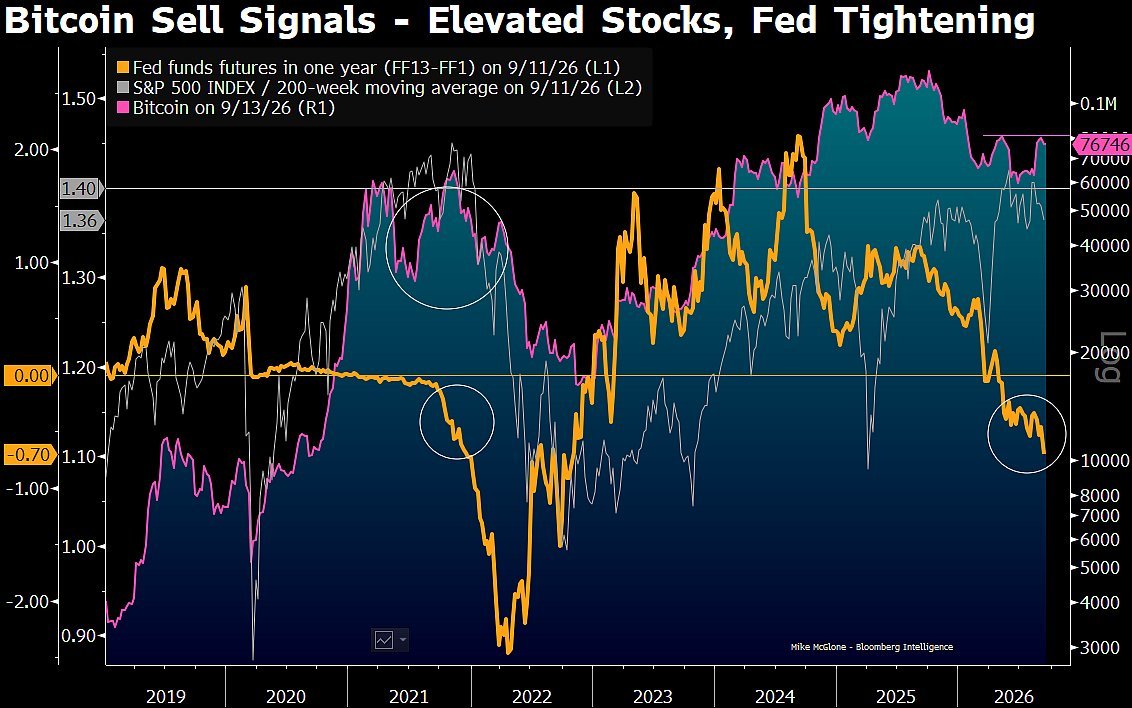
Bloomberg Intelligence’s analysis highlights three pressure factors that have activated bearish signals on the charts:
- Technical ceiling: The price rebound stalled at $76,746, failing to break above the key psychological barrier of $80,000.
- Rate factor: One-year federal funds futures (FF13-FF1) are pricing in another 70 basis points of Fed rate hikes, draining liquidity from speculative markets.
- Wall Street overheating: The S&P 500 has moved critically far above its 200-week moving average, sharply increasing the risk of large-scale profit-taking by institutional investors.
Bitcoin has become too dependent on stocks, and that is bad news
McGlone is categorical: Bitcoin no longer functions as a defensive asset. Over the past five years, its returns have merely matched those of the S&P 500, while exposing investors to nearly three times as much volatility.
From a portfolio analysis perspective, this is an inefficient trade that undermines Bitcoin’s status as a “safe haven.” The situation is further aggravated by the dilution of the industry: created in 2009 as a unique instrument, Bitcoin is now forced to carry the burden of a higher beta for millions of new altcoins, ultimately tying it to the trajectory of technology stocks.
This close relationship with Wall Street makes the crypto market vulnerable to systemic shocks. According to McGlone’s calculations, if the S&P 500 enters a natural correction phase and loses 20%, Bitcoin will inevitably plunge toward its long-term fundamental pivot in the $10,000 area.
Bitcoin can invalidate this scenario only if it proves its independence and begins to rise despite falling stocks. For now, macroeconomic indicators point in the opposite direction.
Source: cryptonews.net