

Don't want to trade it yourself?
Our desk runs DEX portfolios on profit share.
Bitcoin BTC$77,819.21 is on track to flash one of the oldest bullish signals in financial markets. While its record on predictability is mixed, the impending one has backing from the none other than USDT, the world’s largest dollar-pegged stablecoin by market value.
That signal is the golden cross. It happens when a short-term average of an asset’s price, calculated over the last 50 days, rises above the average price over the last 200 days. It indicates that recent momentum has outpaced the broader trend, often marking a prolonged shift to a bullish trend.
There is nothing mathematically special about 50 and 200 days. The windows became standard because generations of traders began watching them across stocks, bonds, commodities and, eventually, crypto.
While it’s one of the oldest and most popular bullish gauges around, it’s also widely criticized for the fact that it is based on moving averages, which lag price rather than lead it. As such, the signal often shows up after much of the move has already happened.
Mixed record
Bitcoin’s own history with the golden cross tells a messier story than a clean bullish signal.
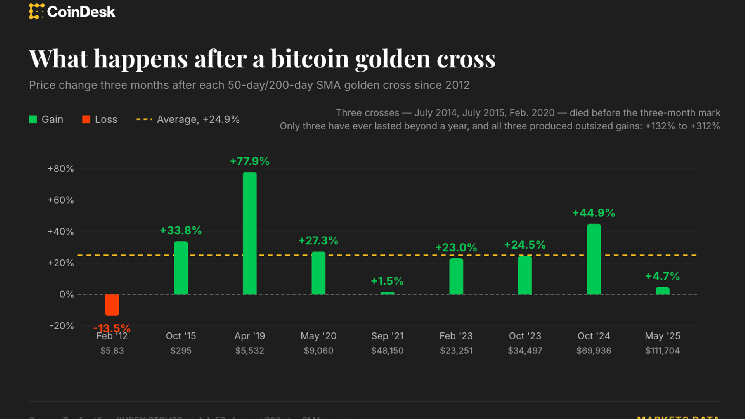
Since 2012, bitcoin has formed this exact pattern, the 50-day average crossing above the 200-day average, 12 separate times.

Three of them delivered big, sustained gains. The first, on Feb. 9, 2012, was followed by a 306% gain over the next year. One in October 2015 stayed intact for over two years and rode bitcoin to what was then a record high near $19,800 in December 2017. Another in May 2020 gained 312% over the following year, with bitcoin later touching nearly $64,900.
Others barely survived long enough to mean anything. Two separate crosses, in July 2014 and July 2015, were wiped out by an opposing death cross within two months of forming, before there was even enough time to measure a three-month return.
A few recent ones produced strong three-month gains, in some cases over 40%, only to be invalidated by a death cross well before the one-year mark. One in September 2021 barely moved at all, gaining just 1.5% before dying out a few months later, shortly before bitcoin fell more than 70% from its highs over the following year.
Add it all up, and a clearer pattern emerges. Across the nine crosses where a three-month return could actually be measured, the average gain was 24.9%. But only three of the twelve crosses survived a full year without being broken by a death cross first, and across those three, the average 12-month gain was 250%. In other words, the signal has a decent record over three months, but making it to the one-year mark intact has been the exception, not the rule.
Source: cryptonews.net