


Don't want to trade it yourself?
Our desk runs DEX portfolios on profit share.
Currencies39026
Market Cap$ 2.81T+3.36%
24h Spot Volume$ 45.89B+3.88%
DominanceBTC57.85%+0.78%ETH10.95%+1.64%
ETH Gas0.08 Gwei
MarketBitcoinAnalysisTop StoriesBtc PricePrediction
Sep 4, 2026
4min read
byRupam Roy
forThe Coin Republic
<img src="https://xpertsstudio.com/wp-content/uploads/2026/09/image_16.png" alt="Bitcoin Price Jumps After U.S. Treasury Buys Back $12.5B Debt” loading=”lazy”>
The U.S. Treasury completed a $12.5 billion cash-management buyback settling Sept. 4 that targeted one- to two-year coupons maturing Oct. 2026–Sep. 2028, and Bitcoin jumped above $80,000 to about $81,457 as traders assessed potential liquidity effects. Analysts warn buybacks retire debt rather than mirror Fed QE, while Glassnode notes overhead supply at $83,000–$86,000, a U.S. 10‑year yield near 4.8%, roughly $14 billion in options open interest into the Sept. 25 expiry and rising derivatives leverage, leaving momentum fragile ahead of a Sept. 9 buyback and the Fed meeting on Sept. 15–16.
See what traders are focused on

Key Insights
- The U.S. Treasury reportedly bought back $12.5 billion of its own debt to support market liquidity.
- The buyback drew attention because Treasury liquidity conditions can affect bond yields and broader risk assets.
- Bitcoin traders are watching whether lower yields and easier liquidity conditions could support BTC price momentum.
The U.S. Treasury completed a $12.5 billion cash-management debt buyback on Sept. 3. Bitcoin price rose above $80,000 as traders assessed the operation’s liquidity effects. The transaction targeted short-dated nominal coupons maturing between October 2026 and September 2028.
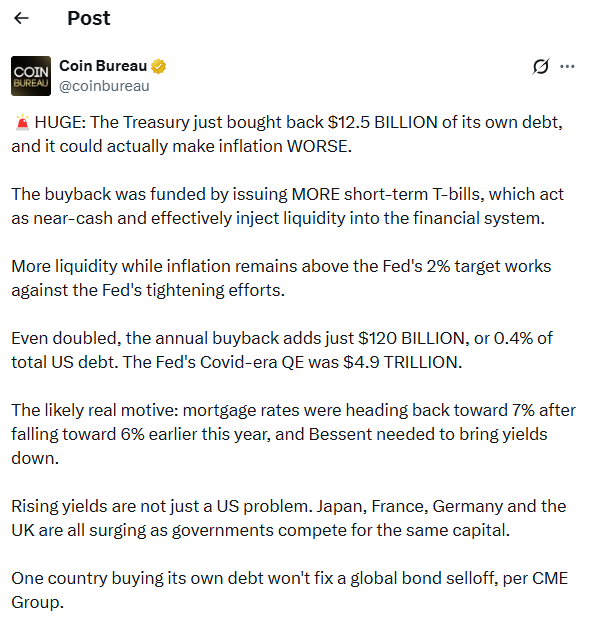
The Treasury operation mattered because buybacks can alter near-term cash and bill issuance dynamics. However, Treasury guidance describescash-management buybacks as debt-management tools, not monetary stimulus. That distinction limits direct comparisons with Federal Reserve quantitative easing.
Bitcoin Price Rises as Treasury Executes $12.5 Billion Buyback
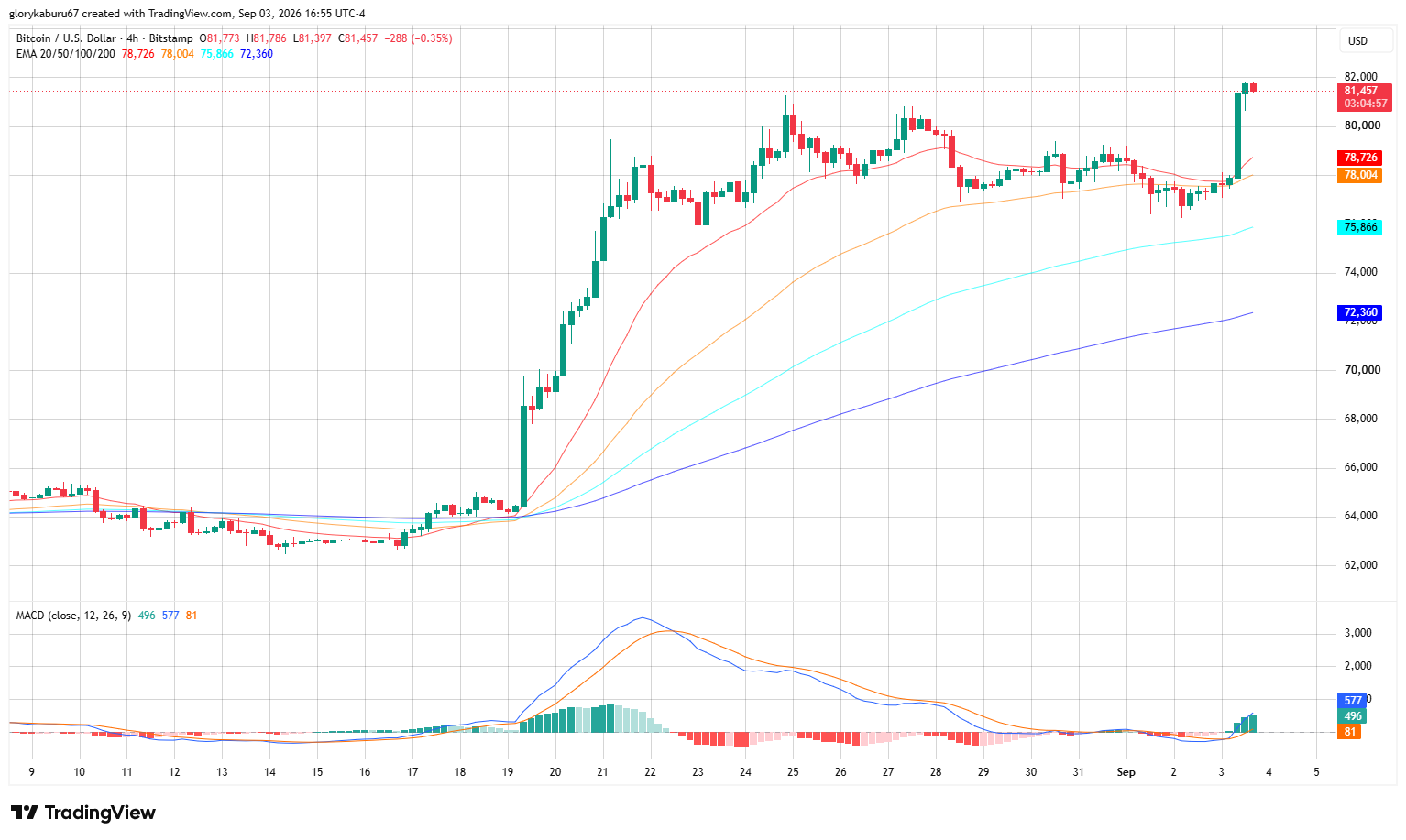
TradingView data showed Bitcoin trading near $81,457 on Sept. 3. The four-hour chart kept BTC above its 20, 50, 100 and 200-period exponential moving averages, which stood near $78,726, $78,004, $75,866 and $72,360, respectively. The Moving Average Convergence Divergence also stayed positive, with the MACD line above the signal line.
The U.S. Treasury’s August refunding schedule had already listed Thursday’s operation. It set a maximum purchase amount of $12.5 billion for one- to two-year nominal coupons. Settlement was scheduled for Sept. 4, making the transaction a planned cash-management operation rather than an emergency intervention.
CME Group’s Econoday calendar also classified the transaction as a cash-management buyback. Its data listed the same maturity bucket and purchase ceiling. Treasury uses these operations to manage cash balances and reduce disruptions around large financing flows.
Treasury documentation also rejects a broader liquidity interpretation often attached to buybacks. Program guidance states that purchased securities are retired after settlement. The department also treats buyback spending as another
That means the transaction does not mirror Federal Reserve asset purchases. Quantitative easing expands the central bank’s securities holdings and reserves. Treasury buybacks instead retire selected debt while financing requirements remain within the government’s broader issuance program.
Bitcoin Price Faces $83,000 Supply Zone Despite Liquidity Narrative
Glassnode researcher Frederik Theissen wrote on Sept. 2 that Bitcoin had stalled below overhead supply. Glassnode placed that supply band between $83,000 and $86,000 after August’s short squeeze. The firm also said the U.S. 10-year Treasury yield had climbed to 4.8%.
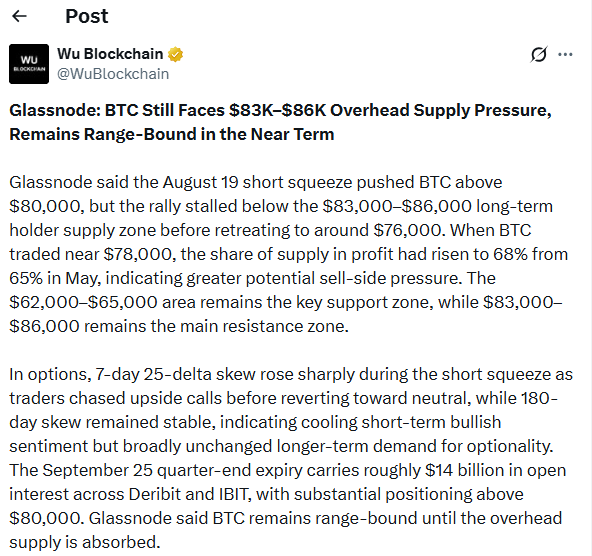
Bitcoin’s move above $80,000 therefore returned price toward a previously identified resistance area. Glassnode said higher sovereign yields remained an important driver of global discount rates. That relationship keeps Treasury-market conditions relevant for risk assets.
The same research found 68% of Bitcoin supply sat in profit during the latest May-level retest. That compared with 65% during the earlier test. Glassnode interpreted the difference as a heavier potential sell-side supply after summer redistribution.
The technical picture, therefore, remained mixed after Thursday’s rebound. Price recovered the psychological $80,000 level, but overhead supply remained close. A sustained move through the Glassnode band would require stronger spot demand than a short-lived macro reaction.
BTC Crypto Derivatives Leverage Builds
TradingView data showed Bitcoin trading below $78,000 on Sept. 2 before accelerating higher the following day. The four-hour chart showed BTC holding above its short-term moving averages as momentum improved. Bitcoin then advanced toward the $81,000 area on Sept. 3, confirming a stronger breakout from the prior session’s range.
Those figures showed leverage remained active during the rebound. Rising open interest can amplify either direction when prices approach heavily traded zones. It does not establish that Treasury operations caused the rally.
Glassnode’s Sept. 2 report also found short-dated options positioning had cooled from August’s squeeze. Seven-day options skew returned toward neutral after traders previously chased upside calls. The firm said demand for longer-dated options remained steady.
That derivatives reset reduced evidence of extreme near-term bullish positioning. Still, September options exposure remained concentrated above $80,000. Glassnode estimated roughly $14 billion in open interest across Deribit and BlackRock’s IBIT around the Sept. 25 expiry.
Fed Meeting and Treasury Operations Set Next Catalyst
Federal Reserve Governor Christopher Waller said Sept. 3 that inflation remained above the Federal Open Market Committee’s 2% goal. He said improving inflation data could support holding rates at the Sept. 15–16 meeting. A renewed inflation setback could support another rate increase.
Treasury’s next scheduled cash-management buyback was set for Sept. 9, with another $12.5 billion ceiling. The department also plans larger long-end liquidity-support operations beginning that date. Bitcoin traders now face overlapping Treasury flows, inflation data and Federal Reserve policyexpectations.
Source: cryptorank.io