


Don't want to trade it yourself?
Our desk runs DEX portfolios on profit share.
The Bitcoin price has surged 24% in August, with Standard Chartered targeting $100,000 and Bernstein $150,000 as institutional flows revive the bull case.
The Bitcoin to US Dollar (BTC/USD) exchange rate jumped back towards $78,600 on Monday after one of its strongest weekly advances in years, putting the cryptocurrency within touching distance of $80,000.
Bitcoin has gained 23.7% in August and reached $79,176 at its monthly high, a dramatic reversal from the sub-$63,000 levels seen little more than a week ago.
The rally has also reopened a forecast debate that looked rather fanciful when Bitcoin was languishing around $60,000 earlier this summer.
Standard Chartered still sees $100,000 by the end of 2026, Bernstein is sticking with a much more aggressive $150,000 target, while Citi’s more cautious 12-month base case stands at $82,000.
What has changed rather abruptly is the flow picture.
The US Treasury’s decision to expand purchases of longer-dated government bonds helped weaken the Dollar and revive the idea that Bitcoin can trade as a hard asset when confidence in conventional policy comes under pressure.
Standard Chartered’s Geoff Kendrick called the Treasury move “exactly the type of thing Bitcoin loves” and now says there is a risk that the bank’s $100,000 year-end forecast is actually “too low”.
That is quite a shift in tone for a target which, only a few weeks ago, still required a very substantial recovery.
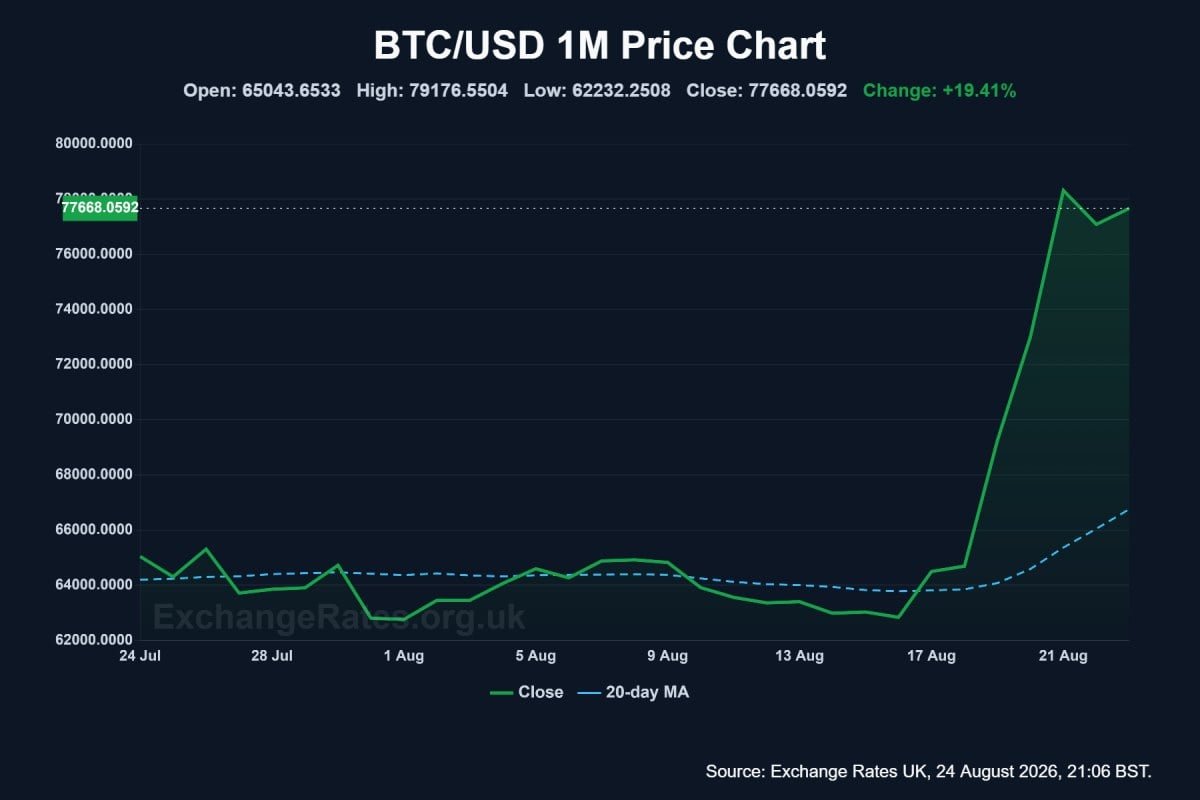
Bitcoin’s one-month advance has accelerated sharply since 18 August, with BTC/USD breaking above its rising 20-day moving average and reaching almost $80,000 before consolidating.
Bitcoin Forecast: $100,000 Is No Longer the Bullish Extreme
Standard Chartered’s target would imply a return towards the psychologically important six-figure threshold, although it would still leave Bitcoin below the October 2025 record above $126,000.
Kendrick’s confidence reflects more than the latest short squeeze.
A softer Dollar, greater expectations of policy support and Bitcoin’s fixed supply all strengthen the debasement argument when investors become uneasy about government debt and monetary credibility.
We saw the reverse of this relationship in our June coverage of the Dollar surge, when higher US yields and a stronger Greenback hit Bitcoin alongside gold and silver.
The Dollar has since lost much of that support, and we have seen the same shift help revive the bullish case for gold as investors again look towards alternative stores of value.
Bernstein’s forecast goes considerably further.
Analysts led by Gautam Chhugani retain a $150,000 year-end Bitcoin target, although the bank itself has called that forecast “ambitious” following the deep correction from last year’s record.
Bernstein argues that the underlying institutional-flow picture was not quite as disastrous as bearish sentiment suggested.
Corporate treasury purchases partly offset ETF redemptions during the downturn, while Bernstein believes forced selling from Strategy remains unlikely.
The target would require Bitcoin to almost double again from current levels in just over four months, so there is not much room for another prolonged period of consolidation.
Still, the rally has at least moved $150,000 out of the realm of pure arithmetic fantasy and back into the discussion.
Citi’s $82,000 Forecast Faces an Interesting Test
Citi sits at the cautious end of the institutional spectrum.
The bank cut its 12-month Bitcoin base-case forecast from $112,000 to $82,000 in July after assuming net ETF inflows would effectively disappear.
Its bull scenario stands at $108,000, while a recessionary bear case combined with continued ETF withdrawals would put Bitcoin around $53,000.
The curious part is that one of Citi’s central bearish assumptions has already started to change.
US Bitcoin ETFs recorded five consecutive days of inflows last week, with almost $2bn returning to the products.
Citi analyst Alex Saunders said “ETF flows remain the key catalyst to watch”, adding that their resumption is critical for a sustained rally.
With Bitcoin now around $78,600, Citi’s $82,000 base case offers relatively little upside from current levels.
If ETF demand continues to rebuild, the more interesting comparison may soon be Citi’s $108,000 bull scenario rather than its base forecast.
Bitwise: New Bitcoin Bull Market May Be Intact
The latest institutional flow data offer some support for that argument.
Bitwise’s latest Crypto Market Compass estimates that global Bitcoin investment products attracted almost $1.96bn last week, including roughly $1.89bn into US spot Bitcoin ETFs.
The asset manager also highlights an unusually important technical change.
Bitcoin has reclaimed its short-term-holder cost basis, 200-day moving average and True Market Mean in rapid succession.
“As long as bitcoin holds above these key pricing levels, we think that a new bull market is likely intact,” the Bitwise research team said.
There is a short-term catch.
Bitwise’s sentiment indicators have moved rapidly into stretched territory, and the firm’s Crypto Fear & Greed Index is near levels previously associated with major peaks.
The bank therefore sees room for a pullback or consolidation even while retaining the broader constructive view.
That feels fairly plausible after a move of more than 20% in a handful of sessions.
VanEck’s Capitulation Signal Arrived Just Before the Rally
VanEck’s research provides another useful piece of the puzzle.
Only days before Bitcoin exploded higher, the asset manager found that eight of its 12 capitulation indicators were flashing, with researchers describing the market as “nearing or currently in an accumulation phase”.
That call was based partly on the duration of Bitcoin’s correction, which was approaching the length of previous bear-market transitions.
The subsequent rally does not prove that the correction is finished, but the timing is difficult to ignore.
Naeem Aslam at Zaye Capital Markets argues that Bitcoin is increasingly trading as both a risk asset and a hedge against fiscal and monetary uncertainty.
The next phase, he says, needs genuine spot demand rather than simply traders being forced out of short positions.
IG’s Chris Beauchamp reaches a similar conclusion, noting that “the beginnings of an inflow revival are in play” but stressing that institutional demand must persist for the recovery to extend.
That probably leaves flows as the cleanest test of the rally.
Bitcoin can be followed against Sterling on our live BTC/GBP price and conversion page, alongside the BTC/USD market above.
Bitcoin Price Outlook: $82,000, $100,000 or $150,000?
There is no genuine institutional consensus here.
Citi’s $82,000 base case implies that much of the recovery has already happened, although its $108,000 bull scenario leaves substantial upside if ETF demand continues.
Standard Chartered’s $100,000 target now sits somewhere near the middle of the debate, and Kendrick is openly suggesting it may prove too conservative.
Bernstein’s $150,000 forecast remains the outlier, requiring a much more powerful second-half bull market.
The encouraging signal for Bitcoin bulls is that the debate has shifted very quickly from whether $60,000 could hold to whether $80,000 is merely another staging point.
After a 24% August rally, chasing price is a different proposition from buying capitulation.
But if ETF inflows persist and Bitcoin continues to hold the technical levels reclaimed last week, the six-figure forecasts have suddenly become much harder to dismiss.
Source: www.exchangerates.org.uk