


Don't want to trade it yourself?
Our desk runs DEX portfolios on profit share.
Choosing a Web3 social platform in 2026 means choosing between architectures that barely resemble each other.
- Bluesky leads decentralized social on scale, without using a blockchain.
- Farcaster changed operators twice within eight months as revenue fell.
- Aave handed Lens to Mask Network and refocused on DeFi.
- Portable identity is the feature centralized platforms cannot copy.
Bluesky runs on a federated protocol with 41.4 million registered accounts and no chain underneath it. Farcaster settles accounts on Optimism, reported 250,000 monthly users in December, and has been sold once and put up for a new operator again since January. Lens moved from Aave to Mask Network in the same week and now runs on its own Layer 2 with stablecoin gas. Nostr has no company behind it whatsoever. The differences matter more than the shared label does.
In January, infrastructure firm Neynar took over the Farcaster protocol from Merkle Manufactory, whose founders announced they would return $180 million in venture funding to investors; days earlier, Mask Network assumed stewardship of Lens Protocol as Aave Labs moved into an advisory role. Bluesky, meanwhile, kept adding accounts at a pace none of the blockchain-native projects came close to matching. Anyone choosing a platform now is choosing between very different things: an open protocol with a small but committed developer base, a federated network with real scale, and a set of publishing tools that survived the last cycle.
Your followers live in a database you do not control
The distinction between protocol and client matters more here than in any other corner of crypto. On X or Instagram, your identity, your followers and your posts sit in one company’s database, and losing the account means losing all three. Farcaster, Lens and the AT Protocol behind Bluesky split those layers apart. Your account and social graph live on a network, and the app you open is only a client reading from it.
Switch clients and your followers come with you. That is the entire argument, and every other feature in this category is downstream of it.
Vitalik Buterin has said that every post he made or read in 2026 went through Firefly, a multi-client that supports Lens, Farcaster, X and Bluesky at the same time. The trade-off is that nobody is obliged to keep any particular client running.
Bluesky has 41 million accounts and no blockchain
Bluesky is the outlier on scale and the outlier on definition. It runs on the AT Protocol, an open federated standard, with no token and no on-chain component, which puts it technically closer to Mastodon than to Lens. Purists exclude it from Web3 entirely. Users do not appear to care.
The platform ended 2025 with 41.41 million registered users, up nearly 60% across the year from 25.94 million, and users created 1.41 billion posts during 2025, representing 61% of everything ever published on the network. Daily active users reached roughly 4.5 million by January 2026. That works out to around 10 to 11% of registered accounts showing up on a given day, which is the honest number to watch. Registrations spike on news events and then flatten. Bluesky does not publish a daily active user figure itself, so that number comes from third-party trackers and should be read as an estimate.
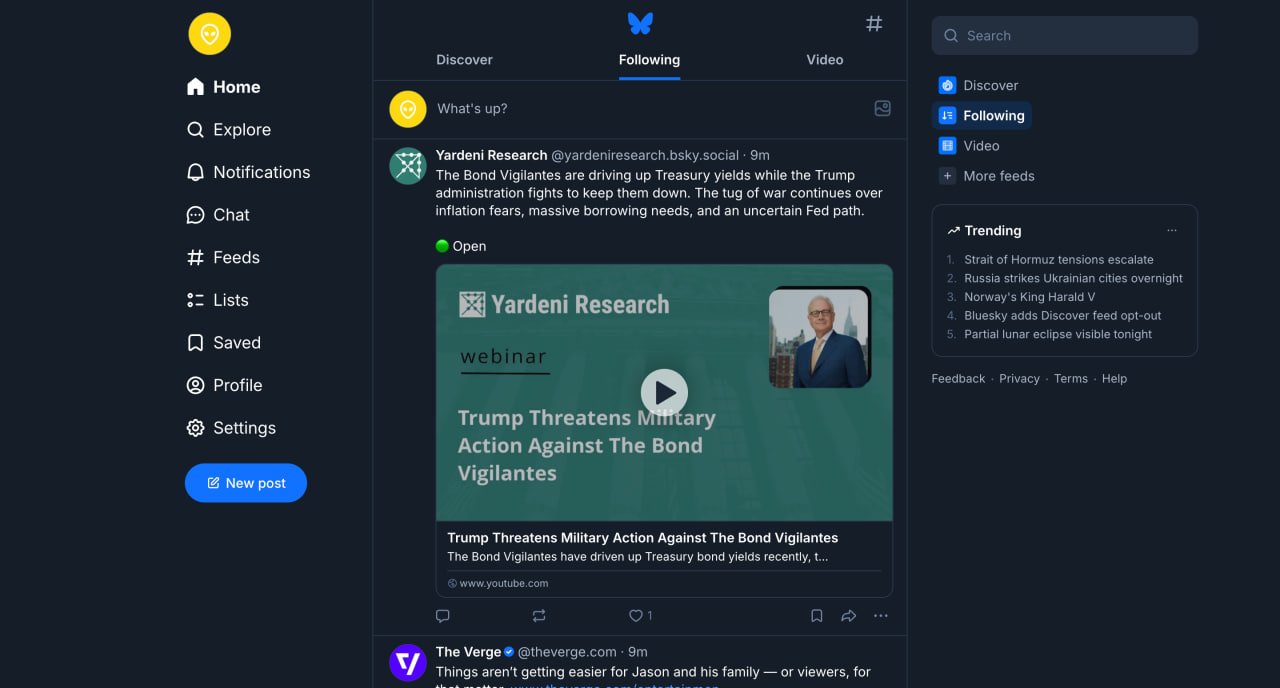
Funding is not the constraint. Bluesky raised $100 million in a Series B in April 2025, taking total funding to $123 million. Moderation load is the constraint: users filed 9.97 million reports in 2025, a 54% increase over the prior year, and the platform carried out 2.08 million account takedowns.
- Custom feeds: subscribe to algorithms other users build instead of one house algorithm
- Labelers: third-party moderation services you opt into per account
- Own domain as handle: verify yourself by pointing a DNS record at your profile
- Self-hosting: run your own personal data server and keep your repository
- No token, no wallet, no gas: signup is an email address
Farcaster survived its own billion-dollar valuation
Farcaster is the most technically interesting project in the category and the clearest cautionary tale. Founded by two former Coinbase executives, it registers accounts on Optimism, syncs data through Snapchain and shares one social graph across every client built on it. Merkle Manufactory raised close to $180 million and hit a $1 billion valuation.
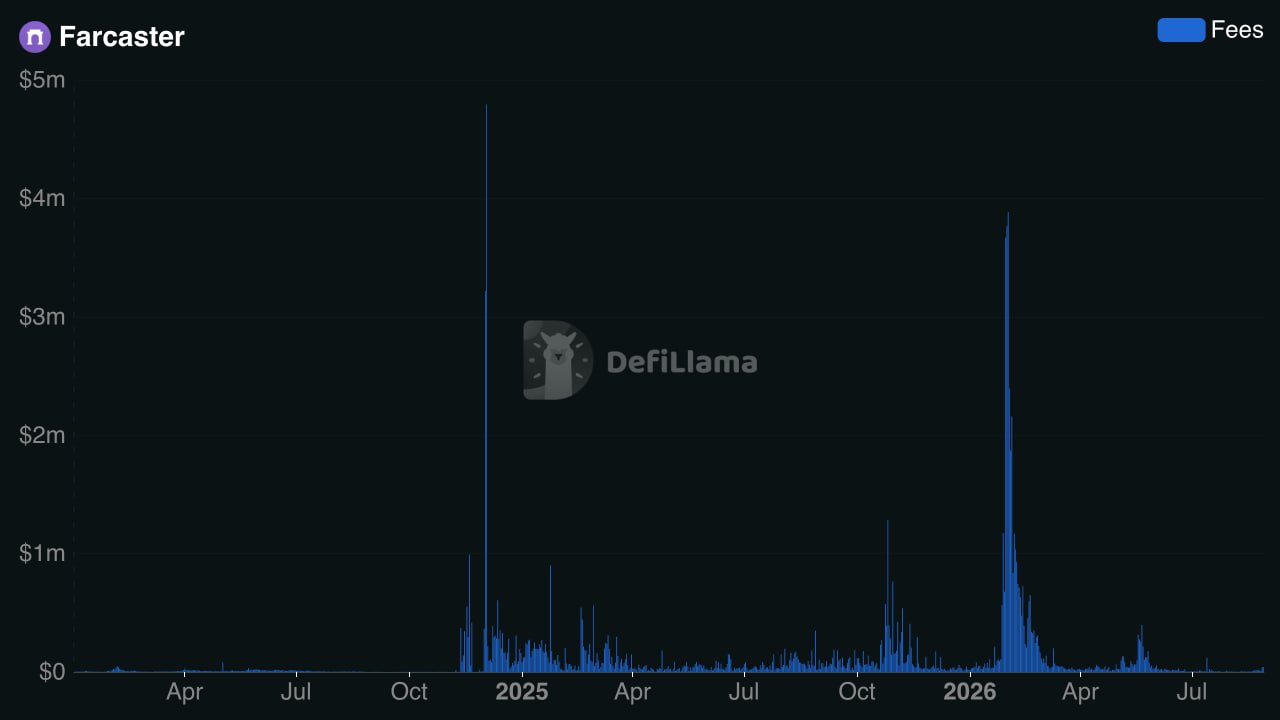
Then growth stopped. Dan Romero cited 250,000 monthly active users in December and more than 100,000 funded wallets while confirming the protocol was not shutting down. Protocol earnings for the fourth quarter of 2025 came to $1.84 million, down 85% year over year.Neynar, an infrastructure startup that had itself raised roughly $14 million, took over the contracts, repositories, app and the Clanker token launchpad.
Less than seven months after the acquisition, Neynar started a process to find a new home and team to run Farcaster and Clanker, with DeFiLlama showing roughly $27.88 million in gross protocol revenue during the first quarter of 2026, most of it Clanker trading fees rather than social activity, and a sharp decline since. The protocol still works. Its commercial ownership is unsettled.
- Mini Apps: full applications rendering inside a post, formerly called Frames
- Channels: topic-based rooms that work like subreddits over the same graph
- Storage rent: accounts pay to keep casts stored rather than paying per post
- Farcaster Pro: $120 per year for longer casts, extra embeds and priority placement
- Multiple clients: the official app, Supercast and Firefly all read the same account
- No native token as of 2026, and the founding company is repaying investors in full
Lens changed hands from a DeFi team to a social team
Lens spent years as a side project of the people who built Aave. That ended in January. Stani Kulechov confirmed that Aave’s role narrows to technical advisory support while Mask Network leads the product roadmap, user experience and daily operations for Lens-based apps. The transition moved no ownership, intellectual property, treasuries or governance control, and the on-chain social graph, profiles, follows and smart contracts stay open-
Technically, Lens is now its own chain rather than a Polygon deployment. Lens Chain is an EVM-compatible Layer 2 using the ZKsync stack with GHO as native gas, delivering sub-cent average transaction costs, and its activity is weighted toward posts, follows and collects rather than DeFi. Account abstraction supports signless and gasless smart accounts, with onboarding through email and phone verification.
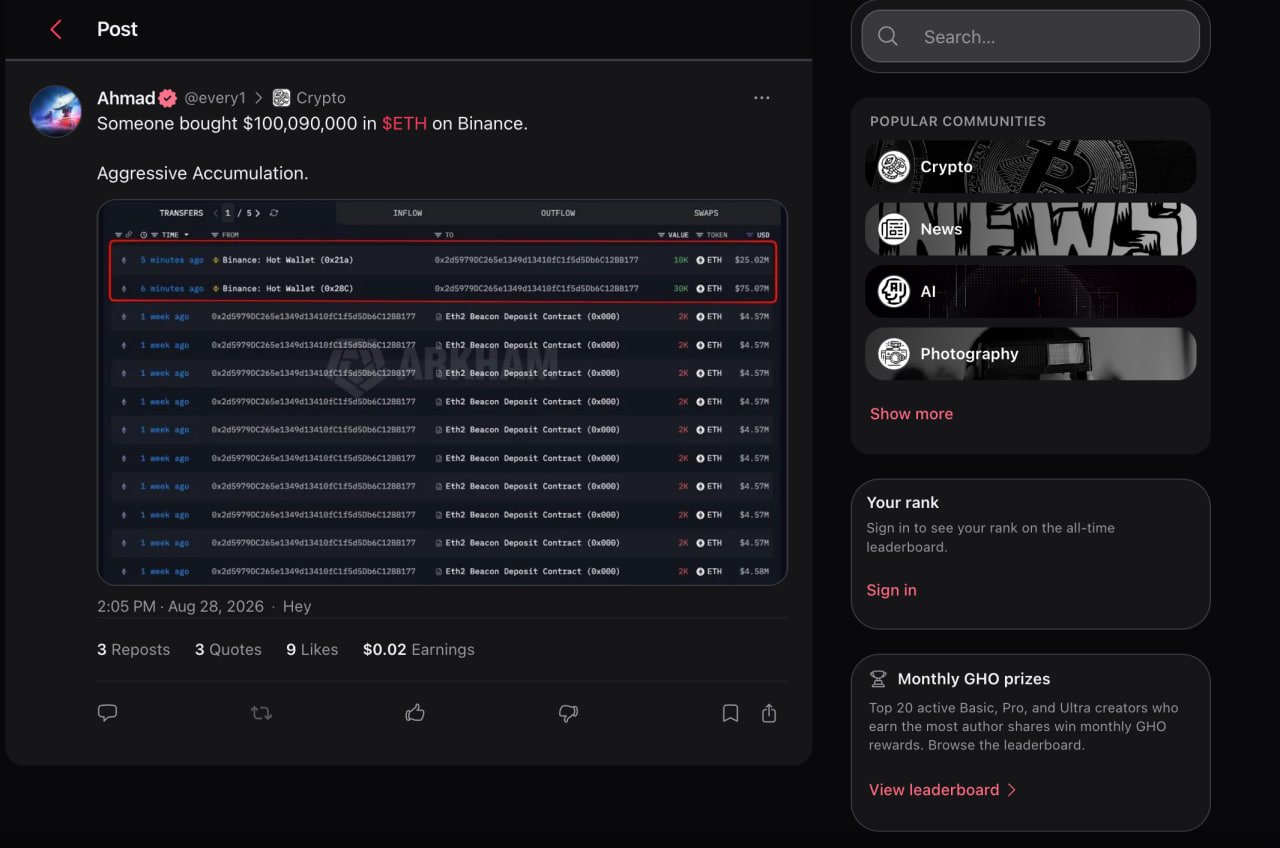
Earnings display next to likes and reposts, which is the clearest statement of intent any of these platforms makes. It is also a fair picture of the current scale: a post with a few dozen interactions earns cents, not dollars. The project has raised $46 million in total, including a $31 million round led by Lightspeed Faction.
- Open Actions: arbitrary smart contract calls attached directly to a post
- Collects and rewards: readers mint a post at a price the creator sets, and top creators earn monthly GHO payouts
- Modular primitives: Accounts, Feeds, Graphs and Groups that developers combine with Rules
- Stablecoin gas: fees are paid in GHO, so costs do not swing with a volatile token
- Client choice: Hey, Orb and Firefly all read the same profile and follower list
Nostr keeps working because it asks the network for almost nothing
Nostr is the minimalist entry in this list and the one most often left out of roundups. There is no chain and no company. Identity is a key pair, posts are signed events, and relays are simple servers that store and forward them. A user imports the same key into Damus, Amethyst or Primal and keeps the follower list and post history intact, verified by signature rather than by an export file.
That design buys real censorship resistance at a cost the numbers reflect. The network is small, the culture skews heavily toward Bitcoin, and spam filtering depends on web-of-trust tooling that varies by client. Development through early 2026 focused on plumbing rather than growth: remote signing support, and a migration away from the deprecated NIP-04 direct message standard toward better-encrypted alternatives.
- Zaps: Lightning payments attached to posts, functioning as the native tipping layer
- Relay choice: publish to several relays at once so no operator can silence you
- Key-based identity: one npub works across every compliant client
- Clients: Primal for most people, Damus on iOS, Amethyst on Android, Coracle for tinkerers
- Real risk: lose the private key and the identity is gone permanently
Mastodon runs on donations, and the growth curve shows it
Mastodon predates all of this and outlasted several better-funded rivals. It has also stopped growing. The network counts over 10.5 million registered accounts across more than 10,000 independent servers, with roughly 750,000 to 1 million monthly active users, well below the 2.6 million peak recorded in November 2022. Governance changed in the meantime: Eugen Rochko stepped down as CEO in late 2025, Felix Hlatky took over as executive director, and the project restructured into a board-governed nonprofit.
For publishers and institutions that want federation without a wallet, it remains the least complicated option available.
The smaller platforms still worth a line
Mirror
Long-form publishing with entries archived to Arweave. Readers mint essays as collectibles instead of paying a subscription. Closest thing the category has to a durable creator model.
Hive
The community fork that split from Steemit in 2020 and now carries most of the remaining activity. Upvote-to-earn rewards, blog-length posts, an audience that never left.
Zora
Posting as minting. Every upload becomes a tradable coin on Base, which makes it a media feed and a market at the same time, with all the volatility that implies.
Firefly
Not a network but a client that reads Lens, Farcaster, X and Bluesky in one timeline. The practical answer for anyone who does not want to pick a side yet.
| Platform | Scale | Wallet |
|---|---|---|
| Bluesky | 41.4M accounts | Not needed |
| Farcaster | 250K monthly | Built in |
| Lens | Not published | Abstracted |
| Nostr | No central count | For zaps |
| Mastodon | Under 1M monthly | Not needed |
| Mirror | Niche | Required |
Two protocols, two owners, five days apart
● JANUARY 20, 2026
Aave hands Lens stewardship to Mask Network and narrows its own role to technical advice. Ownership, IP and governance stay where they are.
● JANUARY 21, 2026
Neynar acquires Farcaster from Merkle Manufactory, taking the contracts, repositories, app and Clanker.
● JANUARY 22, 2026
Merkle confirms it will return roughly $180 million to venture backers. Romero states the protocol is not shutting down.
● FEBRUARY 24, 2026
Mask and Lens partner with XMTP on standardized encrypted messaging across their platforms.
● AUGUST 2026
Neynar opens a search for a new team to run Farcaster and Clanker, under seven months after buying them.
Why moderation moves to the app instead of disappearing
The standard objection to immutable social protocols is that nothing can ever be removed. That is half right. The protocol keeps the record; the client decides what its users see. Bluesky pushes this furthest with subscribable labelers and custom feeds, which is why its report volume rose sharply through 2025 while, by its own transparency reporting, complaints per thousand monthly active users fell over the same period.
Enforcement therefore becomes competitive rather than absolute. An app that filters badly loses users to an app that filters well, and neither one can erase your audience in the process. Buterin framed the underlying case in January: decentralization enables better mass communication by providing a shared data layer that anyone can build a client on top of.
How a post became a checkout counter
Mini Apps were Farcaster’s genuine contribution to the internet rather than to crypto. Instead of a link that sends you to a website, the application renders inside the post: swap a token, mint an image, vote, buy. Lens does the equivalent through Open Actions attached to a post’s smart contract, and the same idea now shows up in wallet apps that embed social feeds.
Distribution economics are brutal, though. Across 18 mini apps audited by the agency FORKOFF, the top quartile reached 4,200 weekly active users by week four against a median of 287. Treat that as directional operator data rather than a census, but the shape of it matches what protocol revenue shows.
Trading fees dressed up as a social business
Farcaster Pro launched in May 2025 at $120 per year, and the first 10,000 subscriptions sold out in under six hours, raising $1.2 million. Subscription revenue went back out as weekly USDC reward pools for top creators and developers, peaking above $25,000 per week. Clanker, the Base launchpad that lets users deploy tokens through Farcaster interactions, generated more than $50 million in cumulative protocol fees after launching in late 2024.
Most of that is trading revenue wearing a social interface. When trading cooled, the platform cooled with it. friend.tech ended the same way: the team raised $52.4 million through the protocol before renouncing control of its smart contracts to a null address in September 2024. Creator-key economies pulled in speculators, and speculators left when the returns did. Mirror held up better precisely because it asks less of the reader.
An email address versus a seed phrase
Signing up for Bluesky takes an email address. Signing up for a chain-native network historically meant a wallet, a seed phrase and gas before you could change a profile picture. Lens attacked this directly with gasless smart accounts and email or phone onboarding, and Farcaster hid most of it behind its own app, but the gap in outcomes sits in the table above: tens of millions on the federated side, hundreds of thousands on the on-chain side.
The second problem is retention after incentives. Airdrop-driven signups inflate every metric a protocol reports and then vanish, and user counts across this sector have been contested for years, including inside Farcaster’s own community.
Venture capital is no longer the funding model
Consolidation is the base case now rather than the exception, with two of the four leading protocols handing operational control to different teams inside a single week. Competition moves to the client layer, since the protocols are open and the differentiator is whichever app people actually open in the morning. Funding shifts from venture capital toward subscriptions, hosting fees and creator payouts, because the previous model produced a $1 billion valuation attached to a quarter-million monthly users.
For builders, protocol choice and client choice are now separate decisions carrying separate risks. For users, the switching cost of trying one is close to zero, which is the whole point of the architecture.
One development deserves closer attention than it received. In February, Mask and Lens partnered with XMTP to integrate standardized encrypted messaging across their platforms, enabling cross-app communication and programmable AI agents inside the social layer. Direct messaging has been the missing primitive in decentralized social since the beginning, and it is the layer where Discord and Telegram still hold the entire crypto industry’s daily conversation. Whoever ships portable encrypted DMs at scale takes a category no decentralized protocol has meaningfully touched.
Source: coindoo.com