

Don't want to trade it yourself?
Our desk runs DEX portfolios on profit share.
Two days after the CLARITY Act stalled in a Senate cloture vote, the SEC issued its “Innovation Exemption,” letting qualifying venues trade tokenized stocks on-chain without registering as exchanges or dealers. Industry experts say the move keeps momentum alive, but warn that agency action can’t replace the durability of statute.
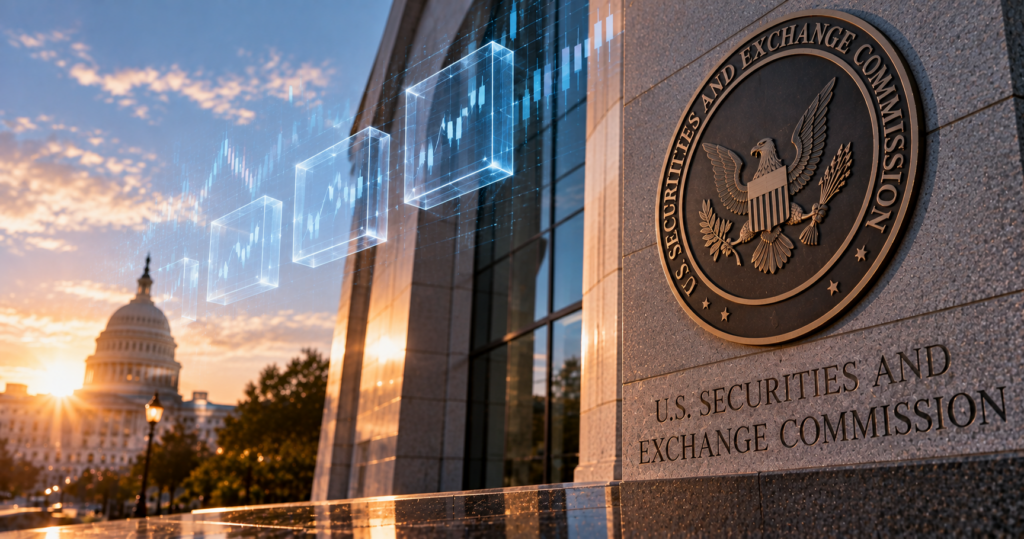
The US Securities and Exchange Commission (SEC) rolled out a five-year, temporary and conditional innovation exemption on Thursday morning, allowing qualifying venues to trade tokenized public stocks on the blockchain.
The exemption follows the CLARITY Act’s failure to reach the desired60-vote threshold in the US Senate earlier this week.
“The Innovation Exemption is designed to resolve challenges that have prevented responsible innovation from taking root in the United States while providing investor protections and market integrity standards. Moreover, and without exception, the anti-fraud and anti-manipulation provisions of the federal securities laws apply in full to all securities activities in these markets,” SEC Chair Paul Atkins said in a statement.
Want to see more from DefiRate? Add us as a preferred news
CLARITY could, technically, still be alive
The Senate did not kill CLARITY on Tuesday. It simply declined to let the chamber start debating it. Cloture on the motion to proceed on the Act failed 49-50, eleven votes short of the 60 needed.
Brian Armstrong, co-founder and CEO of Coinbase, one of the largest cryptocurrency exchanges in the world and a long-time supporter of the CLARITY Act, called the failure a “disappointment” and called on the SEC and Commodity Futures Trading Commission (CFTC) to take matters into their own hands.
Speaking with DeFi Rate, Charles Farrell, senior managing associate atDentons, said the bill is “technically still alive” because Sen. Thom Tillis changed his vote to “no” for procedural purposes and moved for reconsideration.
“Practically, however, its prospects this Congress are poor unless negotiators quickly produce a new bipartisan compromise,” Farrell said.
The ethics objections appear to be the primary reason the vote failed disputes over stablecoin rewards and broader consumer-protection, banking and national-security concerns had also affected the outcome
Some industry experts have highlighted CLARITY’s outcome does not change where the market already is. Adam Morgan McCarthy, lead researcher at LO:TECH, said the US remains “the most competitive digital asset market” as US-denominated stablecoins continue to dominate in volume and circulation.
“[The] result delays the easier path this bill would have created, but the activity and development were already happening here,” he said.
The SEC rolls out “innovation exemption”
Atkins did not have to wait long before rolling out the “innovation exemption.” Tying it directly to Congress’ failure to advance CLARITY, the Chairman highlighted the SEC’s move as “a significant step forward.”
Vivek Raman, co-founder and CEO at Etherealizeand current CFTC Innovation Advisory Committee member, said it was an “anticipated” move.
According to Raman, legislation “remains the best long-term solution.” However, innovation does not need to stop while “Congress continues its work.” He added the SEC’s innovation exemption is “one of the most important regulatory developments for tokenization [the market has] seen in years.”
Commissioner Mark Uyeda placed the order in a longer tradition, noting the SEC has used its exemptive authority before to let new products develop under supervision, pointing to money market funds, index funds and exchange-traded funds (ETFs) as past examples that grew out of the same tool.
The order itself is temporary and conditional. The Exchange Act exempts Qualifying Tokenized Securities Venues (TSVs) from its definition of “exchange,” and certain liquidity providers, also known as “Covered Firms,” from the definition of “dealer.”
This means such platforms can legally run on-chain trading pools for tokenized stocks without having to register as a formal national securities exchange or broker-dealer.
The exemption is not a substitute for CLARITY
For all its speed, the Innovation Exemption is not a substitute for what CLARITY was meant to settle.
Dentons’ Farrell noted the ceiling on agency action.
“Agency action is not equivalent to legislation: regulators cannot confer comprehensive spot-market authority on the CFTC or conclusively settle jurisdictional boundaries beyond their existing statutes, and their actions remain subject to judicial review and later revision or rescission by future administrations,” Farrell said.
He concluded the short-term direction remains favorable and “increasingly clear.” However, without a statute, that clarity becomes less durable and not as certain in the long term.
Orest Gavryliak, Chief Legal Officer at 1inch, made a similar point, highlighting that the US remains with “rescindable agency guidance, regulation by enforcement, and a patchwork of state rules.”
Yet, he added, the industry continues to lack a “durable safe harbor written into law.”

CZ Says IPOs Will Move On-Chain, Have They Not Already?
The CFTC Could Move Ahead with CLARITY Act Before Congress
MEXC Research: Futures Become Primary
Source: defirate.com
2 Comments
Pingback: SEC Commissioner Peirce Champions Uniswap’s Permissionless – xpertsstudio
Pingback: CFTC Grants Broader Pass for Crypto Apps Linking to Derivatives Markets – xpertsstudio