


Don't want to trade it yourself?
Our desk runs DEX portfolios on profit share.
AI translated#Donald Trump#regulation#USA
Trump Agrees to Tighten Restrictions on Officials’ Crypto Business Involvement
Senate Republicans introduce stricter crypto restrictions.
On September 14, Republicans in the U.S. Senate introduced the final draft of the CLARITY Act, imposing stricter restrictions on officials’ involvement in the crypto business. President Donald Trump agreed to the new terms, according to a statement from Senators Cynthia Lummis, John Boozman, and Tim Scott.
The text was prepared ahead of a procedural vote on September 15. According to the authors, 126 significant changes were made to the document during negotiations at the request of Democrats.
One of the main concessions was expanding the role of state prosecutors in enforcing ethical standards. Previously, Democrats and Republican Tom Tillis demanded stronger provisions due to concerns about conflicts of interest stemming from Trump’s crypto business.
Changes in the Bill
The final version added a ban on issuing and sponsoring digital assets, requiring officials to divest significant financial interests in related businesses.
Officials subject to these restrictions and their spouses must sell such stakes or place them in a qualified blind trust—an independent manager without influence over decisions.
State prosecutors will have the ability to enforce these bans through the courts. If an official is suspected of a violation, the law provides for a lawsuit against the U.S. Attorney General.
Direct lawsuits against crypto intermediaries that host assets issued in violation of the ban are also permitted.
Another set of changes addressed banks’ concerns about stablecoins. If the Treasury Secretary determines a significant outflow of deposits from local banks, the department must develop rules limiting rewards to holders of payment “stablecoins.” These powers will expire 18 months after the law’s enactment.
The authors also adjusted provisions of the Blockchain Regulatory Certainty Act. Protection from some money transfer registration requirements now extends to miners and validators previously excluded.
Direct references to the criminal statute 18 U.S.C. 1960 were removed from the text.
The revision strengthened restrictions on related-party transactions and conflicts of interest for crypto exchanges, brokers, and dealers.
Prospects for Passage
On September 15, the Senate is set to vote on ending debates to proceed with the CLARITY Act. Sixty votes are needed for success, which would advance the bill, but amendments and further votes remain ahead.
In a comment to CoinDesk, Blockchain Association head Summer Mersinger expressed optimism ahead of Tuesday and thanked senators from both parties for continuing negotiations.
However, confirmed support from the necessary number of legislators is still lacking. As of Friday, September 11, supporters of the bill had not yet secured 60 votes, and negotiations continued over the weekend.
The latest concessions aim to remove one obstacle—an ethics dispute. Democratic Senator Angela Alsobrooks emphasized the need for state prosecutors’ powers in case of Justice Department inaction.
“I made it very clear that I will not vote for any bill that does not address ethics issues,” she said.
This is a condition for support, but not confirmation of agreement with the published version.
Even Senate passage does not guarantee a swift conclusion. In early September, Galaxy’s head of research Alex Thorn <a href="https://www.ccn.com/news/crypto/clarity-act-september-timing-crunch-bitcoin-price-risk/” rel=”nofollow noopener” target=”_blank”>called it unlikely that the law would be enacted before the midterm elections in November.
The expert cited the House of Representatives’ shortened September schedule as the reason. The House must reconcile Senate changes.
Prediction markets also place the chances of completing the process by year-end below 50%. At the time of writing, traders on Polymarket estimate a 31% chance of the bill passing both chambers and being signed by the president by the end of 2026.
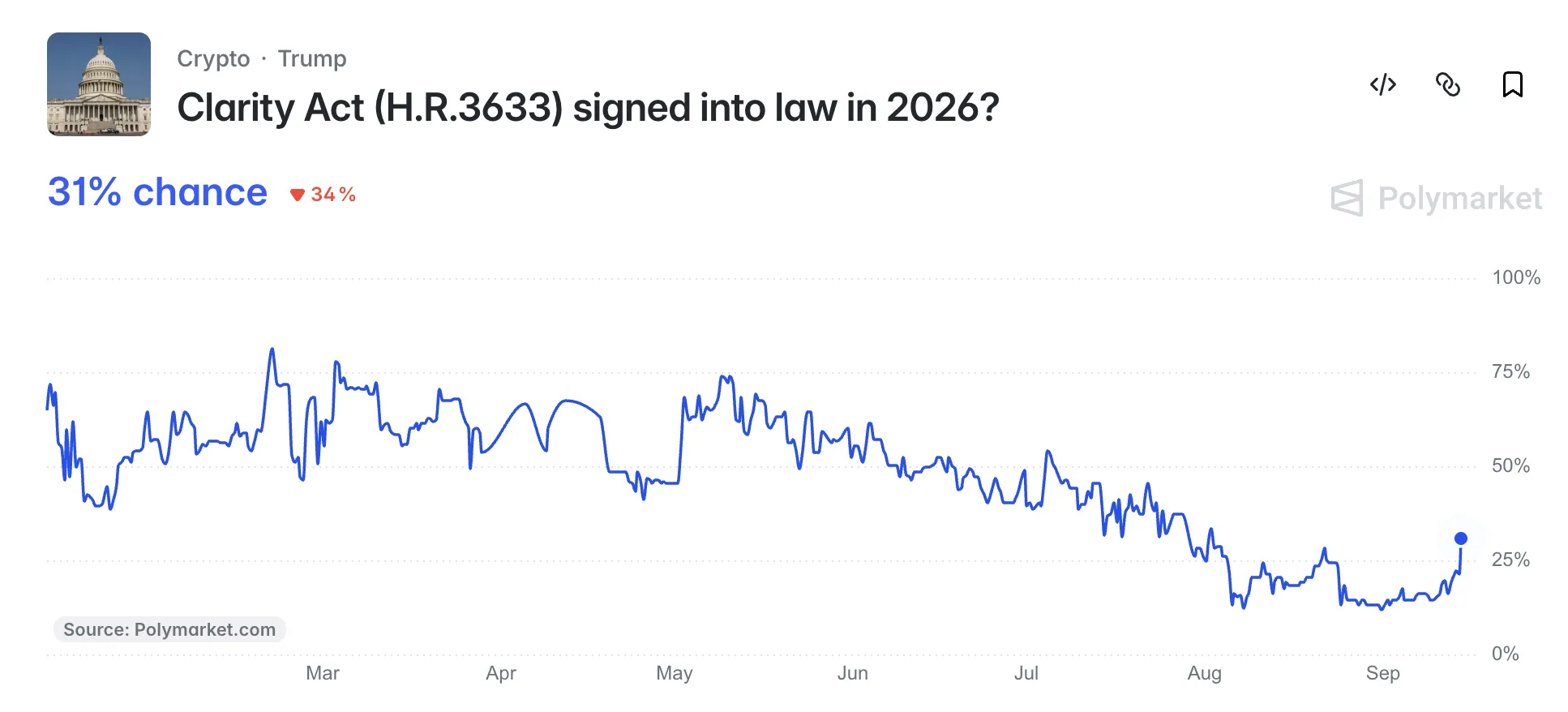
Users on Kalshi give a 49% chance of the CLARITY Act or another crypto market structure law meeting contract conditions being enacted by January 1, 2027.
Earlier, on September 10, Republicans introduced an updated version of the document with requirements for trading DeFi protocols that do not meet decentralization criteria.
Found a mistake in the text? Select it and press CTRL+ENTER
How AI Agents Are Regulated Worldwide
Bitcoin Recovers to $78,700 After U.S. Inflation Data Release
Albuquerque Bans Crypto ATMs Due to Fraud Concerns
OpenAI Seeks Congressional Clarity on Legality of Coordinated AI Slowdown
ESMA questions legality of Polymarket, Kalshi in Europe
Republicans Update CLARITY Act Ahead of Senate Vote
US Senate to Investigate OpenAI Following Hugging Face Incident
US Sanctions Xinbi, Seizes Over $52 Million in Cryptocurrency
Coinbase CEO: US Crypto Market to Gain Regulatory Clarity Regardless of CLARITY Act Outcome
Source: forklog.com