

Don't want to trade it yourself?
Our desk runs DEX portfolios on profit share.
- Kalshi and Bitnomial now offer live US Bitcoin perpetuals, while the SEC’s crypto fundraising framework remains only a proposal.
- The CFTC could approve derivatives through existing exchange rules, but token issuers still lack an active crypto-specific public fundraising route.
- Comments on the SEC proposal close October 20, after which revisions and a final agency vote will determine whether issuers can use it.
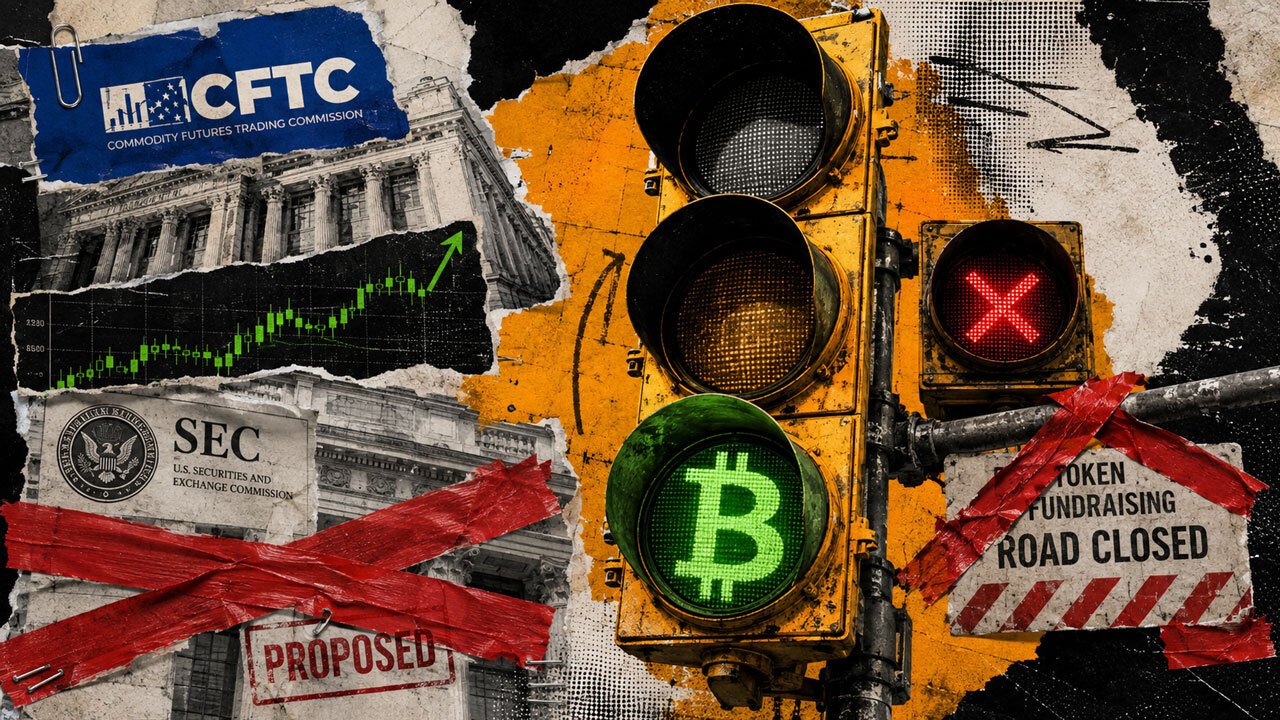
On May 29, the CFTC approved a Bitcoin perpetual contract for a regulated US exchange. Almost three months later, on Aug. 18, the SEC proposed a legal route through which crypto projects could someday raise money from the public under rules written for token networks.
That’s a pretty unusual order in which Washington is rebuilding the American crypto market. The rules for trading and hedging an established asset are already producing live products, while the rules that would let founders finance new assets still have to pass through public comments and another SEC vote.
Bitcoin traded around $77,000 on Aug. 21, up about 22% over seven days, while CoinGlass recorded roughly $154.6 billion in 24-hour Bitcoin futures volume and $56.2 billion in open interest. Its latest rolling window also showed about $840 million of Bitcoin futures liquidations, while the previous day’s snapshot captured $3.1 billion of bearish crypto liquidations as BTC broke through $72,000. The windows overlap, so they describe stages of the same rally rather than separate totals.
Both sets cover global platforms, including offshore markets, but they show how heavily a fast Bitcoin repricing travels through derivatives while the domestic true-perpetual market is still being built.
Kalshi’s BTCPERP approval established that a US platform can list a true crypto perpetual under existing derivatives law, and Bitnomial now offers one as well.
The SEC’s Regulation Crypto Assets is still just a proposal that no issuer can use. For now, a regulated institution has a clearer route to trade a crypto derivative in the United States than a founder has to fund the token that might one day trade beside it.
Perpetuals fit through an old regulatory door
A standard futures contract expires on a specific date, so a trader who wants to keep the position must close it or move into a later contract. A perpetual has no expiry. Instead, regular payments between long and short traders help keep its price close to the underlying market, allowing the position to stay open as long as the trader maintains enough collateral.
Crypto exchanges outside the United States turned this design into the industry’s main derivatives product because it gives traders continuous exposure without repeated contract rolls. US exchanges spent years using dated futures, including contracts with very long expiries that behaved somewhat like perpetuals but still ended on a fixed date. The legal category for a true perpetual inside the domestic market basically didn’t exist.
The CFTC could resolve that problem through a framework it already uses for new futures products. Kalshi filed BTCPERP under Regulation 40.3, which lets the commission review a contract’s terms and decide whether it complies with the rules for a designated contract market. Once the agency approved it, Kalshi’s perpetuals platform could offer a Bitcoin contract with exposure of up to six times the collateral posted by a trader.
Alongside the individual approval, the CFTC published a policy statement for perpetual contracts explaining how its existing core principles apply. Exchanges now have clearer guidance on contract design and funding systems, but each exchange still needs its own filing and must meet the usual rules for margin, surveillance, customer protection, and clearing. One approved product therefore provides a route for others to follow without granting automatic permission to list every perpetual.
The commission briefly offered another route on June 12, when it gave no-action relief to Bitnomial and Coinbase Derivatives. That relief allowed the two exchanges to remove expiration dates from specified existing contracts without treating the amendment as a completely new listing. It expired on June 30, making it a short conversion window rather than a standing option that exchanges can use today.
Bitnomial says it has launched US perpetual futures, including a live Bitcoin contract. Coinbase’s public materials still describe its domestic perpetual-style products as long-dated futures with five-year expiries, and a May update says eligible US customers will receive access to Deribit perpetuals at a later stage. In the absence of a newer public contract specification, Coinbase should not be counted as a verified true-perpetual launch.
The CFTC’s Innovation Advisory Committee met on Aug. 20 and discussed crypto regulation alongside artificial intelligence and prediction markets. The committee advises the commission, and the official recap announced no new perpetual approval, leaving the product status unchanged while extending an agency process that has already moved from one contract filing to live US markets at Kalshi and Bitnomial.
Live products and proposals aren’t the same thing
Regulatory announcements can sound equally final in a headline even when they’re at very different stages. The current position is easier to understand when approved products, expired relief, open comment periods, and proposed rules are separated:
| Initiative | Regulator | Status on Aug. 21 | What it permits or explores |
|---|---|---|---|
| Kalshi BTCPERP | CFTC | Approved and live | True Bitcoin perpetual on a designated contract market |
| Bitnomial crypto perpetuals | CFTC | Live | US-regulated perpetual futures, including Bitcoin |
| Coinbase domestic perpetual-style futures | CFTC-regulated venue | Publicly described with five-year expiries | Long-dated contracts; true-perpetual conversion is unverified publicly |
| June no-action relief | CFTC | Expired June 30 | Temporary route for Bitnomial and Coinbase to amend specified contracts |
| Energy 24/7 trading and perpetuals inquiry | CFTC | Comment period open through Aug. 26 | Possible use of around-the-clock and perpetual design in energy markets |
| Regulation Crypto Assets | SEC | Proposed; comments due Oct. 20 | Token-specific offerings up to $75 million and a safe-harbor exit |
| CLARITY Act | Congress | Senate process pending | Statutory division of crypto market authority between the SEC and CFTC |
Derivatives moved first because the CFTC could place them inside an established exchange system. A designated contract market already has requirements covering capital and customer protection, along with systems for clearing and trade surveillance. The commission needed to decide whether a particular contract complied with those duties; it didn’t have to invent a new kind of company or a complete legal framework for every issuer that might use it.
Token fundraising asks the SEC to resolve a broader set of issues. The agency needs rules for what issuers disclose, how much they can raise, which financial statements they must provide, and how buyers can resell the token. It must also decide when a token can separate from the investment contract used to finance it and whether federal rules override state registration requirements.
The proposal entered the Federal Register on Aug. 21, giving the public until Oct. 20 to comment before the agency considers revisions and votes on a final version.
Congress is running on a separate, third schedule. The Senate Banking Committee advanced the CLARITY Act in May, and a cloture motion is scheduled to ripen on Sept. 15. Senate Banking Chair Tim Scott said on Aug. 20 that he still sees a the final draft explained how the bill would define the SEC-CFTC boundary in federal law and make that allocation harder for a future commission to rewrite
These different timetables already affect who can use the American market. A regulated institution can take a Bitcoin position larger than its posted collateral and hold a contract with no expiry, while a founder seeking to sell tokens under crypto-specific public disclosures has no active SEC route.
Trading companies can move more of their business onto domestic venues without waiting for the next token issuer, while projects still rely on conventional securities exemptions, private funding, or offshore structures.
Crypto sends its market design back to Wall Street
Perpetuals are also moving beyond the asset class that made them popular. On July 23, the CFTC extended through Aug. 26 its request for comment on 24/7 trading and perpetual contracts in US energy derivatives, bringing a format refined on offshore crypto exchanges into a discussion about oil, gas, and power markets.
The appeal is easy to see. Traders using a perpetual don’t have to choose a maturity date or keep rolling a position, while the exchange replaces expiry with continuous funding and liquidation systems that keep the contract tied to its reference price. That can make exposure more convenient and use capital more efficiently, although the systems must operate continuously and manage risk without a scheduled reset.
Energy also shows why crypto’s design can’t be copied into every market. Bitcoin has no warehouse, delivery schedule, or seasonal production cycle, while a barrel of oil is connected to storage costs and physical supply. The CFTC’s case-by-case approach lets regulated exchanges test perpetual mechanics while accounting for those differences, and its policy statement doesn’t create a right to list every asset with any margin setting.
The SEC is trying to build something broader and more reusable on the fundraising side. Regulation Crypto Assets would provide a $5 million startup exemption, $20 million and $75 million public tiers, and a safe harbor through which a token could separate from the original investment contract once the issuer’s essential work ends.
Because that system would cover many projects and several stages of their lives, it has more legal ground to define before anyone can use it.
Building the trading layer first has a practical benefit if the SEC eventually finalizes its proposal. Newly financed tokens could enter a domestic market with regulated hedging and better price discovery already in place.
The drawback is that sophisticated trading capacity can expand while the supply of projects legally financed through public token sales stays limited, leaving the United States better prepared to trade assets than to create them.
The current market therefore reflects the order in which the rules arrived: Kalshi and Bitnomial have live true perpetuals, the June conversion window has closed, and the CFTC is considering whether crypto’s around-the-clock design can work in energy. The SEC has only opened the process for token fundraising, so bringing creation home will depend on whether the commission turns that proposal into a usable final rule.
1HDown0.09%24HUp0.57%7DUp22.92%
30DUp21.61%60DUp26.70%90DDown0.07%
Bitcoin is +0.57% over the past 24 hours and currently sits at rank #1 by market cap.
Market cap$1.55T
Volume (24h)$28.85BDown46.89%
Circ. supply20.07M
FDV$1.63T
Loading price history…
Related AssetBitcoin#1BTC$77,454.0524-hour change: up0.57%Loading price history…24HUp0.57%7DUp22.92%30DUp21.61%Related CompanyKalshiPrediction market for trading the futureRelated CompanyCoinbaseA leading digital currency company
BitcoinUSAdoptionAnalysisRegulationTradFiDerivatives
Editorial credits
Source: cryptoslate.com