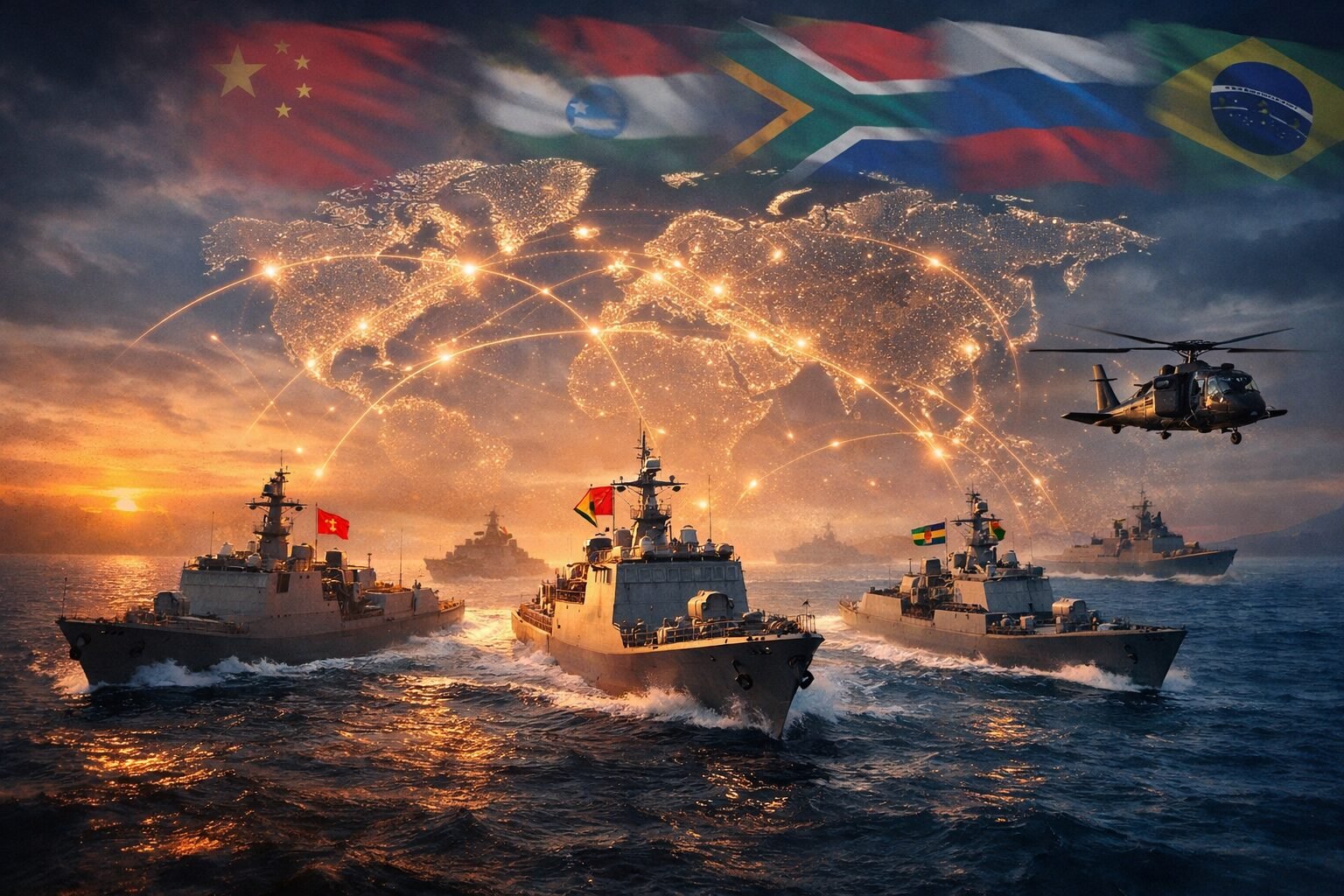
BRICS global security took on an entirely different meaning in January 2026, when warships from China, Russia, Iran, and the UAE gathered off South Africa’s Western Cape for the “Will for Peace 2026” naval exercise — the first-ever operational military event under the BRICS global security alliance framework.
Therefore, BRICS full form — Brazil, Russia, India, China, South Africa — built its identity around economic reform, but right now the bloc is putting its military ambitions on full display. BRICS security cooperation has moved well past rhetoric, and those eight days at Simon’s Town laid the challenges of BRICS as a unified military actor bare for anyone paying attention.
Also Read: US Stablecoin Push Threatens BRICS De-Dollarization Plans
BRICS Security Cooperation Highlights Strategic Global Security Role
A Command Structure Built by China
China led the exercise as primary coordinator — taking on strategic planning, tactical execution, and also the command and control infrastructure. Within the BRICS global security alliance, no single member had ever assumed that kind of centralized leadership role before. During those eight days, Beijing was actively institutionalizing BRICS global security from the inside out. South Africa’s joint task force commander, Captain Nndwakhulu Thomas Thamaha, had this to say at the opening ceremony.
“It is a demonstration of our collective resolve to work together. In an increasingly complex maritime environment, cooperation such as this is not an option. It is essential.”
General Rudzani Maphwanya, Chief of the SA National Defence Force, also addressed the ceremony:
“Exercise Will For Peace 2026 gives us a chance to work side by side with our partner navies, sharing knowledge and capabilities while building trust at sea. Together, we strengthen our ability to tackle piracy, prevent illegal line crossings, and ensure safe shipping routes for everyone as well as mutual support to maritime security.”
China’s Growing Footprint
BRICS security cooperation, at the time of writing, has grown well beyond what anyone envisioned at the bloc’s founding. China’s military footprint in Africa has been expanding rapidly — the PLA Navy logged at least 15 port calls on the continent between 2024 and 2025, exceeding all previous recorded periods. Under FOCAC’s Beijing Action Plan for 2024–2027, China is also extending professional military education to 6,500 African military and police personnel by 2027. These commitments have reinforced the argument that Beijing is increasingly shaping BRICS global security to serve its own strategic agenda within the broader BRICS global security alliance.
The Fractures Inside the Bloc
And yet, the challenges of BRICS as a unified security actor became obvious fairly quickly. India and Brazil — both founding members and part of the original BRICS full form — stayed away from the exercise entirely. Harsh Pant, a geopolitical analyst at the Observer Research Foundation, said India’s absence was simply “about balancing ties with the US.” Darren Olivier, Director of African Defence Review, was also more direct about the exercise’s real nature:
“There’s no mechanism within BRICS to plan, organise or execute a military exercise. Calling it a ‘BRICS’ exercise makes about as much sense as having a ‘G7’ or ‘G20’ exercise. South Africa may be attempting to make the exercise appear to be more legitimate by casting it as a BRICS exercise, but this has not been organised by BRICS.”
Defending the Decision

South Africa’s Deputy Defence Minister Bantu Holomisa defended the decision to host and pushed back on Western criticism:
“Let us not press panic buttons because the USA has got a problem with countries. Those are not our enemies. Let’s focus on cooperating with the BRICS countries and make sure that our seas, especially the Indian Ocean and Atlantic, they are safe.”
Also Read: Russia Pursuing BRICS Bridge for an Alternative Financial Corridor
Democratic Alliance Spokesperson on Defence Chris Hattingh pushed back, arguing that parliament needs to have a say in BRICS global security decisions of this kind:
“These decisions affect South Africa’s foreign relations, trade, security, and reputation — and they cannot be made behind closed doors. The SANDF exists to defend South Africa and its people, not to provide a platform for global power politics.”
When the President Was Overruled
The BRICS global security alliance also cracked from the inside. Ramaphosa gave a direct order — no Iranian naval participation. The order was ignored. Iranian warships arrived, docked, and took part in drills led by China’s 48th Naval Task Force. A Board of Enquiry followed, and it was the second such incident involving Iran and South Africa’s military leadership in just six months. The BRICS full form bloc has always cited sovereignty as a founding principle, but that principle was being tested at home, not by outside pressure. The challenges of BRICS as a functioning security community are real, and BRICS security cooperation will not mature until civilian control of military decisions is something all members can actually count on.