


Don't want to trade it yourself?
Our desk runs DEX portfolios on profit share.
Currencies39214
Market Cap$ 2.68T+0.40%
24h Spot Volume$ 39.96B-8.14%
DominanceBTC57.00%-0.07%ETH10.96%-0.15%
ETH Gas0.13 Gwei
FeaturedTechnologySolanaCoinbaseOutageGovernanceSolana Foundation
Sep 16, 2026
2min read
byLiam ‘Akiba’ Wright
forCryptoSlate
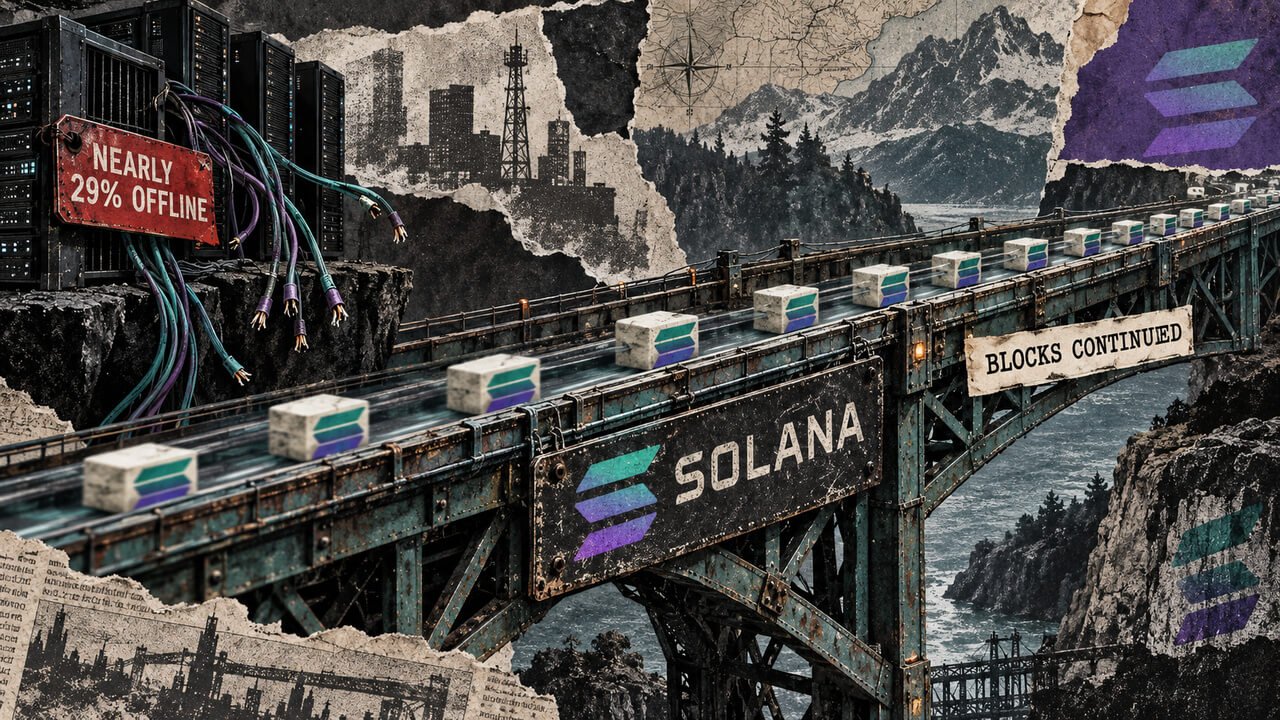
On Aug. 12 a Teraswitch routing failure left validators representing nearly 29% of Solana stake unable to vote while the chain continued producing blocks, according to a Solana Foundation account published Sept. 14. The outage, traced to a stale route on a Miami edge router and resolved about 33 minutes after the <a href="https://xpertsstudio.com/bitcoin-btc-reacts-to-first-rate-hike-in-years/” title=”Bitcoin (BTC) Reacts to First Rate Hike in Years”>first alarm, caused skipped slots above 32%, non-vote throughput to fall below 300 transactions per second from roughly 1,100–1,300, and about half an hour of delayed finality. The incident underscores concentration and infrastructure risk for Solana and crypto DeFi/DEXs that rely on fast settlement despite provider hardening and ongoing work to improve diversity and observability.
See what traders are focused on
The Solana network kept producing blocks on Aug. 12 when an infrastructure failure stopped validators representing nearly 29% of network stake from voting, according to a Solana Foundation account published Sept. 14.
Independent monitoring found that the chain remained live, yet its performance deteriorated: more leader slots were skipped, transaction throughput fell sharply, and settlement finality was delayed.
The disruption began at Teraswitch, which the Foundation described as Solana’s largest infrastructure provider. A Teraswitch postmortem traced the outage to a stale default route left on a Miami edge router, with Teraswitch’s provider traffic fully recovering 33 minutes after the first alarm.
Routine transit-provider maintenance activated that route, while transposed values in a routing policy applied a “no-export” instruction toward Europe and Asia-Pacific.
In practical terms, the bad route spread across Teraswitch’s network and prevented affected data centers from reaching the Internet through healthy local routers. Twelve sites across Europe and Asia-Pacific lost Internet and inter-site connectivity, including infrastructure hosting Solana validator and RPC nodes.
Independent blockchain-risk monitoring firm Metrika broadly corroborated both the scale of the disruption and continuous block production. Its data showed skipped slots rising above 32% and non-vote transaction throughput dropping below 300 per second from a typical range of roughly 1,100 to 1,300.
Metrika’s observer also recorded about half an hour in which newly produced blocks had not yet reached finality, the point at which their transactions become irreversible. The backlog finalized as connectivity returned.
Solana avoided a chain-wide production halt, but users and systems depending on rapid settlement faced materially weaker performance.
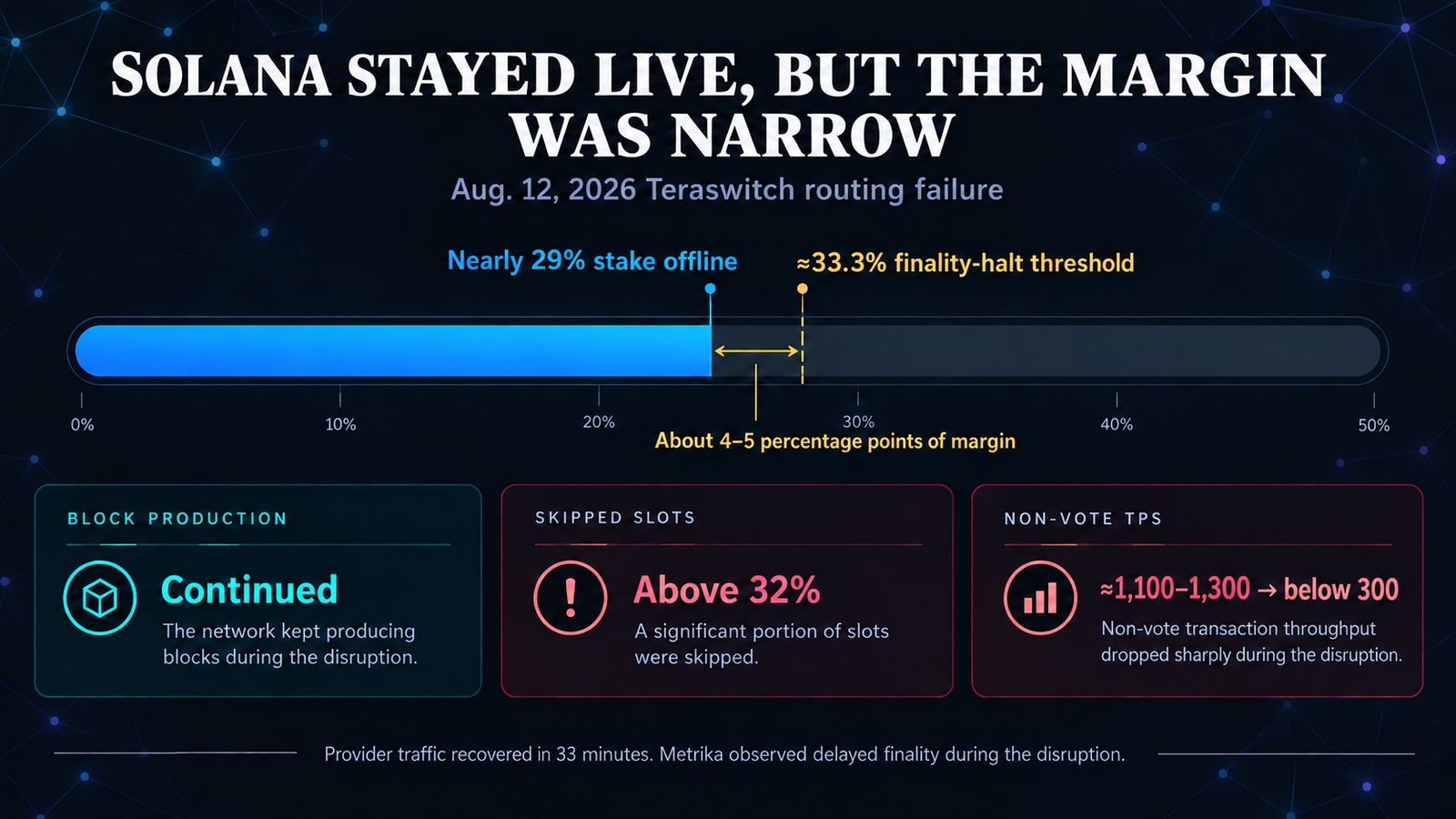
Solana needs more than 66% of stake voting to maintain consensus finality. The roughly 29% offline share stayed about 4% to 5% below the corresponding 33% finality-halt threshold
The Foundation said Teraswitch had hosted 38% of network stake in 2025 and that its team reduced the provider’s share below 30% before the outage. That hosting share and the incident’s delinquent stake estimate measure different things, even though both highlight concentration risk.
Many separately operated validators lost connectivity together because they shared one provider failure domain.
Teraswitch later deployed provider-side hardening that day so an invalid route can no longer stop sites from using healthy local edge routers. Its September postmortem said additional route monitoring remained in progress, leaving infrastructure diversity and observability as continuing resilience tests.
Source: cryptorank.io