


Don't want to trade it yourself?
Our desk runs DEX portfolios on profit share.
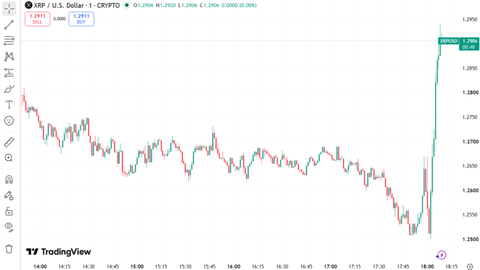
<img src="https://xpertsstudio.com/wp-content/uploads/2026/09/image-126.png" alt="Ripple XRP and Bitcoin after CLARITY Act Senate setback” loading=”lazy”>
Ripple and Strategy are arguing that the failed CLARITY Act vote did not change the existing legal position of XRP or Bitcoin in the U.S.
The Senate voted 49 – 50 against advancing the bill on September 15, falling short of the 60 votes needed. The setback triggered a sharp crypto market reaction, with XRP falling nearly 10% and Bitcoin sliding toward $76,000.
However, Ripple says XRP’s existing legal foundation remains intact.
Ripple points to XRP’s existing legal clarity
Ripple Chief Legal Officer Stuart Alderoty highlighted two developments that predate the Senate vote.
A 2023 federal court ruling found that Ripple’s programmatic sales of XRP on exchanges did not constitute securities transactions, although the court found that certain institutional sales did.
Alderoty also pointed to a March 2026 joint interpretation from the SEC and CFTC that listed XRP among 16 digital assets classified as digital commodities.
“Don’t forget – Ripple and XRP stand on settled ground,” Alderoty wrote on X.
The failed Senate vote therefore does not itself overturn the earlier court ruling or regulatory interpretation.
Related:CLARITY Act fails key Senate vote as crypto bill stalls
Strategy says Bitcoin already had clarity
Strategy made a similar argument for Bitcoin.
The company, formerly known as MicroStrategy, holds 845,050 BTC acquired for approximately $63.73 billion, at an average price of $75,412 per Bitcoin.
With BTC trading around $76,206 after the vote, the company’s holdings were roughly 1% above their aggregate purchase price.
“Bitcoin has had legal and regulatory clarity in the U.S. for years,” Strategy wrote.
The company’s position is that Bitcoin did not require the CLARITY Act to establish its basic regulatory status.
CLARITY Act setback leaves broader rules unresolved
While XRP and Bitcoin retain their existing legal and regulatory treatment, the Senate vote leaves the broader U.S. crypto market-structure question unresolved.
The House passed the CLARITY Act 294 -134 in July 2025, with 78 Democrats supporting it. By the September 2026 Senate vote, the bill failed to secure enough support to advance.
Ahead of the vote, 18 state attorneys general urged Congress to reject the legislation. Industry participants including Chainlink and Grayscale have also highlighted the need for clearer rules, while pointing to regulators such as the SEC and CFTC as important players in the meantime.
Ripple CEO Brad Garlinghouse also criticized the political disagreements surrounding the bill after the vote.
Representative Tom Emmer separately criticized Senator Kirsten Gillibrand over her opposition to the legislation:
The Senate setback leaves the industry waiting for lawmakers and regulators to determine how broader U.S. crypto market rules will evolve.
Source: www.altcoinbuzz.io