

Don't want to trade it yourself?
Our desk runs DEX portfolios on profit share.
15Sep.202618:39
2026.09.15 2026.09.15
What Is the Crypto Fear and Greed Index?
Maxim Tkachenkohttps://www.litefinance.org/blog/authors/maxim-tkachenko/

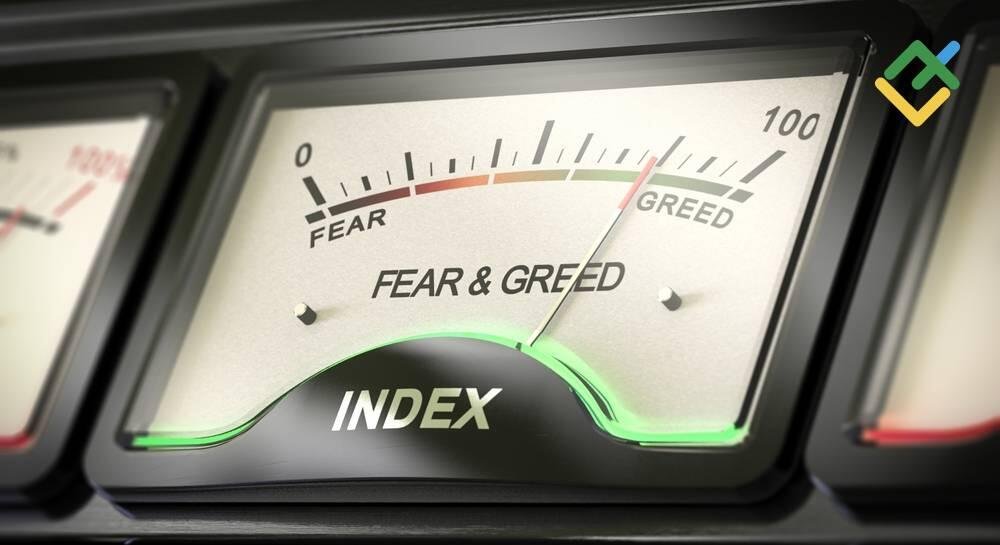
The Crypto Fear and Greed Index is the best-known measure of sentiment in the crypto market. It reads the mood of the crypto community and puts it on a scale from 0 to 100. The number comes from six weighted inputs such as volatility, trading volume, momentum, surveys, social media activity, and Google Trends data. Together, they turn scattered signals into one figure that millions of crypto investors check before they trade.
The Crypto Fear and Greed Index does not predict prices, but it captures investor sentiment at the current moment. That is why reading it correctly turns the index into a practical risk management tool. Ignoring it deprives traders of an extra
The article covers the following subjects:
Major Takeaways
- The index rates market mood from 0 to 100, where 0 is extreme fear, and 100 is extreme greed. The number is not a vague estimate. It is calculated from six separate indicators.
- The index is calculated from six components: volatility (25%), market momentum and volume (25%), social media (15%), surveys (15%), Bitcoin dominance (10%), and Google Trends data (10%). Each component is compared with the corresponding average values for the last 30 and 90 days.
- Extreme values carry the most signal. The extreme fear zone (0–24) has historically indicated oversold conditions and buying opportunities, while the extreme greed zone (75–100) has pointed to overbought conditions. In turbulent markets, though, these readings can last far longer than most traders expect.
- The index shows where the market is now, not where it is going. When it comes to predicting the next day, the index is right about 49% of the time, which is close to random.
- The index updates every 12–24 hours, depending on the provider. Always check the countdown to the next update on the index panel to be sure the reading is current before you open a crypto trade.
- In 2026, the index fell to a record low of 5, below both the COVID crash (8) and the FTX collapse (12). That reading was a clear sign of capitulation across the broad market.
- Since 2018, the market has spent about 62% of the time in the fear zone. Crypto simply runs on fear, and greed shows up only in brief bursts when a bull run takes hold.
What the Crypto Fear and Greed Index Actually Measures
The Crypto Fear and Greed Index measures investor sentiment, the irrational force that turns markets into a roller coaster. The idea comes from behavioral economics, which says that people give too much weight to recent events and tend to follow the crowd. When fear peaks, many investors dump their positions even though nothing has changed in a project’s fundamentals. During euphoria, they do the opposite and buy at the top, ignoring every warning sign.
The concept started in traditional markets, where CNN Money built its Fear & Greed Index to gauge market sentiment on Wall Street. In 2018, Alternative.me adapted the idea for crypto and added Bitcoin dominance as one of the inputs. The index works on a simple loop. When fear takes over, investors sell at once and push prices down even further. When greed prevails, everyone buys, and crypto bubbles start to form.
However, the index is not a buy or sell signal. It simply shows what the crowd is feeling. At sentiment extremes, market participants often become overly optimistic or pessimistic. That is why contrarian traders watch it, following Warren Buffett’s advice to be fearful when others are greedy and greedy when others are fearful.
Fear and greed are the two poles the crypto market swings between, and the index shows where that pendulum sits right now. Traders often call it a crypto mood thermometer. Learn to read it, and you see something that price charts alone will not show you.
How Is the Crypto Fear and Greed Index Calculated?
So how is the Crypto Fear & Greed calculated? The index is a weighted average of six components. Every component compares current readings with its average values for the last 30 and 90 days to spot meaningful de 100, and the components are combined with fixed weights into a single score
- Volatility (25%)measures current volatility and maximum drawdowns against the 30-day and 90-day averages. An unusual spike in volatility during a price decline is a classic sign of a fearful market. This component reacts the fastest, since volatility in crypto can change within hours.
- Market momentum and volume (25%)compares current volumes and price action with their historical averages. High volume in a positive market points to greed, while high volume in a negative one points to fear.
- Social Media (15%) looks at the tone and volume of social media interactions around Bitcoin and other crypto assets, mainly on X (Twitter). The algorithms evaluate not only how many posts appear but also how many interactions they receive and whether their tone is positive or negative. This helps track search trends and viral discussions in real time.
- Surveys (15%)are weekly polls of market participants, currently paused by some providers but historically part of the formula. They bring in a subjective element that still says something useful about market sentiment.
- Bitcoin dominance (10%)is BTC’s share of total crypto market capitalization. A rising share points to fear, with investors moving into the safer asset, while a falling share points to greed and a rush into altcoins. That decline often marks the start of an altseason, and traders track it with a separate altseason index alongside the main Fear and Greed Index.
- Google Trends (10%)covers search volume for Bitcoin, where growing interest lines up with greed. The wording of the queries matters too. A spike in searches for Bitcoin price manipulation, for example, is a sign of fear. The catch is that the general public tends to start searching only after the main price move is over.
The Crypto Fear & Greed Index differs from provider to provider. CoinMarketCap, for example, relies on five components, including derivatives data such as the put/call ratio and its own social media data. Nevertheless, the underlying logic is the same everywhere. The index tracks deviations from the norm and compares current readings with the corresponding long-term averages.
Here, the index is in the neutral zone, meaning the market is neither fearful nor greedy enough to act on.
|
Market sell-off, potential bottom |
||
|
Caution, opportunities emerging |
||
|
Bullish sentiment, rising risks |
||
Limitations of the Crypto Fear and Greed Index
The Crypto Fear and Greed Index works as a barometer rather than a ready-made trading plan. Here are the main limitations worth keeping in mind:
- No predictive power. Studies show the index does not improve the accuracy of next-day forecasts.
- Bitcoin bias.The most widely cited version, from Alternative.me, is built around BTC. For portfolios weighted toward altcoins, this can distort the picture, especially during an altseason, when Fear and Greed Index scores for Bitcoin diverge from sentiment around Ethereum or Solana.
- Too few extreme readings. Since 2018, the index has dropped below 10 on only about 20 days. That is not enough history to say what such readings usually mean, so what happened after them before may not happen again.
- Lag.The index updates on a delay while the crypto market runs around the clock. By the time a reading is published, it may already be stale, especially in volatile stretches when prices swing 5 to 10% within hours.
- No fundamentals. The index ignores halvings, regulatory decisions, and institutional flows. It reflects the market’s reaction to those events, not their cause.
- Open to manipulation. Social media can be flooded with bots, and surveys can be skewed. The developers filter for this, but the risk never disappears completely.
- Self-fulfilling signals.When too many traders act on the index alone, the price can move on that alone, with nothing fundamental behind it.
How Traders Read the Index
The Crypto Fear and Greed Index is a road sign, not a GPS. It shows you where you are, not the route to take. You need to verify the index’s signals carefully. Here are five principles that help you get the most out of it:
The index is most useful at the extremes. Extreme fear (0–24) and extreme greed (75–100) are the zones where emotions peak and a reversal becomes possible. At a neutral reading of 50, the index gives you almost nothing, because there is no clear signal. The point of the index is to catch the unusual readings, not the everyday ones.
Never trade on the index alone. Use it alongside technical analysis such as support and resistance levels, the RSI, and moving averages, plus on-chain metrics and trading volume. When the index shows extreme fear and the RSI is oversold on the daily chart, you get a confluence of signals, which is a much stronger basis for an investment decision.
In a strong bull trend, high readings can hold for weeks without pointing to a reversal, and a bear market can keep the index in the fear zone for just as long. Always take market conditions into account. In 2021, for instance, the index stayed above 70 for more than two months, and Bitcoin still reached new highs.
The index is a snapshot of the market right now, which makes it useful for intraday crypto trading and far less useful for long-term investing. The same applies across time frames: a signal on the hourly chart can point one way while the weekly chart points the other.
The Crypto Fear and Greed Index does not exist in a vacuum. Fed decisions, the dollar index, and geopolitics all influence market trends. The index reflects the market’s reaction to these factors but does not predict them. When uncertainty runs high, readings can stay in the fear zone for a long time, even when on-chain data looks bullish.
Fear and Greed Index Historical Examples
The history of the Crypto Fear and Greed Index is a record of crashes and recoveries, and every peak and trough on its chart provides a valuable insight into the nature of crypto market sentiment.
The index plummeted to 8, hitting a record low for the first time in history. Bitcoin plunged from $10,000 to $4,000. Panic selling seized the market. Those who bought on fear saw a 300% return over the next 12 months. This is a classic example of how a fearful market creates the best opportunities.
May 2021: China mining crackdown
The index dropped to 11 after China began tightening restrictions on mining. Fear surrounding Bitcoin was so intense at the time that the BTC price tumbled from $58,000 to $30,000. However, those who bought during this period of fear reaped nearly 100% returns over the next six months when Bitcoin hit a new all-time high.
The index fell to 12. The bankruptcy of one of the largest exchanges prompted a wave of fear across the entire crypto market. The Bitcoin Fear and Greed Index shifted into the extreme panic zone, and the price sank below $16,000. At the time, many analysts pointed to the Bitcoin Rainbow Chart, which also indicated that the market was oversold.
On February 6, 2026, the index hit a new all-time low of 5. Sentiment stayed subdued for most of the year, and every attempt at a rally ran into skepticism.
On August 25, 2026, the index jumped to 74 amid a market recovery following a prolonged period of fear. Trading volume surged, and social media interactions reached levels comparable to those seen during the bull market of 2024.
The pattern is the same across all these episodes, and it says a lot about crypto market behavior. The lowest readings have come during sharp market declines, and every time the market needed weeks or months to recover. Therefore, extreme fear is not a signal to buy right away, but a reason to start watching closely and prepare for market volatility.
Conclusion
The Crypto Fear and Greed Index is a barometer of market sentiment, and its extreme readings carry the most weight. Extreme fear (0–24) often signals oversold conditions and a possible moment to consider long trades, while extreme greed (75–100) indicates overbought conditions and mounting risks.
However, the index means little without market context, so always use it alongside technical tools such as the RSI, key support and resistance levels, on-chain data, and macroeconomic factors. Crypto investors are driven by emotion, and the index simply reflects that. Use it as part of your risk management, not as your only reason to act.
Crypto Fear and Greed Index FAQs
How accurate is the Crypto Fear and Greed Index?
The index accurately reflects current market sentiment but is poor at predicting future prices. Studies show it is about 49% accurate at calling the next day’s direction, which is close to random. So, the index is useful for reading the present, not forecasting the future.
What is a good Crypto Fear and Greed score?
There is no single right answer here. A good score depends entirely on your strategy. Traders who go against the crowd treat extreme fear (0–24) as a buying opportunity and extreme greed (75–100) as a time to take profits. Long-term investors are usually more comfortable in the neutral zone.
What does extreme fear mean on the index?
Extreme fear (0–24) means panic selling and investors leaving the market in large numbers. Historically, readings this low have often coincided with swing lows and offered good entry points for long positions. However, it is essential to confirm signals using other indicators.
How often does the Crypto Fear and Greed Index update?
Update frequency depends on the provider. Alternative.me and CoinMarketCap refresh once a day, while some aggregators recalculate throughout the day using social media data. Check when the reading you are looking at was published, since it can go stale quickly.
Price chart of BTCUSD in real time mode
The content of this article reflects the author’s opinion and does not necessarily reflect the official position of LiteFinance broker. The material published on this page is provided for informational purposes only and should not be considered as the provision of investment advice for the purposes of Directive 2014/65/EU.
According to copyright law, this article is considered intellectual property, which includes a prohibition on copying and distributing it without consent.
Rate this article:
{{value}} ( {{count}} {{title}} )
Source: www.litefinance.org
2 Comments
Pingback: CoinEx to Close Exchange on Ninth Anniversary – xpertsstudio
Pingback: Bank of Russia flags crypto and stablecoins as financial market risk – xpertsstudio