

Don't want to trade it yourself?
Our desk runs DEX portfolios on profit share.
- MSTR
- BTC-USD
- KLSH.PVT
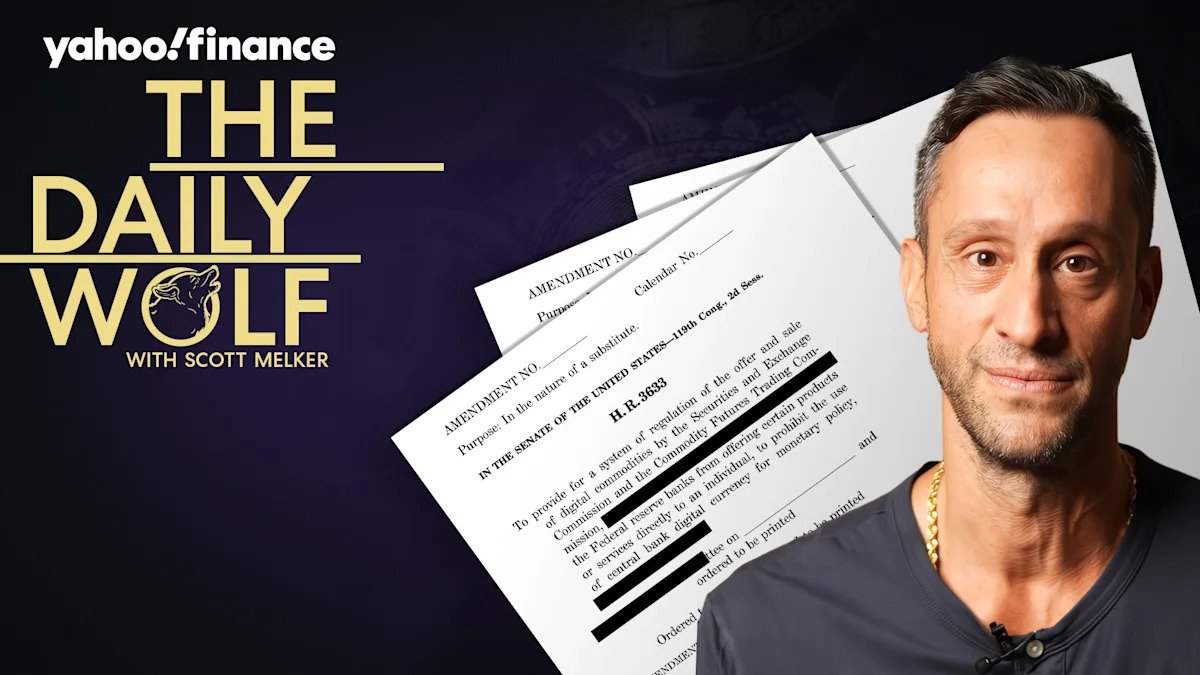
Scott Melker discusses the latest crypto-related headlines, including the latest draft of the CLARITY Act, which includes 126 changes; Trump agrees to new ethics provisions in the CLARITY Act, and Strategy’s (MSTR) $139M repurchase of STRC (STRC).
“The Daily Wolf with Scott Melker” airs every day at 12:00 p.m. Tune in for your daily dose of all things crypto.
Make sure to also check out Yahoo Finance’s new crypto hub to find the latest crypto-related news.
It’s not hyperbolic to say that this is going to be a huge week for crypto markets. We have two specific catalysts, of course, the FOMC meeting and rate decision on Wednesday, but the Clarity Act vote on the Senate floor tomorrow. We’re going to dig into all of that now. Let’s go.
What is up everybody? Welcome to the Daily Wolf on Yahoo Finance. I am your host Scott Melker, also known as The Wolf of All Streets. It’s Monday, so we get a full weekend of fodder for the news to discuss, but really this is a show that’s about looking forward.
We’re not going to talk about deeply the odds of a rate hike or rate cut. It seems a consensus now is that there will be a hike and we will find out on Wednesday. I for one have been in the camp that it was unlikely that worst would hike or hike for long, but we will see now that prediction markets are putting it at an 80 or 90% chance. But we have something that’s much more specific to Bitcoin and to crypto markets that’s happening this week that we’re going to unpack right now.
Here it is. Senate Republicans release final Clarity Act draft as Trump excess accepts most ethics provisions.
Okay, so I promised you basically that we would not talk about the Clarity Act for the last month and we were pretty successful at doing it. You’ll remember that we had an update on the Clarity Act nearly every single day. Well, now it’s time to pay attention. Tomorrow is the cloture vote on the Clarity Act on the Senate floor.
Now, a lot of people are misrepresenting what that vote means. Many people think that they’re voting on the Clarity Act tomorrow as if that means it will pass tomorrow and be sent to the house and then off to the president if it passes. What actually is happening tomorrow is a cloture vote, meaning that they’re basically voting on voting on bringing it bringing it to the floor so that they can decide whether it is even worth discussing. But regardless, it is a big day.
So, as updates, we were wondering what would happen in the month off, right? Would they actually pay attention to what was happening? Would it just be kicked to the curb? Would there be meaningful updates? Well, we got a meaningful update over the past few days. And that is that the champions of this bill, Lummis, Boozman and Scott have released a 635 page proposed substitute for the entire Clarity Act if it passes cloture tomorrow.
And notably, they have said, we haven’t read the entire text, but that it has 126 changes specifically requested by Democrats to get them to vote for it. So their point here, obviously, is that they are taking all necessary steps to come to consensus and to give up what is necessary to get this bill across the finish line.
Now, just on the voter math before we just dig into what’s actually in this new proposal. It takes 60 votes for cloture to pass. There are 53 Senate Republicans, meaning that they need seven Democrats to vote for it, assuming all Republicans do, which is not a foregone conclusion. Mitch McConnell’s missing, so it’s really 52 Republicans and eight Democrats needed. And we have four or five Republicans that have actually signaled that they are likely, at least a month ago, to vote no because they of various reasons. Because lobbyists have given them a bunch of money to say that. We’ll see what happens when it’s actually time to vote.
Now, if you’ve been listening to me over the past few months, you know that I thought the Clarity Act had an extremely low chance of passing, and it was specifically because of ethics. Well, I could be wrong. We’ll see. Trump agrees to new bipartisan ethics provision in massive crypto bill, Republican senators say. So what they’re saying is that he has agreed to 80% of the Tillis-Gallego ethics proposal, which is the proposal that was floated by Republicans, obviously, by his own party.
He’s conceding a lot here. Covered officials, judges and spouses would be restricted from issuing or sponsoring digital assets for compensation. So, this really does, uh, prohibit a lot of crypto activity by politicians. Notably, does not include the kids. Now, who do you think’s making money in the Trump family? But listen, we’ll give them the benefit of the doubt that that doesn’t need to extend that far.
So qualifying ownership of at least $15,000 in crypto businesses would generally require divestment or placement in a blind trust. That’s what’s being updated here. This threshold applies to equity and qualifying qualifying crypto businesses, not just personal crypto holdings. And this was a big sticking point. State attorneys general receive enforcement authority. Trump did not want to give that originally when this was proposed because he thought that it could be weaponized politically. He wanted it just to be the DOJ. So this means that State Attorney General receive enforcement authority, including against intermediaries that knowingly list prohibited politician-linked assets.
So it seems we are much closer on ethics and they are really putting the Democrats’ feet to the fire to say, ‘Hey, we’ve come 80% of the way, are you willing to come, uh, a meaningful percentage on your side?’ Now, the next major updates that we’re seeing in this new text is for developers, DeFi and self-custody, which is very important to the industry. So developers who publish software without controlling user transactions would not be treated as money transmitters solely for writing or maintaining that software. And this bill also continues to protect lawful self-custody through the keep your coins provision.
This is very important. Regulators would evaluate DeFi according to actual control, who can change the rules, restrict users or alter the protocol. So, of course, that leads us to the last major sticking point that we’ve seen, which is stablecoin rewards. That’s the one that killed this bill effec- effectively in December when Brian Armstrong came out and said, ‘No bill is better than a bad bill.’ By the way, I’m interviewing Brian Armstrong on Wednesday. You guys should probably tune in for that.
But here’s where we’re at with uh stable coins. Pretty much a similar place. Crypto platforms cannot pay passive yield simply for holding them. It has to be something active tied to transactions, liquidity, staking, etc. But here is the big innovation that’s a head scratcher. Treasury receives a circuit breaker if transfers into stablecoin substantially damage deposits at community banks with less than 10 billion in assets.
So I had to do a deep dive on what that means. Like how can Treasury do a circuit breaker on this? So the proposal gives Treasury a one-time window during the first 18 months after enactment to determine whether stablecoin rewards are causing substantial deposit losses at community banks, which are those with less than 10 billion in assets, and then they would be able to act on it. So it’s a one-time provision, if they see significant deposit flight, the Treasury can step in and try to write new rules.
So we have some major boundaries here that are being written. This language makes a lot of sense. Listen, there are a lot of question marks here where I wonder if the Clarity Act is even good for the industry at all, but at the end of the day, my default is that we need clear rules of the road. They can’t be changed if we get a more contentious administration like we had in the past moving forward into the future. And it would be great to see Clarity pass.
That said, uh, let’s take a look at uh Kalshi’s odds right here really quick. Will the Clarity Act become law before October 1st, 2027? 40%, that’s next year. Before July 1st, uh 2027, that is 37%. We can bring up the markets now here for the ones that are more relevant and near term, because that’s the ones that matter, 11%.
11% chance that it uh, that it passes before October 1st. So, markets still not believing this is going to happen. So Congress continues to debate how crypto companies can reward investors, but our favorite treasury companies, Strategy and Metaplanet are dealing with what their existing financial structures have cost investors.
So first we’ll start at Strategy. Not as negative as that uh transition sounded. But Strategy repurchased 139 million of STRC shares, leaves Bitcoin holdings unchanged. They’ve almost gotten STRC back to par. It was trading over $98 last I checked. Obviously wanted to get this up to 100. But very interesting that Strategy has massively slowed down here. They have created the two cash reserves. The one that they’re allowed to use discretionary uh buying of Bitcoin or their own shares or STRC. They’ve been using to buy STRC and they used more of that money.
So they did not dilute MSTR shareholders any further. They didn’t sell any MSTR. They did not buy or sell any Bitcoin here. In this case, they did exactly what they’ve been doing in recent memory, which is taking that extra cash they had raised, buying STRC so that they can get it back to par. I think they will. I think we’re going to look back and say that people like me were right when we said buy STRC in the 70s or the 80s, right?
Because naturally it was going to float back to full par. There was too much fear, uncertainty and doubt and negativity in the market for the actual reality of the situation. There were narratives saying the strategy was going to zero, they were going to be forced to sell 10 billion dollars in Bitcoin a week. Uh, they were insolvent, they were bankrupt. The reality is, I continued to tell you when I defended the actual math, data and facts was that they hold 845,050 Bitcoin. They cannot be insolvent or bankrupt when they have such an absolutely massive stack.
So Strategy is obviously working on shoring up the preferred shares here, while Metaplanet is reducing the number of shares its executives could eventually receive. And this is an update to a big story we had last week. You’ll remember that it came out that effectively every time Metaplanet diluted their shareholders to buy Bitcoin, they were also diluting them to pay the executives because it was a fixed 20% pool that continued to rise with the diluted shares. Tons of push back against Metaplanet. Metaplanet stock crashed and left many wondering what the hell will Metaplanet do about this.
Well Metaplanet makes 41% executive reward pool cut. Will shareholders forgive the dilution? That’s me in the picture right there. Right? Uh, I don’t know if they’ll forgive the dilution. It’s a valid question. But what they’ve done here is they’ve reduced potential shares under their Series 10 rights by 41% from 319.5 million to 188.2 million million, right?
So basically their CEO, who a lot of people were saying had some kind of conflicting interest, obviously was overpaying and rewarding themselves. CEO Simon Gerovich says the change eliminates more than 221, excuse me, 220 million of potential warrant value and raises Bitcoin per diluted share by approximately 8.8%. So they’re not rolling this thing entirely back, but they are rolling it back significantly. It seems that they’re trying to thread the needle over uh still getting paid and doing enough for shareholders not to keep selling off their stock.
But the words they used here are the most interesting to me. Bitcoin per diluted share. So we’ve looked at metrics like Bitcoin per share, MNAV, all these new terms that we’ve basically come up with for treasury companies. Well, we have a new one that’s going to hit the dictionary. Bitcoin per diluted share. So maybe that is going to become the metric moving forward by which we value Bitcoin treasury companies.
But it’s clear here that total Bitcoin holdings can rise while each shareholder’s claim on that Bitcoin barely improves because there are other mechanics behind the scenes. So now Bitcoin per diluted share is going to be the number that matters. Now, Metaplanet shareholders, uh, feared losing part of their ownership and rightfully so.
The next story is how Revolut customers may have lost control of something much harder to replace. Their identities. Bitcoin activity, passports exposed after Revolut falls for fake government request. This is so horribly, astoundingly, terribly bad.
So a, a group calling itself Revolut Smilick claims responsibility and is demanding payment of 10,000 Bitcoin from Revolut. That’s this one right here. Revolut facing ransom request after hackers obtained customer data. So, here’s what happened. The allegers allegedly used an email account on a legitimate government agency domain, don’t know how they did that, to submit fraudulent information requests.
Revolut responded by giving their high wealth, uh high net worth individuals identity documents, verification selfies, addresses, statements and transaction histories including Bitcoin transactions and balances to the hackers. Okay. So we’ve obviously seen exploits in the past, which are problematic. We’ve obviously seen data breaches in the past which are problematic.
We know about the wrench attacks that have happened in France, uh, for example, which is what happens when somebody finds out that you are potentially holding Bitcoin. In this case, these are the higher net worth individuals and now the hackers know not only all of your identity information, including literally your verification selfies, addresses and statements, they know exactly how much Bitcoin you have bought and sold, are holding, and your transaction history.
So before, at least the hackers or the criminals had to go the next step to try to figure out how much Bitcoin you had or even if you had it. They just knew you paid taxes or that your data, you know, was breached because you had bought a ledger or a treasure or something like that. Now they not only know that, they know exactly what you have. This is so bad, right? I mean, your funds can be safe, but that doesn’t resolve the risk when criminals have your passport, address and complete financial history. This is absolutely horrifying.
I I’m going to actually stop the show at that story because it’s such a head-shaker. Where are you even safe holding financial assets at this point? And this isn’t an AI story. This is literally like somebody just spun up a fake email address and convinced Revolut to send the information. So, uh, really, really scary stuff.
Now, obviously, tomorrow’s going to be a huge day. You know what we’re going to be covering this week, which is what’s happening with the Clarity Act. If it just fails tomorrow, there’s not going to be as much to cover. But if it somehow does pass cloture, we’re going to have a lot to talk about as to which parts of these provisions get debated and which ones make it potentially into law. That’s it. See you tomorrow. Peace.
Source: finance.yahoo.com