

Don't want to trade it yourself?
Our desk runs DEX portfolios on profit share.
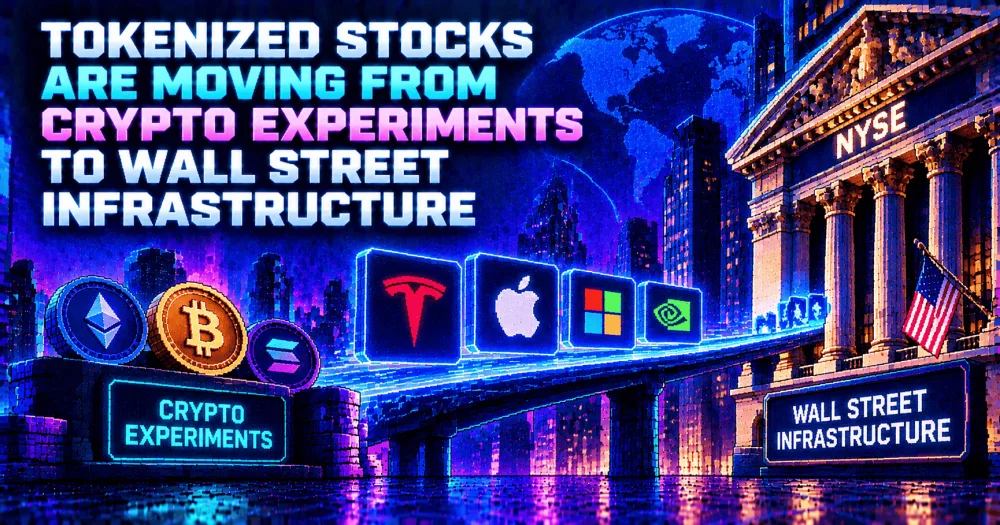
Tokenized stocks are transitioning from crypto experiments into mainstream financial infrastructure. Nasdaq, DTCC, Robinhood, Kraken, and Ondos all see tokenization as a market-structure initiative that has the potential to impact equities trading, settlement, custody, collateral, and access to the market.
Tokenized Stocks Are No Longer Just a Crypto Experiment
Stock tokenization used to be a crypto-native phenomenon that existed primarily on crypto platforms that represented price exposure to public companies. However, in 2026, the space is witnessing a fundamental shift, with major financial institutions building critical infrastructure around tokenized securities.
Why Tokenized Stocks Are Moving Into Financial Infrastructure
The single most important reason for the adoption of tokenized equities by the financial infrastructure space is the value proposition around operations. With programmability, portability, and onchain settlement, blockchain technology has the ability to fundamentally reinvent the structure and settlement of securities.
From Crypto Platforms to Nasdaq and DTCC
Crypto platforms demonstrated investor appetite for onchain equity exposure. Nasdaq and DTCC now bring exchange, custody, clearing, and settlement expertise to the same market, providing stock tokenization with much broader institutional credibility.
What Are Tokenized Stocks?
Tokenized stocks are crypto assets that represent shares or rights to shares. Some structures tie directly to real securities held by custodians. Others encode separate economic claims that mirror the economics of an underlying stock.
How Stock Tokenization Works
A provider typically encodes a specific right to a share into a token. The provider may hold the underlying shares with a custodian and issue corresponding blockchain tokens. Smart contracts can then govern transfers, redemptions, and compliance.
Tokenized Stocks vs Traditional Stocks
Traditional stocks generally live within the confines of broker, exchange, clearing, and custody ecosystems. Tokenized equities can settle across compatible blockchains and digital wallets. The underlying legal rights may be comparable, but the infrastructure is very different.
Tokenized Stocks vs Synthetic Stock Tokens
Tokenized equities and synthetic stock tokens can appear analogous on a stock price chart. The similarities often end at the price chart, however. The two products have fundamentally different legal and economic structures.
Who Owns the Underlying Shares?
It depends on the product. A custodian, broker, or special-purpose entity may hold shares on behalf of token holders. Investors should always research who controls the stock and what claim the token provides.
Why Wall Street Is Embracing Stock Tokenization
Wall Street views tokenization as an opportunity to reinvent market plumbing. The primary value propositions are always-on trading, faster settlement, reduced post-trade costs and friction, and greater collateral mobility. Each of these areas represents a major
24/7 Trading and Always-On Markets
Blockchain provides 24/7 availability, unlike traditional exchanges. This can enable tokenized equities to trade beyond regular market hours. Investors can gain flexibility, although significant liquidity may still concentrate in U.S. hours.
Faster Settlement on Blockchain
U.S. equities currently settle on a T+1 cycle. Tokenized securities could enable much faster settlement by shifting assets almost immediately between approved participants. This can reduce exposure and capital costs.
Lower Settlement and Post-Trade Costs
Traditional securities markets involve a proliferation of databases that must be reconciled. Shared blockchain settlement can reduce the operational and capital expenditures involved in post-trade processing. Firms could save significantly if tokenization reduces the burden of reconciliation and operations.
Tokenized Stocks as Onchain Collateral
Tokenized equities can serve as valuable collateral within digital financial systems. Investors may eventually pledge them as margin or collateral without leaving a blockchain environment. This could create major efficiencies for capital markets.
Nasdaq Is Building Infrastructure for Tokenized Equities
Nasdaq wants to bring public equities into blockchain-based markets. The firm is focused on the regulated infrastructure side, which may give Nasdaq equity tokens an edge in terms of connection to issuers.
What Are Nasdaq Equity Tokens?
Nasdaq Equity Tokens are Nasdaq’s planned blockchain-based equity representation product. They emphasize preserving corporate actions, ownership, and market integrity, creating a link between issuers and tokenized versions of their stocks.
Why Nasdaq Invested $100 Million in Kraken’s Parent Payward
Nasdaq has agreed to invest $100 million in Payward, the crypto-native parent company of Kraken. Payward brings crypto-native distribution and expertise in blockchain technology. Nasdaq offers exchange technology, compliance expertise, and institutional market infrastructure.
How Nasdaq Equity Tokens Could Work With xStocks
xStocks offers crypto-native users exposure to tokenized equities. Nasdaq can bridge Nasdaq equity-token products with this ecosystemhanced compliance protections
When Will Nasdaq Tokenized Stocks Launch?
Nasdaq has indicated that its framework for tokenized equity products could launch in 2027. The actual timing will depend on a variety of factors, but investors should view this as a long-term infrastructure play.
DTCC Is Turning Tokenization Into Wall Street Infrastructure
DTCC represents a critical pillar of U.S. market infrastructure. Its work to adopt tokenization can have far-reaching implications for the industry, as it connects with critical components like clearing, settlement, and custody.
What Is DTCC’s Tokenized Securities Platform?
DTCC is building infrastructure for the representation of eligible securities on a blockchain. Underlying assets can remain within the custody framework, while tokenized versions settle across approved digital networks with defined controls.
How Tokenized Securities Could Work With Existing Market Infrastructure
DTCC does not have to disrupt existing markets to realize the value of tokenization. The firm has the potential to connect blockchain-based representations of assets with custody and settlement systems in a way that reduces complexity for the industry.
Why Tokenization Matters for Clearing and Settlement
Clearing and settlement processes are highly repetitive. Tokenization can help automate operations while reducing the number of parties involved in the process. Smart contracts can also embed controls around transfers of assets directly within the transaction.
Robinhood, Kraken and Ondo Are Bringing Stocks Onchain
Consumer platforms and crypto-native firms are building out their tokenized stock offerings. They are focused more on the distribution side, but the industry as a whole is seeing rapid expansion of the tokenized stock market.
Robinhood’s Tokenized Stock Strategy
Robinhood has been expanding its tokenized stock offerings to include eligible international users. The firm is leveraging blockchain for financial applications, with potential future applications for trading, collateral, and DeFi.
Kraken and xStocks
Kraken has partnered with xStocks to bring tokenized equity exposure to crypto-native users. The environment better suits users who are already accustomed to wallets, stablecoins, and always-on markets. However, the success of this approach will ultimately depend on liquidity, regulation, and interoperability.
How Ondo Tokenized Stocks Work
Ondo offers tokenized versions of U.S. stocks and ETFs for eligible investors. Its approach encodes blockchain tokens with exposure to assets that are held within regulated financial institutions. Users can access the tokens through their preferred wallets and platforms.
Tokenized Equities and DeFi
DeFi can provide a wide range of composability benefits for tokenized equities that go beyond traditional custody and trading environments. Investors may see new opportunities with tokenized shares in lending markets, collateral applications, and decentralized exchanges. This level of composability cannot be replicated with traditional brokerage accounts.
Are Tokenized Stocks Actually Stocks?
The answer depends on the structure of the particular product. Some tokenized securities can preserve rights comparable to traditional shares. Other products only provide indirect economic exposure to a stock.
Ownership vs Economic Exposure
Ownership grants investors recognized rights over an asset. Economic exposure only reflects gains and losses relative to the value of the asset. The two structures can behave very similarly in normal markets, but they often diverge in times of stress.
Custody of the Underlying Shares
Asset-backed tokenized stocks still require reliable custody solutions. The shares themselves may be held by a bank, broker, or another custodian. Investors should always carefully assess segregation, audits, redemption rights, and protections in the case of bankruptcy.
Dividends and Corporate Actions
Many tokenized stock structures are capable of distributing dividends or their equivalents to token holders. Corporate actions are more complex, however. Proper infrastructure is necessary to ensure that tokenized shares accurately reflect splits, mergers, and tender offers.
Voting Rights
Voting rights vary considerably by tokenized stock structure. Some products may encode governance rights that grant voting power over corporate actions. Other structures only track financial performance. Investors should never assume that a tokenized stock includes the voting rights of a traditional share.
What the SEC Says About Tokenized Securities
The regulatory principles are relatively straightforward. The advent of blockchain technology does not eliminate securities laws. Regulators focus on the economic reality of the token and investor accessibility.
Are Tokenized Stocks Regulated Securities?
Under most structures involving real equities, tokenized stocks still qualify as securities. The change in format does not alter the economic reality of the asset. However, platforms must still consider registration, custody, disclosure, and trading requirements.
Do Existing Securities Laws Apply On-chain?
Existing securities laws can apply when assets move on-chain. A blockchain record does not constitute an exemption from regulation. Firms should design their tokenization structures around the same investor protections framework as traditional markets.
Issuer-Sponsored vs Third-Party Tokenization
Issuer-sponsored tokenization typically involves the company or an approved partner. Third-party products represent separate economic claims around the same issuer’s shares. Issuer-backed products can preserve more direct corporate governance connections.
Tokenized Stocks vs Traditional Stock Trading
The advantages of tokenized stocks versus traditional stocks depend on the structure of the market and the needs of the investors. The traditional markets provide deep liquidity and regulatory protections. Tokenized stocks offer greater flexibility and programmability.
| Feature | Tokenized Stocks | Traditional Stocks | Synthetic Stock Tokens |
|---|---|---|---|
| Underlying Asset | Usually linked to real shares or securities | Real company shares | May track price without holding shares |
| Trading Hours | Potentially 24/7 | Mainly exchange trading hours | Often 24/7 |
| Settlement | Can settle onchain within minutes or seconds | Usually T+1 in the U.S. | Depends on platform and smart contracts |
| Ownership Rights | Depend on legal structure | Established shareholder rights | Usually no direct shareholder rights |
| Dividends | May pass dividends or equivalent payments | Paid directly to eligible shareholders | Depends on product design |
| Voting Rights | Sometimes available | Usually available to eligible shareholders | Usually unavailable |
| Custody | Shares may sit with a regulated custodian | Broker, custodian, or central depository | Often collateral-based |
| Transferability | Can move between compatible wallets or platforms | Usually stays inside brokerage infrastructure | Often transferable onchain |
| DeFi Use | Can potentially serve as collateral or liquidity | Very limited | Often designed for DeFi use |
| Liquidity | Still fragmented across platforms | Deepest liquidity | Depends heavily on platform |
| Regulation | Securities laws can still apply | Established securities framework | Structure and jurisdiction determine treatment |
| Main Risk | Custody, counterparty, smart contract, and liquidity risk | Market and broker-related risk | Counterparty, oracle, collateral, and smart contract risk |
Trading Hours
Traditional exchanges concentrate liquidity within specific hours. Tokenized markets can provide 24/7 availability that better suits global investors.
Settlement
Traditional U.S. equities settle on a T+1 cycle. Blockchain systems can enable much faster settlement between known parties. This can reduce counterparty risk and capital costs.
Ownership
Traditional brokerages operate within established ownership frameworks. Tokenized shares can have different legal structures, depending on the product. Investors should always research the details of what they are buying.
Liquidity
Traditional exchanges dominate in terms of equity liquidity. Tokenized stock markets remain fragmented, with limited price discovery across platforms.
Investor Protection
Traditional securities markets have well-established protections for investors. Tokenized markets must provide comparable levels of custody, disclosure, surveillance, and dispute resolution to gain mainstream acceptance.
The Biggest Problems With Tokenized Stocks
Tokenization introduces some valuable innovations, but it also creates new risks. The most important concerns relate to liquidity, regulation, custody, smart contracts, and market structure.
Liquidity Fragmentation
There can be multiple versions of the same stock across different tokenized offerings. Different platforms may utilize separate blockchains and settlement mechanisms, fragmenting liquidity and creating wide price variations.
Regulatory Restrictions
Are tokenized stocks legal? It depends on the jurisdiction, but such products are often unavailable to investors in certain regions. A product that is accessible in Europe may not be available in the United States.
Custody and Counterparty Risk
Tokenized securities can depend on custodians, brokers, issuers, and redemption agents. If any component fails, investors can suffer losses or delays.
Smart Contract and Oracle Risk
Smart contracts can have coding vulnerabilities. Oracles can publish incorrect information. Bridges can introduce additional attack vectors. Tokenized markets face financial and technical risks simultaneously.
Why 24/7 Trading Does Not Mean 24/7 Liquidity
Can tokenized stocks trade 24/7? Yes, but liquidity often declines substantially outside of regular hours for the underlying stock exchange.
Why Tokenized Stocks Could Change Wall Street
Stock tokenization could change the paradigm around equity markets. Stocks may move from being highly specialized products to continuously accessible financial instruments that span a wide variety of platforms and structures.
From Market Hours to Always-On Markets
Traditional finance has historically been limited by the operating hours of exchanges. Blockchain networks are always on and can support settlement at any time. This has the potential to fundamentally change expectations around equity markets.
From Broker Accounts to Blockchain Wallets
Broker accounts currently dominate in terms of equity ownership. Tokenization has the potential to bring shares into compatible blockchain wallets. Wallets could become a new interface for regulated financial instruments.
From Traditional Settlement to On-chain Settlement
On-chain settlement can shorten the time between trade execution and final asset transfer. Digital securities and digital cash can settle within the same environment, reducing reconciliation burdens.
The Convergence of TradFi and DeFi
Traditional finance provides the benefits of regulation, liquidity, and institutional infrastructure. DeFi brings programmability and continuous operation. Tokenized equities represent the convergence of the two systems.
Investors often confuse tokenized stocks with fractional shares. Both products address the same concern of access to expensive equities, but the mechanics are very different.
What Fractional Shares Already Solve
Fractional shares enable investors to purchase less than one full share of stock. This lowers the entry cost for expensive equities. Brokers enable this type of purchase for most publicly traded companies.
What Tokenization Adds
Tokenization introduces portability, programmability, and settlement advantages. A tokenized share can move across more platforms and potentially serve as collateral.
Why Blockchain Could Matter for Global Investors
Many investors face friction when trying to purchase foreign equities. Broker availability, settlement challenges, fees, and hours can all create barriers. Blockchain distribution can eliminate some of these obstacles where regulators permit.
The Global Race to Tokenize Equities
Stock tokenization has become a worldwide competition. Different regions are experimenting with various combinations of regulation and blockchain technology. The eventual winners will shape the way that global investors access equities.
United States
U.S. markets represent the deepestiderations critically important. Nasdaq and DTCC demonstrate how tokenization can evolve within an established financial ecosystem
Europe
Europe has emerged as an important market for digital securities. Jurisdiction-specific regulations apply to platforms, but the region has strong investor-protection frameworks that will shape the evolution of the industry.
Asian financial centers are embracing tokenization at a rapid pace. The region has access to vast amounts of capital and offers cross-border investment opportunities. National regulations will continue to impact market access.
Crypto-Native Markets
Crypto-native platforms can enable faster adoption due to their existing user base of wallets, stablecoins, and smart contracts. However, the industry must address the challenges of legal compliance and institutional liquidity to compete with traditional markets.
What Tokenized Stocks Mean for Investors
Investors should prioritize structure when evaluating tokenized stocks, rather than getting distracted by crypto-centric marketing. Eligibility, ownership, custody, liquidity, and transfer capabilities matter most.
Can Anyone Buy Tokenized Stocks?
It depends on the product, but most offerings are not available to all investors. Eligibility often depends on jurisdiction, platform, and investor type.
Do Tokenized Stocks Pay Dividends?
Some products can pay dividends or their equivalents, depending on the structure of the offering. Investors should always research the details before purchasing.
Can Tokenized Stocks Be Used in DeFi?
Some tokenized equities can participate in DeFi applications. Potential use cases include lending, margin trading, and collateral, but investors should also consider the risks of smart contracts and liquidity.
Can Tokenized Stocks Be Transferred Between Wallets?
Some products permit wallet-to-wallet transfer, while others restrict movements to specific addresses. This depends on the compliance requirements and design of the token.
The Future of Tokenized Equities
The future of tokenized equities is no longer a question of whether stocks can move to blockchain, but which infrastructure model will dominate the space.
From Crypto Product to Financial Infrastructure
Early iterations of tokenized stocks largely focused on replicating the price of traditional securities for crypto-native users. New infrastructure projects emphasize settlement, custody, and issuer relationships, representing a shift toward financial infrastructure.
The Rise of Always-On Equity Markets
Always-on markets pose one of the most disruptive potential impacts of tokenized equities. Crypto-native traders have already come to expect 24/7 availability. Similar trends could emerge in traditional equity markets.
Will Tokenized Stocks Become the Standard for Equities?
Tokenized stocks do not need to completely replace existing market structures in order to succeed. Blockchain technology can add a layer of infrastructure beneath familiar trading applications.
Tokenized stocks are blockchain-based representations of equities or rights to equities. Some connect to actual shares, while others provide indirect claims.
How Do Tokenized Stocks Work?
A provider typically holds the underlying shares and issues blockchain tokens that encode a specific right to a share. Smart contracts can manage transfers, redemptions, compliance rules, and other functions.
Are Tokenized Stocks Real Stocks?
Some tokenized securities preserve rights similar to traditional shares. Other products create separate claims that are tied to stock performance.
Are Tokenized Stocks Legal?
They can operate legally within regulated frameworks. Availability depends on the jurisdiction, structure, custody, registration, and investor eligibility.
Nasdaq Equity Tokens are Nasdaq’s planned framework for regulated tokenized equities. The project aims to connect traditional securities infrastructure with blockchain-based markets.
Can Tokenized Stocks Trade 24/7?
Many tokenized stocks can technically trade around the clock, but liquidity may weaken substantially outside of regular market hours for the underlying stock exchange.
Do Tokenized Stocks Have Voting Rights?
Not always. It depends on the token’s structure and the legal framework. Some products preserve shareholder rights, while others only provide indirect exposure.
Many asset-backed structures can distribute dividends or their equivalents. Investors should review the product terms before purchasing. Different platforms can handle distributions differently.
What Is The Difference Between Tokenized And Synthetic Stocks?
Tokenized stocks can represent securities or claims related to actual shares. Synthetic stocks usually recreate price exposure through derivatives, collateral, or contractual mechanisms.
Source: <a href="https://bitcoinfoundation.org/news/regulation/tokenized-stocks-are-moving-from-crypto-experiments-to-wall-street-infrastructure/” target=”_blank” rel=”nofollow noopener”>bitcoinfoundation.org