

Don't want to trade it yourself?
Our desk runs DEX portfolios on profit share.
Crypto: Iran Eases the Use of Bitcoin and USDT for Trade
19h05 ▪6min read ▪ byLydie M.
Getting informed▪Bitcoin (BTC)Summarize this article with:
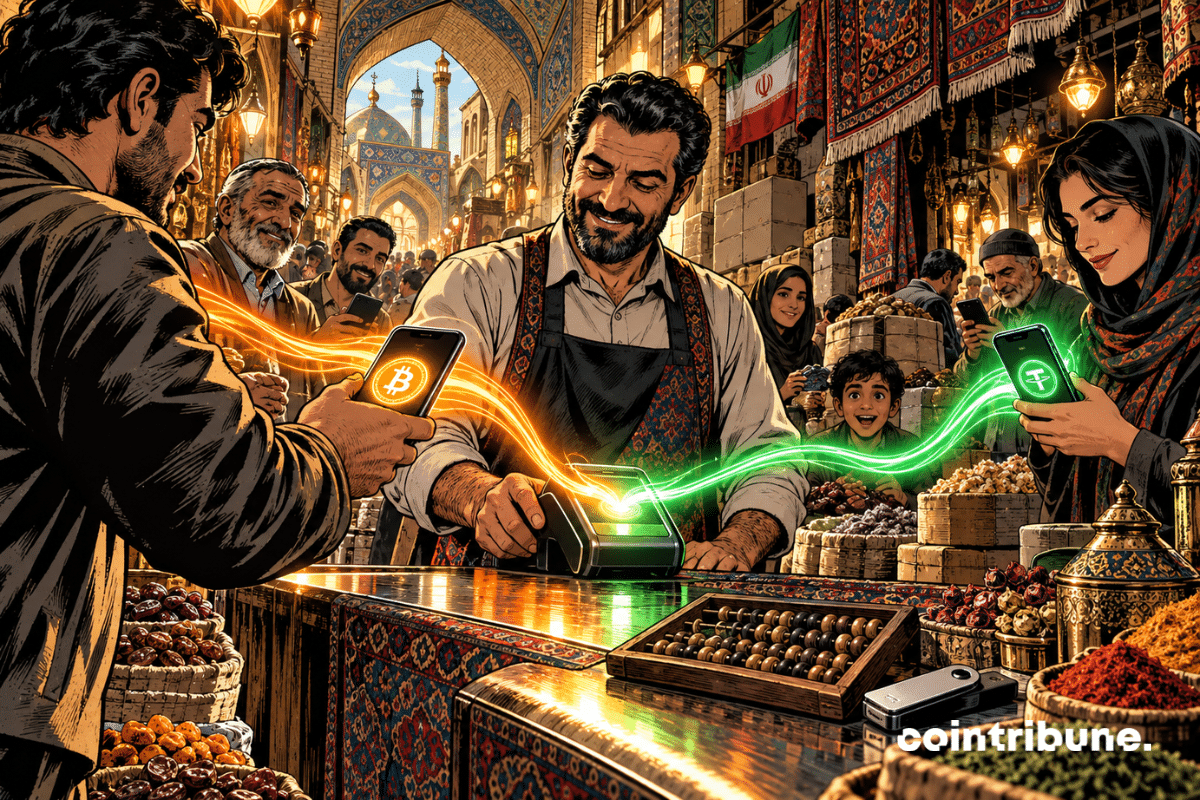
Iran loosens part of its currency controls and allows more room for crypto in its international exchanges. According to the Financial Times, exporters can now use their foreign revenues to directly finance imports and resort to bitcoin or USDT for certain cross-border settlements. Nearly 9.9 billion dollars of crypto activity had already been attributed to Iran in 2025. The Iranian Central Bank has not publicly commented on these new rules.
In brief
- Iranian exporters have more freedom to use their foreign revenue.
- Bitcoin and USDT can be used for certain cross-border payments, according to the Financial Times.
- Four sanctioned Iranian exchanges accounted for 78% of the crypto volume attributed to the country in 2025.
Crypto: Tehran gives more leeway to exporters
The change first applies to currencies. Iranian companies can directly use part of their foreign revenues to finance their imports. They no longer necessarily have to sell these currencies first on the government platform at the official rate.
Crypto is among the possible channels. Bitcoin and especially USDT can be used to settle certain transactionsgton sanctioned Shelbit and Aban Tether, two platforms accused by the US Treasury of facilitating financial circuits linked to Iran
This is not a general legalization of all crypto flows. Tehran is mainly seeking to more easily recover revenues generated abroad while access to international banks remains heavily restricted.
The Financial Times also reports that authorities are still investigating export revenues that have not been repatriated. The Central Bank has not responded to Cointelegraph about the details of the arrangement. This point matters: the use of Bitcoin and USDT is reported by the Financial Times, but no official detailed text from the Central Bank has yet been made public in the consulted
Your 1st cryptos with BinanceThis link uses an affiliate program.
Nearly 10 billion dollars circulated in crypto in 2025
Iran already starts from a significant base. TRM Labs estimates at 9.9 billion dollars the crypto volume attributed to the country in 2025. Nobitex, Bitpin, Wallex, and Ramzinex alone represented about 7.7 billion, or 78% of the total. The four platforms were sanctioned by the OFAC on June 2.
Nobitex dominates widely. The US Treasury estimates that the exchange processed more than half of Iranian digital asset inflows in 2025. Wallex accounted for about 12%, Bitpin 10%. Ramzinex has processed more than 2.45 billion dollars since its creation.
Connections with foreign platforms are also documented. TRM Labs says it traced 3.84 billion dollars of flows between CoinEx and sanctioned Iranian entities over more than seven years. About 2.7 billion concerns Nobitex.
The same report identifies nearly 67 million dollars from the Iranian Central Bank arriving at CoinEx addresses between June 2025 and June 2026. The movements reportedly used several blockchains and intermediate steps before reaching the exchange. CoinEx denies any business relationship with the Iranian government or local platforms.
The case goes beyond CoinEx. An investigation covered this summer by Cointribune also identified 676 million dollars of transfers between Shelbit and Binance. However, Reuters did not establish that all these funds were directly controlled by Iranian authorities. The amounts are high. The circuits are also numerous.
Washington now puts the entire Iranian crypto sector under pressure
The United States has expanded its response. On August 24, the US Treasury officially added digital assets to Iranian sectors that can be subject to sanctions. The arrangement allows OFAC to target foreign individuals or companies operating in this sector or providing certain services to it.
Washington specifically cites crypto among the means used by Iran to move money outside traditional financial circuits. On the same day, the Treasury sanctioned Ivan Obukhov, a broker based in the United Arab Emirates. The administration claims he processed more than 100 million dollars in cryptocurrencies since 2023 to facilitate oil sales benefiting the IRGC Qods Force.
Sanctions had already begun to directly target exchanges. Nobitex, Wallex, Bitpin, and Ramzinex in June. Shelbit and Aban Tether in August. Bitcoin and stablecoins allow the transfer of funds without using a US correspondent bank. This does not make transactions invisible.
Public blockchains leave traces. Centralized exchanges also keep customer data, and stablecoin issuers can block certain addresses. This is especially true for USDT.
For foreign companies, the risk remains concrete. Cointribune had already detailed the exposure to sanctions of companies paying Iran in crypto, notably in maritime transport. Tehran is therefore opening its commercial circuits to digital assets more as Washington precisely expands its means to monitor them. No need to speculate further. In 2025, nearly 10 billion dollars had already circulated in the Iranian crypto ecosystem. The new rules now seek to make part of this infrastructure more useful for foreign trade.
Maximize your Cointribune experience with our “Read to Earn” program! For every article you read, earn points and access exclusive rewards. Sign up now and start earning benefits.

Lydie M.
Enseignante et ingénieure IT, Lydie découvre le Bitcoin en 2022 et plonge dans l’univers des cryptomonnaies. Elle vulgarise des sujets complexes, décrypte les enjeux du Web3 et défend une vision d’un futur numérique ouvert, inclusif et décentralisé.
The views, thoughts, and opinions expressed in this article belong solely to the author, and should not be taken as investment advice. Do your own research before taking any investment decisions.
Source: www.cointribune.com