


Don't want to trade it yourself?
Our desk runs DEX portfolios on profit share.

The U.S. labor market delivered a stronger-than-expected August jobs report, pushing Bitcoin lower as traders increased bets that the Federal Reserve could raise interest rates at its September meeting.
U.S. employers added 162,000 nonfarm jobs in August, according to the Bureau of Labor Statistics, far above the roughly 56,000 – 65,000 jobs economists had expected. The unemployment rate remained unchanged at 4.1%.
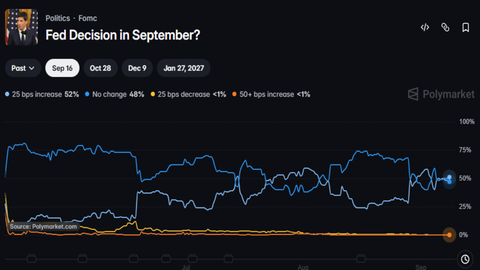
Bitcoin reacted quickly. After briefly trading above $82,000, BTC fell back below $80,000 as markets reassessed the outlook for U.S. monetary policy. As of Monday, Bitcoin was trading around $79,500, while markets were pricing roughly a 60% probability of a September Fed rate hike.
The stronger labor data creates a new test for the crypto market after weeks of improving institutional demand.
Strong jobs data revives Fed rate hike bets
August payroll growth was significantly stronger than the average monthly gain of 31,000 recorded over the previous 12 months. Employment gains were concentrated in food services and drinking places, while local government education also added jobs.
The unemployment rate remained at 4.1%, while average hourly earnings increased 0.3% during the month and were up 3.1% from a year earlier.
For financial markets, the combination of stronger hiring and steady unemployment reduced expectations for immediate monetary easing. Fed funds futures subsequently increased the probability of a September rate hike to around 58% – 60%, compared with roughly 50% before the report.
That shift matters for Bitcoin because higher interest rates can reduce liquidity available for risk assets such as cryptocurrencies.
Trump pushes for lower rates as markets price tighter policy
The jobs report also highlighted the difference between political pressure and market expectations.
Donald Trump called for lower interest rates following the employment data, arguing that the U.S. economy and credit position supported cheaper borrowing costs. However, traders moved in the opposite direction as the strong labor market gave the Federal Reserve less immediate reason to ease policy.
The September 15 – 16 Fed meeting is therefore becoming the next major catalyst for Bitcoin and other risk assets.
The upcoming inflation data will be particularly important. Investors are now looking for evidence that inflation is cooling enough to offset the stronger labor market signal. U.S. consumer price data is due later this week and could determine whether the recent increase in rate hike expectations holds.
Bitcoin’s institutional support faces a macro test
The stronger jobs report arrives after a significant recovery in institutional demand for Bitcoin.
U.S. spot Bitcoin ETFs recorded $986.9 million in net inflows during the week ended September 4, extending their positive streak to three consecutive weeks. August was even stronger, with the funds attracting $3.52 billion in monthly net inflows.
That institutional buying helped Bitcoin recover toward the $80,000 – $82,000 area, but the latest macroeconomic shift shows that ETF demand alone may not be enough to keep prices moving higher if investors begin pricing a more restrictive Fed.
This follows the broader market pattern seen earlier in September, when Bitcoin and other cryptocurrencies came under pressure as traders responded to changing rate expectations.
What the September Fed decision means for Bitcoin
The August jobs report does not guarantee a rate hike. It simply changes the balance of expectations ahead of the Federal Open Market Committee meeting.
A continued rise in rate-hike expectations could keep pressure on Bitcoin and other risk assets, particularly if upcoming inflation data remains elevated. On the other hand, softer inflation could reverse some of the hawkish repricing and allow the recent Bitcoin rally to resume.
For now, Bitcoin remains close to the $80,000 level after retreating from its latest multi-month high. The combination of strong ETF inflows and a more hawkish interest rate outlook leave the market caught between institutional demand and tighter financial conditions.
The next major test will be the U.S. inflation report. If inflation cools while employment remains resilient, markets could regain confidence in the Bitcoin rally. A hotter inflation reading, however, would strengthen the case for tighter Fed policy and could extend the current pullback.
Source: www.altcoinbuzz.io
1 Comment
Pingback: Why Bitcoin, Ethereum and XRP uphold bullish outlook despite correction? – xpertsstudio