

Don't want to trade it yourself?
Our desk runs DEX portfolios on profit share.
AI translated#Middle East#Opinions
Opinion: Conflicts Accelerate Cryptocurrency Adoption in the Middle East
Conflicts boost crypto adoption in the Middle East.
Military conflicts and the instability of national currencies have heightened interest in cryptocurrencies as a means of preserving and transferring capital in the Middle East. This conclusion was drawn by Zaid Belbagi, managing partner at London’s Hardcastle Advisory, in an article for the <a href="https://xpertsstudio.com/bitcoin-survives-yen-surge-that-crushed-crypto-in-2024/” title=”Bitcoin Survives Yen Surge That Crushed Crypto in 2024″>Bitcoin Policy Institute (BPI).
According to the organization, the annual volume of on-chain transactions in the region increased from approximately $100 billion in 2022 to around $350 billion in 2025-2026.
Unlike the global market, where growth was driven by institutional investments and regulatory changes, in the MENA region, the drivers are identified as macroeconomic pressure and government digitalization programs.
Initial Market Reaction
Belbagi examined the market’s reaction to the escalation between Israel and Iran in June 2025. Following the initial strikes, Bitcoin fell by about 2.3% to $105,200, while Ethereum lost 7.5%. The total cryptocurrency market capitalization decreased by 3.7%.
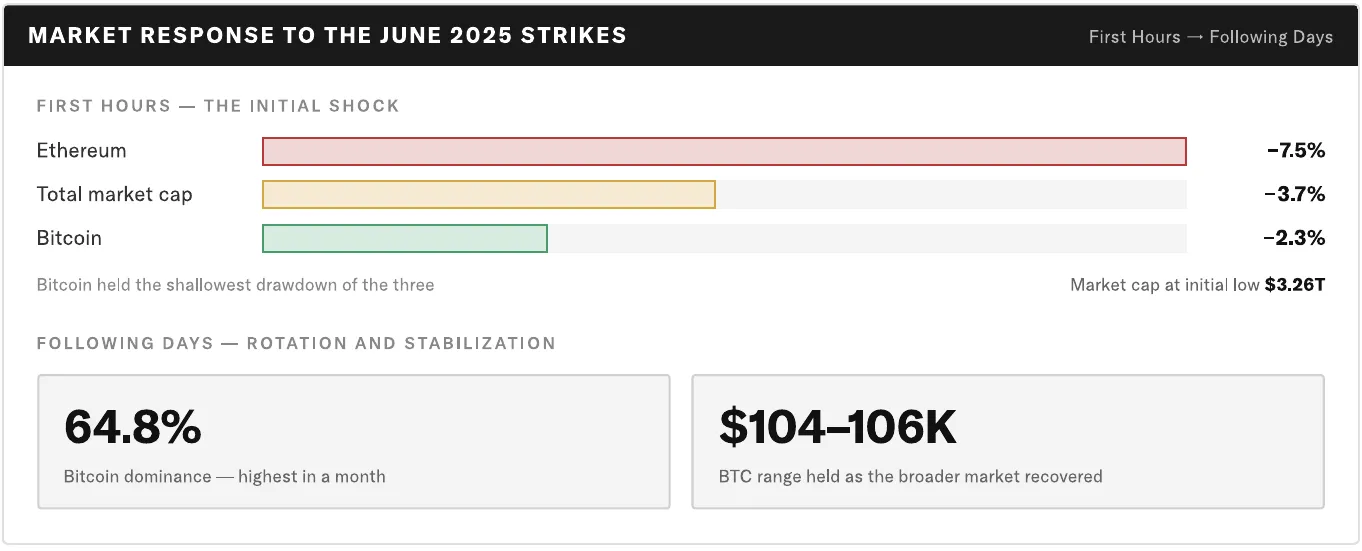
Later, the price of the leading cryptocurrency stabilized in the range of $104,000-$106,000, and its market capitalization share reached 64.8%. The expert interpreted this trend as investors shifting from altcoins to Bitcoin to reduce risk.
He also noted the continuous operation of crypto platforms. Steven Coltman from 21Shares, whose opinion is cited by BPI, pointed out that during strikes on the UAE in 2026, local stock exchanges suspended trading, while digital asset trading platforms continued operations.
Different Reasons for Adoption
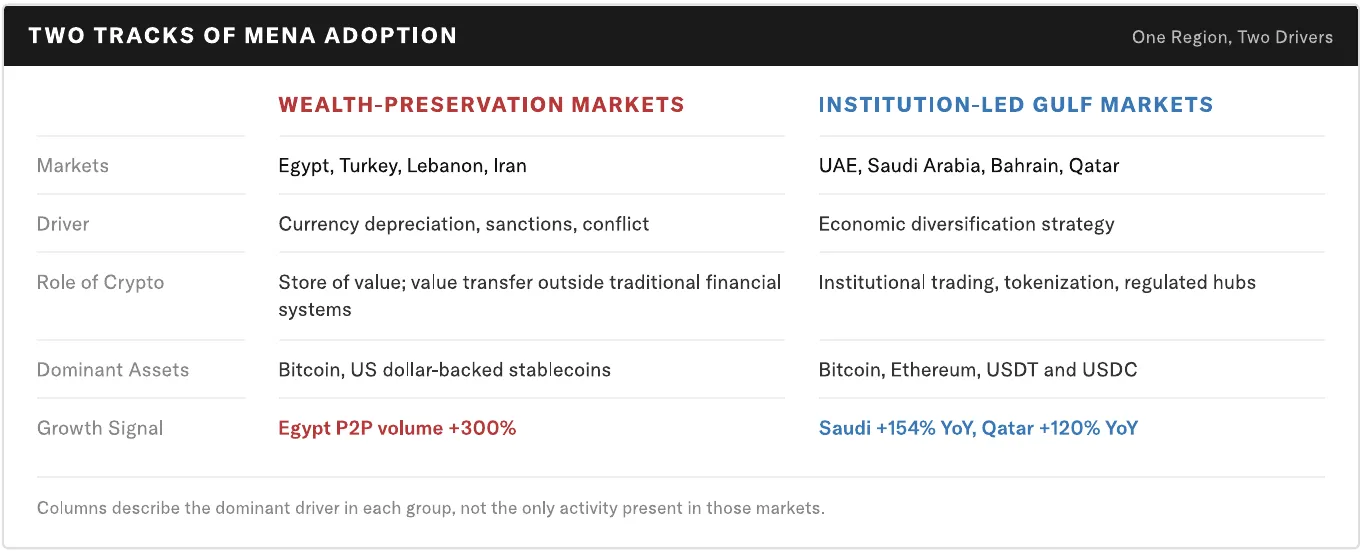
Belbagi identified two scenarios for the region’s development. In Egypt, Turkey, Lebanon, and Iran, the demand for Bitcoin and dollar-pegged stablecoins is linked to currency devaluation and restrictions of the traditional financial system.
In the UAE and Bahrain, growth is supported by regulation, institutional participants, and government economic diversification programs.
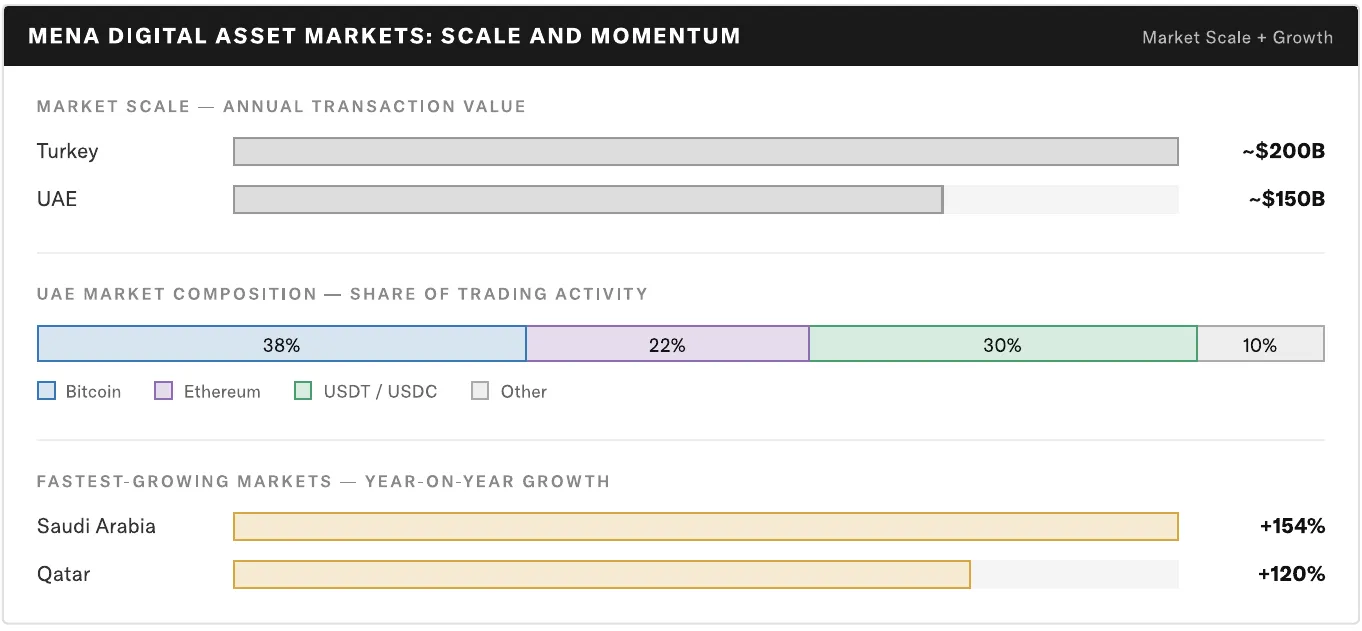
Differences between markets were also recorded by analysts at Chainalysis in their 2025 report. In the UAE, the volume of small crypto payments through trading services—less than $1,000—increased by 88.1% during the reporting period. Specialists linked this to the expansion of everyday use of digital assets.
In Turkey, the situation was different. The country led the region with an annual volume of crypto transactions around $200 billion, but researchers noted an increase in speculative trading.
According to Chainalysis, some participants, amid declining purchasing power, took on greater risk for returns. Meanwhile, the volume of transfers in retail categories up to $1,000 and from $1,000 to $10,000 decreased by 2.3% and 1.6%, respectively.
In Iran, analysts found increasing isolation of the local crypto market: the average number of intermediary transfers between Iranian services and international exchanges rose from 1.6 in 2021 to 4.1 in 2025.
In April, Bitwise’s Chief Investment Officer Matt Hougan and the company’s Head of Research Ryan Rasmussen stated that the conflict in Iran brought Bitcoin closer to being a real means of settlement.
Found a mistake in the text? Select it and press CTRL+ENTER
Hacken Identifies Critical Risk in Management of $91 Billion USDT
CryptoQuant Analysts Highlight Bitcoin Rebound Risks
Opinion: A Week of Two Reversals in Financial Markets
Fidelity Analysts Warn Bitcoin Bear Market May Continue
AI creates new freelance market for cleanup work
Anthropic’s Claude Fable 5.1 Deciphers 17th-Century Cryptogram
Opinion: Strategy Resurfaces as Saylor Buys More Bitcoin
Bitcoin Falls Below $78,000 Following Fed Chair’s Speech
Crypto Funds Attract $1.65 Billion in Three Days Amid Bitcoin Surge
Source: forklog.com