

Don't want to trade it yourself?
Our desk runs DEX portfolios on profit share.
<a href="https://xpertsstudio.com/coldcard-third-wave-attacker-moves-45-of-stolen-bitcoin/” title=”Coldcard third-wave attacker moves 45% of stolen Bitcoin”>Bitcoin: Will the Fed and ECB Raise Their Rates in September?
12h05 ▪7min read ▪ byMillycrypto
Getting informed▪Bitcoin (BTC)Summarize this article with:
The question is not settled. The Federal Reserve decides on its rates on September 16, 2026, and the market is divided: the probability of a hike has fallen back to around 50%, after exceeding 60%, following more cautious remarks from a Fed governor. The European Central Bank could also raise its rates this month. As a result, bitcoin (BTC) drifts without direction: around $79,600 on September 7, just under $80,000, after a low of $76,700 on September 5 and a brief return above $80,000, according to CoinGecko.
In Brief
- Bitcoin holds around $79,600 on September 7, just under $80,000, after a low of $76,700 on September 5 (CoinGecko).
- Spot bitcoin ETFs recorded about $3.8 billion in net inflows over the last three weeks, their strongest period of 2026.
- The Federal Reserve decides on September 16: the probability of a 25 basis point hike has fallen back to around 50% (CME FedWatch), after a cautious signal from Governor Christopher Waller.
- The US August jobs report (162,000 jobs, 4.1% unemployment) argued for a hike; the decline in core inflation reshuffled the cards.
- The ECB, which raised rates in June then paused in July, keeps open the option of a September hike.
- Bitcoin remains about 37% below its October 6, 2025 record ($126,198).
Where does bitcoin price stand this week?
As of September 7, 2026, bitcoin was worth about $79,600, close to $80,000 (according to CoinGecko), after a low of $76,700 on September 5. With September 7 being the US Labor Day, stock markets are closed and crypto volumes thinner than usual. The week has been back and forth: the price first retreated due to rate hike fears, then rebounded thanks to ETF inflows and a more cautious monetary signal. The total crypto market capitalization stood around $2.78 trillion.
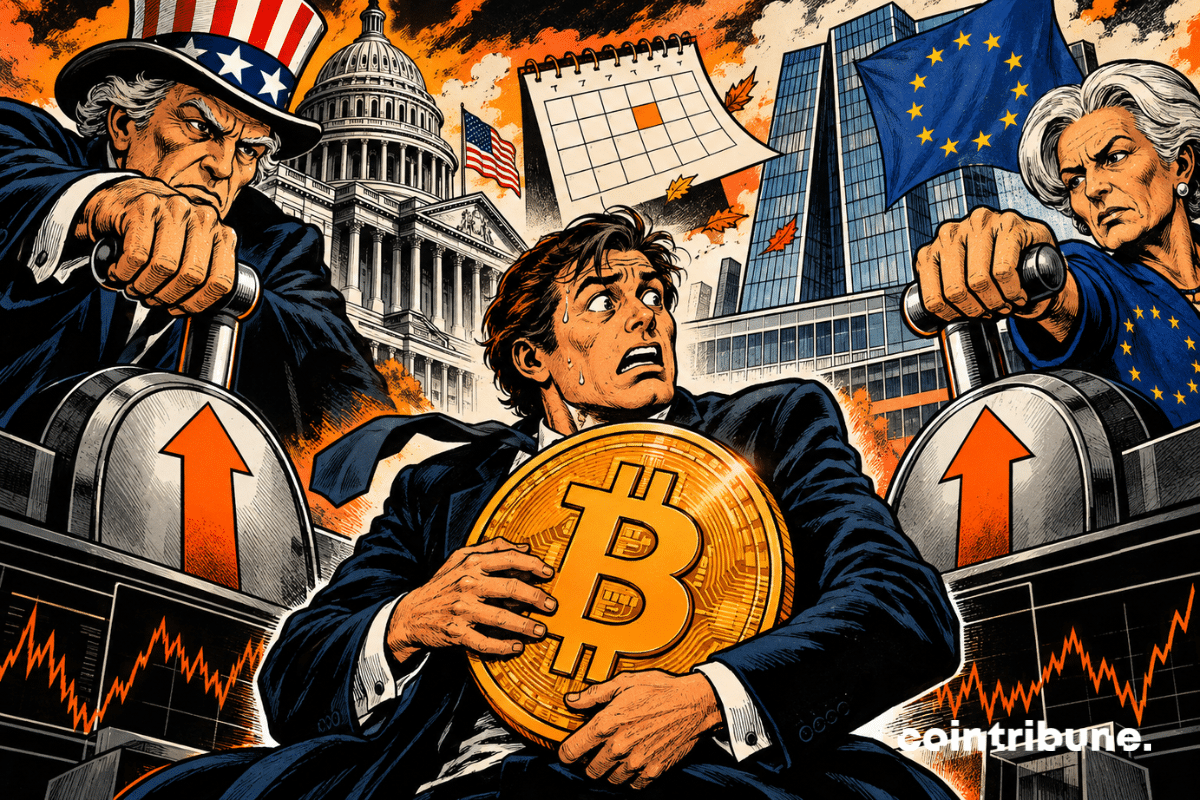
The picture illustrates a market without direction, reacting fact by fact to macroeconomic signals rather than a clear trend. A weekend low, a rebound above $80,000, then consolidation on Monday: the price follows the central bank schedule and that of oil.
Why is the Fed meeting on September 16 closely watched?
The Federal Reserve (Fed) announces its decision on September 16, 2026. At the end of August, a 25 basis point hike seemed likely; early September, the probability fell back to around 50% (CME FedWatch) after Governor Christopher Waller suggested that a decline in inflation might justify holding rates steady.
The key rate is the rate at which a central bank lends to commercial banks: it sets the cost of money for the entire economy. A hike would raise the US range from 3.50-3.75% to 3.75-4.00%. Two forces oppose. On one side, an August jobs report above expectations, with 162,000 jobs added and 4.1% unemployment, pleads for a tightening. On the other, core inflation has recently dropped from 4.76% to 3.05%, supporting the status quo camp. At its previous meeting, the Fed held rates, following a 9-3 vote. The September meeting also includes updated economic projections, closely followed by markets.
Can the ECB also raise its rates in September?
Yes, it is a possibility. The European Central Bank (ECB) raised its deposit rate to 2.25% in June 2026, the first increase in three years, then held it steady in July. Its president Christine Lagarde left open the option of another hike in September, citing rising energy prices.
This point directly concerns a euro saver. The two main Western central banks can tighten policy the same month, for the same cause: oil pushed by tensions in the Middle East. Asked about September’s outcome, Christine Lagarde summarized the Governing Council’s position: “the burden of proof lies with the data.” For a European investor exposed to bitcoin, a double Fed-ECB tightening would mean stricter financing conditions on both sides of the Atlantic, and potentially a stronger dollar against the euro.
Why do rates move bitcoin?
Bitcoin pays no interest. When key rates rise, risk-free investments like bonds or deposits yield more, which reduces the appeal of speculative, non-yielding assets like bitcoin or tech stocks. Conversely, a signal of holding rates, like Christopher Waller’s, eases these same assets, which fueled the weekend rebound above $80,000.
This sensitivity is not new. In July 2026, James Butterfill, head of research at CoinShares, recalled that “bitcoin remains very sensitive to inflation outlooks“, and, by extension, to Fed decisions as well as the conflict in Iran. The mechanism is coupled with a currency effect: higher US rates support the dollar, in which bitcoin is denominated, which weighs on its price for a euro holder.
Should we talk about a crypto winter?
Not strictly. Bitcoin has risen back above $80,000, far from the lows of a true bear market. It mainly moves sideways for weeks, between rebounds tied to ETFs and pullbacks. It is about 37% below its record of $126,198, reached on October 6, 2025.
One figure tempers the most optimistic as well as the most alarmist readings: the average acquisition cost of bitcoin ETF holders is about $83,800, above the current price. Many of these investors are therefore at an unrealized loss, creating a resistance zone for a rise. On the demand side, spot bitcoin ETFs recorded about $3.8 billion in net inflows over the past three weeks, their strongest period in 2026, supporting the rebound despite rate pressure. Additionally, analyst Ali Martinez recalled that bitcoin often experiences high volatility during FOMC meeting weeks, with a tendency to retreat just after the announcement. These flows are however not enough to reverse the configuration as long as the monetary framework is not fixed.
To remember
- Bitcoin: about $79,600 on September 7, 2026 (just under $80,000), about 37% below its October 2025 record (CoinGecko).
- Fed: decision on September 16; probability of a hike fell back to around 50% after Christopher Waller’s cautious signal (CME FedWatch).
- ECB: deposit rate at 2.25% since June; possible hike in September, according to ECB.
The next date is set. The Fed releases its decision and projections on September 16 at 2 p.m., New York time; the ECB issues its decision mid-September. Between them, the US August inflation report, expected a few days before the meeting, will adjust CME FedWatch probabilities. It is this schedule, and the underpinning oil price, that bitcoin holders will follow.
Maximize your Cointribune experience with our “Read to Earn” program! For every article you read, earn points and access exclusive rewards. Sign up now and start earning benefits.

The views, thoughts, and opinions expressed in this article belong solely to the author, and should not be taken as investment advice. Do your own research before taking any investment decisions.
Source: www.cointribune.com