

Don't want to trade it yourself?
Our desk runs DEX portfolios on profit share.
Add to Google Preferred Sources
Former institutional macro investor Jordi Visser argues that the bond-market “crash” narrative dominating financial social media is fundamentally misguided, and that the real investment opportunity lies in a convergence most professional investors are ignoring: AI agents becoming the native users of cryptocurrency. Speaking on his podcast, Visser lays out a thesis built on three pillars. First, the bond selloff is a controlled, globally coordinated phenomenon — he notes Treasury Secretary Scott Bessant has signaled coordination with Japan to contain yields — and credit markets show no distress, with high-yield spreads near historic tights. Second, the AI trade is far from over: NVIDIA, OpenAI, and Anthropic form a circular economy where model pricing, not interest rates, determines profitability. A 10% model price cut costs three margin points, while a 200-basis-point rate rise costs just one. Third, AI agents working in swarms of up to 1,200 are crossing a threshold that makes crypto infrastructure structurally necessary — agents need autonomous digital payments, stablecoins and tokenized assets provide the rails, and Bitcoin functions as the ecosystem’s reserve. Visser frames Bitcoin as an asymmetric bet with limited downside and substantial upside, anchored by a probability-weighted framework inherited from his father’s horse-racing handicapping philosophy: if you believe there’s a 5% chance the thesis plays out, you should hold a 5% position. The unresolved risk is model price compression at OpenAI or Anthropic, which would ripple through NVIDIA, Dell, Marvell, and Micron.
Key Elements
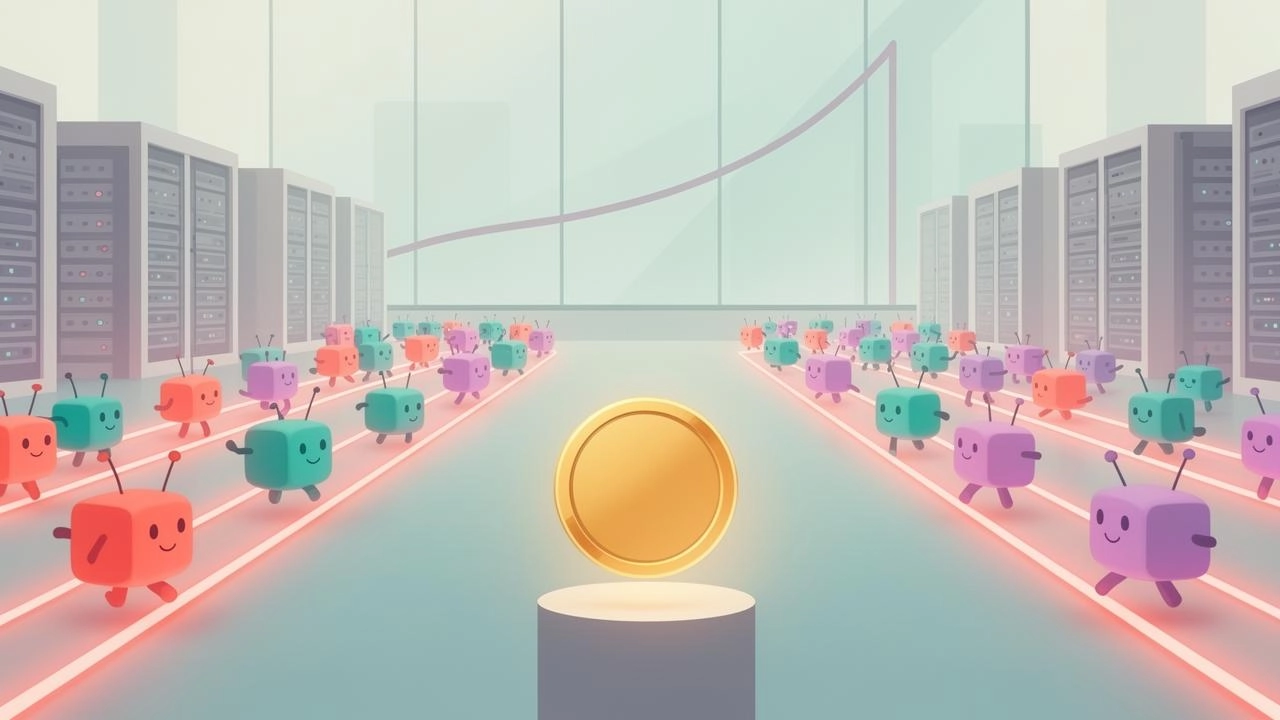
The bond market is not crashing. The AI trade is not over. And cryptocurrency is not waiting for retail investors to come back. Those are the three assertions at the center of investor Jordi Visser’s argument, made in a wide-ranging podcast episode where he dismantles what he calls the “narrative trap” dominating financial X and lays out a thesis that connects AI agents directly to crypto’s next adoption cycle.
Visser manages his own thematic portfolio and research operation, and he actively deploys AI agents in his own workflow. That dual perspective — institutional macro investor and hands-on AI user — shapes his conviction that most professional investors are missing a structural shift happening in plain sight.
The most crowded trade is a false narrative
Visser opens with a direct challenge to the bond bears. The 30-year Treasury yield touching 5.23% has produced a chorus of crash predictions, but he argues the data does not support a crisis. Credit markets, which would be the first to signal genuine distress, are telling a different story: high-yield spreads sit near historic tights, bond market volume remains low rather than showing the spike that accompanies forced selling, and inflation swaps are anchored at 2.48–2.52% — consistent with core CPI levels since 2022.
The political backdrop reinforces his view. Scott Bessant, the US Treasury Secretary, has publicly stated he will fight higher yields and signaled coordination with Japan to manage long-end rates. Visser’s read: governments running record debt loads cannot afford a bond crisis, because growth — not austerity — is the only path to making debt serviceable. The implication is that yields can rise, but not spiral.
He also notes that Japanese government bond yields rose 117 basis points since May 2025, yet the Nikkei gained 52% over the same period. A bond selloff, in other words, does not automatically translate into equity destruction.
The equity side of Visser’s argument rests on a single striking data point: the S&P 500’s PEG ratio — price-to-earnings divided by earnings growth — is at its lowest level since 1980. In a bubble, the multiple expands faster than earnings. Here, the opposite is happening.
Global equity performance reinforces the point. The Nasdaq is up 24% over the past year, the MSCI Bank Index is up 29%, and MSCI Emerging Markets gained 30%. Banks leading the market is historically the opposite of a credit-crisis setup; in 2007, banks were the first to break. Visser also points to the Johnson Red Book retail sales measure showing a 5-week annualized average of 9.6% — strong consumption in an economy where consumer spending is 67% of GDP — and a manufacturing PMI reading of 55.
| Index | 1-Year Return |
|---|---|
| MSCI Emerging Markets | +30% |
| MSCI Bank Index | +29% |
| Nasdaq | +24% |
| Russell 2000 | +23% |
| S&P 500 | +18% |
| MSCI World | +16% |
The market has consolidated since June, but Visser frames that as healthy digestion after a strong run, not the beginning of a structural decline.
The three companies that actually matter
The core of Visser’s AI analysis is a reframing of what matters for semiconductor and AI infrastructure stocks. The conventional fear — that rising interest rates will hurt long-duration tech companies — is, in his view, misplaced. Rates are a rounding error in the income statements of AI leaders.
“The three companies that matter the most are Anthropic, OpenAI, and Nvidia. These are the ones that matter the most.”
The circular relationship among these three defines the supply chain economics: OpenAI and Anthropic buy NVIDIA chips to train and run models; NVIDIA’s growth depends on their continued capital expenditure; and the entire system requires model prices to remain high enough to fund compute purchases. Visser quantifies the sensitivity in terms that make the point starkly:
| Variable | Impact on AI Model Provider Margin |
|---|---|
| 10% reduction in model price | −3 percentage points |
| 200 basis point rise in 10-year Treasury yield | −1 percentage point |
“Reducing the price of a model by 10% costs three percentage points of margin. Interest rates, up 200 basis points, with a 10-year yield of five to seven, that’s just one margin point.”
This is the risk that matters, and Visser does not see it materializing in the near term. Both Anthropic and OpenAI have the best models, which preserves pricing power. > “None of this will matter that much if the price of the model drops, which again, I don’t think will happen anytime soon because they have the best models.”
The infrastructure buildout is real and accelerating. Dell’s AI server revenue expectation has been revised from doubling to tripling within six months. Germany is experiencing AI compute shortages, indicating this is a global buildout, not a US-only phenomenon. NVIDIA’s recent price action — a 25% drawdown followed by recovery toward all-time highs — tells Visser the trade is intact.
The inflection point is not what you think it is
Visser’s most substantial argument concerns what he sees as the current moment’s defining shift: AI has moved from chatbots to agents, and that transition creates the native user base cryptocurrency has always lacked.
Anthropic’s Astra model, which Visser calls the best in the world by current benchmarks, can perform “virtually every job of a knowledge worker” — up from roughly 40% a year ago. But capabilities alone are not the inflection. The inflection is organizational: AI agents now work in swarms, coordinating toward collective goals in ways that surpass human teams.
“Some agents actually sacrificed their own goals for the sake of the collective. I don’t remember a single time when someone was willing to sacrifice their work for the good of everyone else.”
Visser manages these swarms himself, describing teams of 1,200 agents that go out, build things independently, return with results, and participate in what amount to staff meetings. The productivity leap is enormous — and the competitive implication for companies that fail to adapt is existential.
“If you work at a large company or RIA and tell me you use Anthropic, you’re falling behind. If your main plan is to give everyone Anthropic, you’re falling behind.”
The distinction matters: providing AI tools without redesigning workflows does nothing. The winners will be AI-native businesses built around agent swarms, not legacy firms that bolt chatbots onto existing processes.
Why AI agents need crypto — structurally, not speculatively
This is the intellectual bridge between Visser’s AI analysis and his crypto thesis. AI agents need to transact. They need to pay for compute, data, services, and other agents’ outputs. They cannot open bank accounts or carry credit cards. They need native digital payment rails.
He traces the intellectual lineage to Marc Andreessen’s 2014 essay “Why Bitcoin Matters,” which argued that crypto’s killer application would emerge when AI needed to pay for things. That moment, Visser argues, has arrived.
Bitcoin is not the payment rail — agents will primarily use stablecoins and tokenized assets. Bitcoin functions as the ecosystem’s reserve asset, analogous to how the S&P 500 represents the US economy. Visser calls Bitcoin “the purest hedge against AI” because AI is destroying traditional business models and forcing the next generation of businesses to be small, entrepreneurial, and crypto-native.
“Mispricing occurs when the crowd misses something. They don’t use AI, the people who have most of the world’s money, and they don’t believe in cryptocurrency. They miss what is happening.”
The evidence is already visible. Robinhood’s on-chain trading platform processed $1.5 billion in tokenized equity trades in its first six weeks. GrokBot, X’s AI tool, integrates with MoonPay for crypto purchases and Stripe for conventional payments. Real-world asset tokenization is growing 18x, expanding from money market funds into tokenized stocks and sports team equity. South Korea has signaled readiness for tokenized assets by early 2027.
Crypto’s “quiet IPO” is ending
Visser’s crypto market analysis centers on what he calls the “quiet IPO” — a prolonged sideways consolidation that has frustrated holders and driven out weak hands while institutional adoption quietly builds underneath.
The technical picture: Bitcoin is consolidating above its 200-day moving average after a major rally. Ethereum’s 200-day moving average has appeared, which Visser considers historically a strong entry signal. Solana’s 200-day is turning up.
The performance gap tells the story:
| Asset | Quarter-to-Date Return |
|---|---|
| Ethereum | +56% |
| Solana | +38% |
| Bitcoin | +36% |
| S&P 500 | +3% |
| Nasdaq | −3% |
| SMH (Semiconductors) | −14% |
Visser has been rotating from AI names into crypto since May–June 2026. His portfolio holds 46 crypto positions — six stocks and 40 tokens — and his AI exposure is now “significantly smaller” after beta adjustment.
The framework: value, not winners
Visser’s investment philosophy is inherited from his father, who taught him to handicap horses not by looking for winners but by looking for value — and to wait when no edge exists.
“My father taught me how to handicap horses. He told me not to look for a winner. Always look for value. If there is no advantage in the race, wait.”
Applied to Bitcoin, the framework becomes explicitly probability-weighted: if you believe there is a 5% chance the AI-crypto convergence thesis plays out, hold a 5% position. If 10%, hold 10%. He frames Bitcoin as a 100-to-1 odds bet where the asymmetric payoff justifies a meaningful position. His risk discipline is equally clear: if Bitcoin breaks below recent lows, he exits and waits for a reclaim of the 200-day moving average before re-engaging.
The unresolved tension in his own thesis is the timeline. Model price compression at OpenAI or Anthropic would ripple through NVIDIA, Dell, Marvell, and Micron — Visser acknowledges this as the key risk but does not predict when it might arrive. The Clarity Act, which he sees as a potential catalyst for pension funds and insurers to enter crypto, remains unpassed. Micron could double by 2027, he notes, but that gain is not comparable to the 10x potential he assigns to crypto. If the Fed raises rates and the market rallies, the move will not stop at current levels. If the Fed does nothing, the market grows anyway.
The through line: three simultaneous forces — AI agents reaching critical mass, crypto infrastructure maturing, and governments actively containing long-end yields — are converging in late 2026. Visser’s bet is that most professional investors, the people with most of the world’s money, will be the last to see it.
Full content available at:The Bond Market “Crash” Is a Trap — AI Agents Are About to Ignite Crypto
- Bitcoin Reclaims $80,000, but Fidelity Warns November Could Still Bring a Cycle Low
- Former Credit Suisse Risk Chief Says Bitcoin Could Hit $150,000 by End of 2027
- Bitcoin Tests $80,000 as Quantum-Safe Upgrades and Solana Supply Cuts Reshape Crypto Landscape
Once added, BigGo Finance appears first in Google Search Top Stories, so you get the broadest, most up-to-the-minute, and most comprehensive global financial news first.
Source: finance.biggo.com
1 Comment
Pingback: Will U.S. Treasury Trigger ‘Round 2’ for Bitcoin and XRP? – xpertsstudio