

Don't want to trade it yourself?
Our desk runs DEX portfolios on profit share.
Bitcoin $BTC$79,620.75 trades 24 hours a day, seven days a week, allowing traders and fund managers to react to the news and manage risk at any hour, including weekends and holidays.
Yet out of 365 trading days a year, only a handful actually decide whether a year is a win or a loss. Which is why some experts say it’s likely better to buy and hold than to try to time bitcoin <a href="https://xpertsstudio.com/chainlink-price-rally-accelerates/” title=”Chainlink Price Rally Accelerates”>price swings for gains.
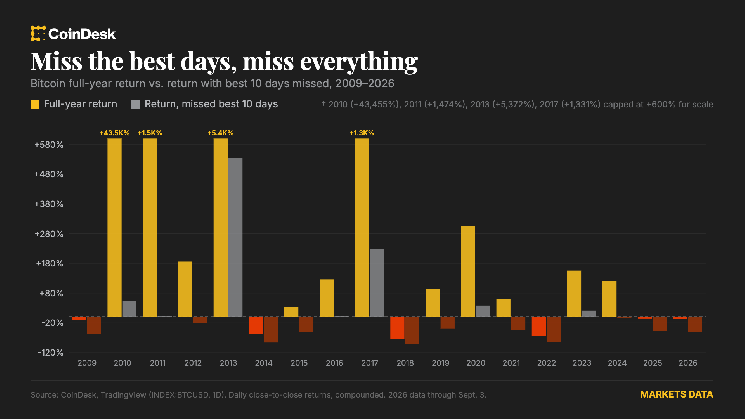
For example, in 2026, bitcoin fell about 9%, a mediocre loss, not a disaster. But without the five best-performing days of the year, bitcoin is down 36%.
Andre Dragosch, head of research at Bitwise Europe, said this is simply bitcoin’s nature. “Bitcoin is actually a relatively boring asset,” he told CoinDesk.
“The majority of performance is usually made in a handful of days, while most of the time it moves sideways and consolidates.”
That’s not a one-off event. Looking through bitcoin’s history since its earliest days in 2010, when it traded for mere cents, gains since then have consistently been concentrated in just a handful of trading days.

In 11 of the last 18 years, removing just the 10 best trading days, out of roughly 365, is enough to turn a winning year into a losing one.
2019 finished up 94% for the year, meaning prices nearly doubled. However, take away the 10 best days of that year, and it’s down 40%. Similarly, 2011 returned a staggering 1,474%. Strip out its 10 best days, and that shrinks to 2.2%, essentially nothing.
However, there were a few exceptions.
2013 and 2017 both stayed solidly positive even after removing their 20 best days apiece, genuinely broad, grinding rallies rather than a few violent spikes.
This pattern partially gave birth to the “c’mon, do something” meme — crypto Twitter’s running joke about bitcoin sitting dead still for weeks on end
Time in the market, not timing the market
This tendency for gains to cluster in just a handful of days makes precise market timing brutally hard.
A trader would need to enter right as a rally is about to start, because missing the mark by even a week or two often means missing almost the entire move.
The conclusion, per Dragosch, follows naturally – time in the market beats timing the market, since catching those handful of explosive days like a clockwork is close to impossible. Put another way, buying and holding bitcoin for the long haul is far easier and often far more rewarding than trading around it or running a fund whose performance is judged year by year.
Related Assets
Bitcoin$79,620.751.88%

- 1Dollar-backed stablecoins can push local currencies lower, Bank of Korea study finds1 hr ago
- 2British investor thought he lost $2,000 in bitcoin in 2012. He just recovered $4.5 million6 hrs ago
- 3$XRP Ledger has fewer active accounts than last year, but bigger trades and more value12 hrs ago
- 4Southeast Asia’s crypto funding rebounds to $680 million as investors focus on mature firms13 hrs ago
- 5Robinhood isn’t backing down after AMC CEO demands halt to stock tokens1 day ago
- 6From warning to listing: UK’s largest retail investment platform opens access to crypto ETNs1 day ago
- 7U.S. Sheriff’s association shifts opposition stance to Clarity Act to ‘neutral’1 day ago
- 8U.S. added stronger than expected 162,000 jobs in August as labor market bounced back1 day ago
- 9We checked 6 years of bitcoin data. The NFP report isn’t big price mover1 day ago
- 10Zcash jumps 20% to landmark $1,000 level as short sellers lose $34 million1 day ago

Anvil: The Missing Collateral Layer
Anvil is a shared on-chain collateral layer built on a programmable letter of credit: reserve assets as a guarantee -no loan, no interest, keep custody & yield.
View Full Report
More From Markets
$XRP Ledger has fewer active accounts than last year, but bigger trades and more value
U.S. added stronger than expected 162,000 jobs in August as labor market bounced back
Zcash jumps 20% to landmark $1,000 level as short sellers lose $34 million
Dollar-backed stablecoins can push local currencies lower, Bank of Korea study finds
British investor thought he lost $2,000 in bitcoin in 2012. He just recovered $4.5 million
Source: cryptonews.net