

Don't want to trade it yourself?
Our desk runs DEX portfolios on profit share.
- A Fed model shows congestion can trigger stablecoin runs even when reserves remain fully backed.
- Small transfers bear the sharpest burden as network fees rise relative to payment value.
- GENIUS regulates issuers and reserves, but leaves public-chain pricing and capacity outside explicit rules.
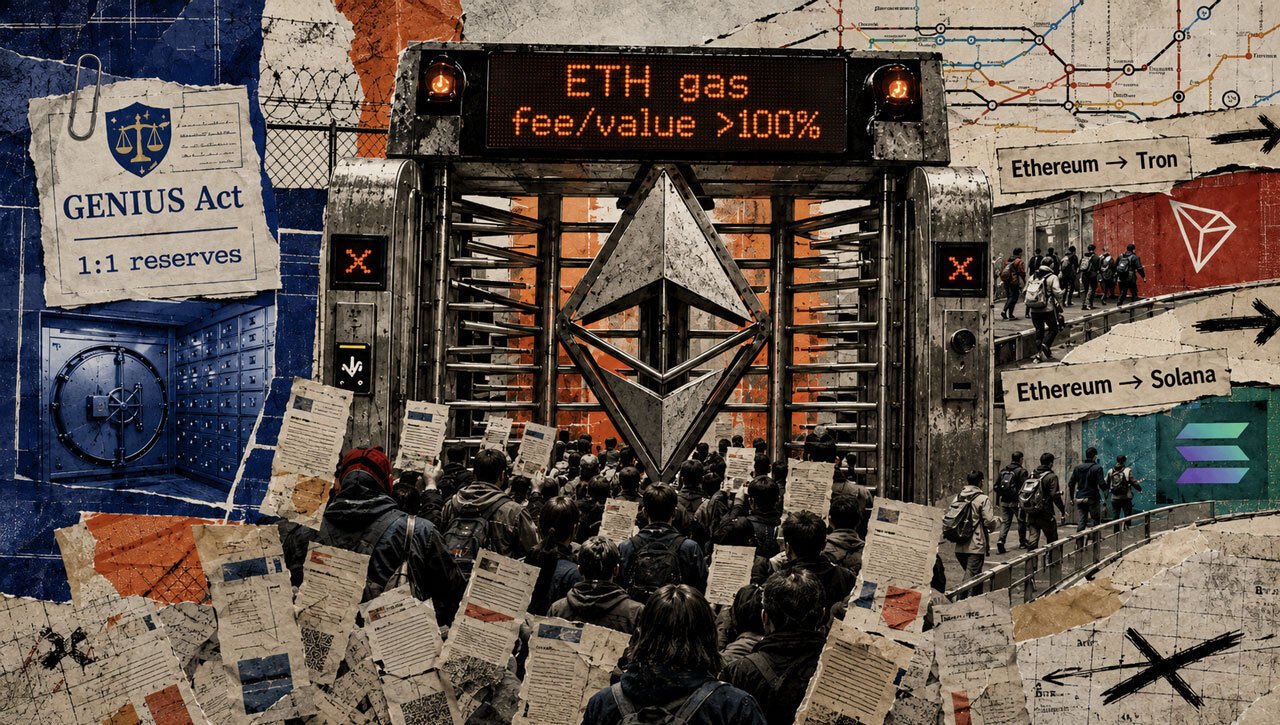
The Guiding and Establishing National Innovation for U.S. Stablecoins Act, or GENIUS Act, is the new federal framework for payment stablecoin issuers. Its reserve rules aim to make each token a safer dollar claim, while the public blockchains moving those tokens retain their own fee markets and capacity limits.
A Federal Reserve staff paper, first dated June 2, 2026, and updated Aug. 31, 2026, models how transaction congestion can destabilize even a perfectly backed digital dollar. The authors are Federal Reserve economists, and the paper carries the standard disclaimer that their views do not necessarily represent the Federal Reserve Board or Federal Reserve System.
When fees climb far enough, small payments become uneconomic and a token’s usefulness can fall. The model predicts that weak payment-network effects can then turn individual exits into coordinated redemptions. In the paper’s empirical work, however, “redemption” means a drop in Ethereum circulation and can include either a cash-out to fiat or migration to another blockchain.
The paper presents a latent mechanism, not a forecast of a current run. It sharpens an unresolved question as Treasury implements GENIUS: the law gives regulators broad tools for policing issuers, reserves and redemption promises, while its explicit reserve provisions and Treasury’s current section 3 proposal set no price or capacity standard for a public blockchain.
How congestion can trigger a run without bad reserves
Traditional stablecoin analysis starts with the issuer’s assets. If a token promises one dollar but its reserves lose value or cannot be sold quickly, holders have a reason to redeem before others do.
The Fed economists deliberately remove that problem from their model. The stablecoin is fully and safely backed. Thefees and payment-network effects: people value a payment asset partly because other people accept and use it
Under low congestion, that network can absorb a shock. Under high congestion and weak network effects, the paper finds a threshold beyond which redemptions can become coordinated and abrupt. Higher fees reduce use; reduced use makes the token less attractive; the weaker network then gives more holders a reason to leave.
“Redemption” needs care here. In the paper’s main empirical panel, it is measured as a negative change in a stablecoin’s Ethereum circulation. That can represent redemption for fiat, but it can also represent migration to another blockchain. The data therefore capture pressure on Ethereum-based circulation, not a clean count of customers cashing out at an issuer.
The study uses an unbalanced weekly panel of five stablecoins from November 2017 through December 2025 where data are available. Its starkest distributional result comes from 2021 through 2025: for below-median USDC transfers, the fee-to-value ratio at the 75th percentile frequently exceeded 100%. For above-median transfers, it was almost never more than 5%.
The statistic describes the distribution of attempted and completed transfer economics rather than a claim that users routinely paid more in fees than they sent. During expensive periods, a representative network fee could exceed the value of many small transfers. A holder can avoid completing such a transfer, wait, batch activity or move through a custodian. The pattern shows how congestion can ration access by transfer size even while the token remains redeemable.
What the evidence establishes
The paper combines a theoretical model with several empirical tests. Those pieces answer different questions and should not be collapsed into one causal claim.
| Evidence | Result | What it supports | Limit |
|---|---|---|---|
| Weekly stablecoin panel | A one-standard-deviation, $10.83 increase in gas was associated with a roughly 0.9 percentage-point rise in weekly redemptions when network effects were low | Fee sensitivity is strongest when a token’s payment network is weak | Gas alone was insignificant, and the result applies to the low-network-effects state |
| Ethereum empty-slot design | The raw empty-slot rate averaged 0.7%; a one-standard-deviation increase of 0.004 corresponded to about $0.77 more gas | A plausibly exogenous congestion shock raises fees | The design identifies the capacity-to-fee link, not the later redemption response |
| 1,230 matched ETH-Tron USDT transfers | From May 2020 through December 2025, the average matched transfer was about $176 million; $1 more in lagged, demeaned gas was associated with 3% to 4% more net matched value moving from Ethereum to Tron | Higher Ethereum fees coincide with cross-chain reallocation | The association cannot identify every owner or establish the motive behind every transfer |
Gas by itself was statistically insignificant in the weekly panel. The reported 0.9-point effect appeared only when high fees interacted with weak network effects, a state covering roughly 7% to 7.5% of observations. The pattern is consistent with the model’s threshold logic, while remaining a historical association rather than a universal causal estimate.
The empty-slot exercise offers a stronger causal design for the first link in the chain. Empty Ethereum blocks are plausibly unrelated to stablecoin demand but reduce capacity and push up gas. The design helps establish that a capacity shock can raise fees. It does not directly establish that the same shock caused every later redemption.
The matched-transfer analysis is an association as well. It links transfers of identical USDT amounts on Ethereum and Tron within a 60-minute window, consistent with a chain switch. The method cannot observe the beneficial owner behind every pair, establish the motive for each move or exclude every alternative explanation.
Together, the findings support a conditional warning, not a forecast: congestion can create an exit incentive, and some historical activity moved toward a cheaper rail when Ethereum became more expensive.
GENIUS protects the token, not every rail
The GENIUS Act requires permitted payment stablecoin issuers to maintain reserves at least one-to-one in specified liquid assets. It also requires public redemption procedures, disclosure of issuer purchase and redemption fees, monthly reporting, examination and certification, and regulatory standards covering capital, liquidity, diversification, operations and information technology.
Those rules address important failure modes: weak assets, opaque redemption promises, undercapitalized issuers and poor operational controls. They also give regulators a clearer path to supervise the entity that creates the dollar token.
Treasury’s Aug. 17 implementation proposal, published in the Federal Register on Aug. 18, focuses on section 3’s restrictions on offering or selling payment stablecoins in the United States. Comments are due Oct. 19. Treasury says the expected effective date for the issuer licensing framework is Jan. 18, 2027, with the broader digital asset service provider restriction expected July 18, 2028.
Treasury proposed GENIUS change forces US exchanges to audit foreign stablecoin or face delisting
The proposed rule distinguishes direct transfers between two people acting on their own behalf, including self-custody transactions, from compensated services such as exchanges, transfer businesses and custodians that can qualify as digital asset service providers.
Treasury just put a deadline on offshore stablecoins’ access to US customers
That division affects who carries compliance duties. The economics of a congested base layer persist across the categories. A reserve can remain liquid while a user still confronts a transaction fee larger than the intended payment.
The distinction is narrow. Issuer purchase and redemption fee disclosure covers different charges from blockchain gas and exchange withdrawal fees. The text now on the table leaves base-layer pricing and capacity outside its explicit stablecoin rules, while GENIUS also gives supervisors broad authority over an issuer’s operational and technological risks. Regulators could therefore scrutinize how an issuer manages rail exposure even though they do not control public blockspace. Treasury’s process remains open, and implementation choices can still change before the rules take effect.
That leaves two safety tests operating at once. Supervisors can examine whether an issuer can honor the dollar claim and manage its operations. Users also experience whether the chosen network can carry that claim at a price proportionate to the payment.
Calm fees show who would feel congestion first
Stablecoins are already spread across rails with different fee markets. A snapshot taken shortly before drafting from DefiLlama’s chain dashboard and API put stablecoin supply at roughly $147.3 billion on Ethereum, $93.2 billion on Tron and $15.7 billion on Solana. The dashboard’s displayed totals were slightly higher, at about $148.0 billion, $93.6 billion and $15.8 billion respectively, reflecting timing and methodology differences.
Ethereum was not congested in the snapshot. Etherscan showed roughly 0.127 to 0.128 gwei gas, while ETH traded near $2,404. Using an illustrative 65,000 gas units for an ERC-20 transfer, that implies a network cost around two cents. Actual gas use and wallet estimates vary.
Costs on the other two chains are structured differently. Tron charges 100 sun per Energy unit; a third-party estimator placed an unstaked USDT transfer around 65,000 Energy to an existing account and 131,000 to a new account, or roughly 6.5 and 13.1 TRX before staking or rented Energy. Solana’s base fee is 5,000 lamports per signature, while a recent analytics snapshot showed a median total fee near 5,800 lamports and a 99th-percentile fee of about 651,400 lamports.
A direct dollar-price comparison would be misleading because each network uses a different fee system and observation method, and all of the figures can change quickly. The useful comparison is structural: a “stablecoin fee” varies by rail and transaction conditions. Network charges also differ from exchange withdrawal or platform fees, which an intermediary sets separately.
Ethereum and Solana are hosting trillions in dollar volume, yet their native tokens risk losing direct consumer demand
The first direct effect of congestion falls on the transaction with the least value to absorb a fixed network charge. A small self-custody user may delay a payment, combine transfers, move to an exchange or stop using the chain. That response can be economically forced even if the token remains redeemable at par.
The visible balance movement is more likely to come next from larger intermediaries. Exchanges, market makers, bridges, issuers and corporate treasury desks can move enough liquidity to alter chain-level circulation or restore inventory where users want to transact. That ordering is an inference from how the market operates, not an owner-level finding in the Fed paper.
Destination chains can inherit both activity and pressure. A surge may deepen their stablecoin liquidity while testing the routes and intermediaries that rebalance inventory. Those second-order effects are analytical inferences rather than findings identified in the paper’s owner-level data. The policy question is broader than whether an issuer holds enough Treasury bills: users also need a tolerably priced route to the redeemable dollar claim when a rail is under stress.
The Sept. 3 snapshot establishes only that Ethereum fees were calm at the observation time; it does not measure systemwide redemption pressure. The paper turns the rail-safety gap into a monitorable risk rather than evidence of an imminent event. Regulators and market operators can watch fee-to-transfer-value ratios by transaction size, abrupt changes in chain-level stablecoin circulation, matched cross-chain flows and exchange wallet imbalances.
GENIUS can make a stablecoin safer without making every route to that stablecoin resilient. If implementation treats reserve quality as the full definition of safety, the next stress episode may reveal that the dollar token was sound while access to it was not.
Related LawGENIUS Act: US Stablecoin LawUnited States · Enacted · ActRelated AssetTetherUSDT · StablecoinRelated AssetUSDCUSDC · StablecoinRelated AssetEthereumETH$2,454.2924-hour change: down1.64%Related AssetSolanaSOL$101.4524-hour change: down3.05%Related AssetTRONTRX$0.3324-hour change: down0.47%
FeaturedUSRegulationStablecoinsResearchLegislation
Editorial credits
Source: cryptoslate.com