


Don't want to trade it yourself?
Our desk runs DEX portfolios on profit share.
Currencies39023
Market Cap$ 2.80T+3.26%
24h Spot Volume$ 44.76B+1.32%
DominanceBTC57.83%+0.72%ETH10.90%+1.04%
ETH Gas0.10 Gwei
MarketRegulationKalshiCrypto RegulationTrending
Sep 4, 2026
4min read
byRupam Roy
forThe Coin Republic
<img src="https://xpertsstudio.com/wp-content/uploads/2026/09/image_3-3.png" alt="Prediction Market Fight: New Jersey Takes Kalshi to Supreme Court” loading=”lazy”>
New Jersey on Sept. 2 asked the U.S. Supreme Court to review KalshiEX v. Flaherty after the Third Circuit ruled for Kalshi on April 6, 2026 and the Ninth Circuit reached an opposite conclusion on Aug. 28, creating a circuit split over whether the Commodity Exchange Act preempts state sports-gambling laws for CFTC-registered event contracts. The petition, coming after the CFTC withdrew proposed event rules on Feb. 4 and issued an enforcement advisory on Feb. 25, creates short-term regulatory uncertainty for prediction markets and crypto derivatives platforms that could affect adoption, token launches and CEX/DEX operations until the Supreme Court decides.
See what traders are focused on

Key Insights
- New Jersey escalated its prediction market dispute with Kalshi.
- Federal appeals courts issued conflicting rulings on sports event contracts.
- Supreme Court review could clarify federal and state regulatory authority.
New Jersey escalated its prediction market dispute with Kalshi on Sept. 2 by asking the U.S. Supreme Court to review a ruling limiting state oversight of sports event contracts.
Attorney General Jennifer Davenport and New Jersey Division of Gaming Enforcement Interim Director Mary Jo Flaherty filed a petition for a writ of certiorari challenging an April Third Circuit decision. The state wants the justices to determine whether the Commodity Exchange Act prevents states from applying gambling laws to sports contracts traded on CFTC-regulated exchanges.
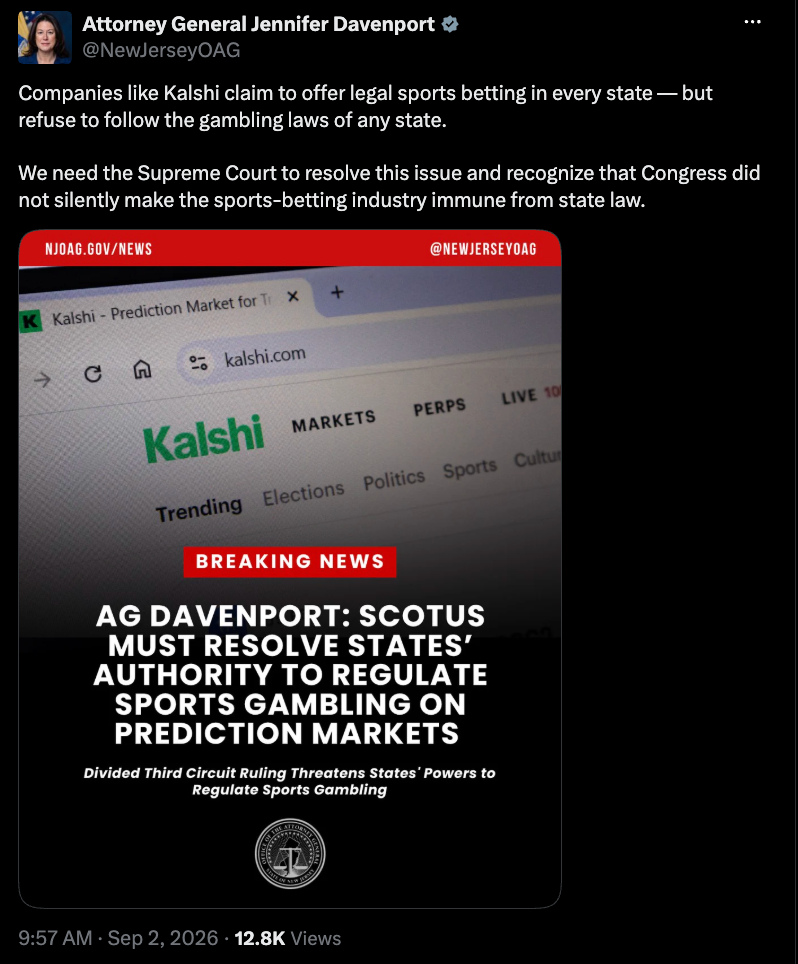
The filing arrived days after the Ninth Circuit reached the opposite conclusion in a parallel Nevada case. That disagreement gives the Supreme Court a clearer opportunity to resolve a growing federal-state jurisdiction dispute affecting Kalshi and other prediction-market operators.
Prediction Market Case Reaches Supreme Court
New Jersey filed a petition for a writ of certiorari after losing before the Third Circuit. The state asked the Supreme Court to review KalshiEX LLC v. Flaherty.
Supreme Court records showed New Jersey previously requested extra time for its petition. Justice Samuel Alito extended the filing deadline through Sept. 3.
The dispute started after New Jersey gaming officials challenged Kalshi’s sports-related event contracts. Kalshi argued federal regulation prevented state authorities from enforcing local gambling restrictions against those contracts.
Davenport rejected that position in the state’s Sept. 2 announcement. She said companies offering sports wagers should comply with state gambling laws.
The filing asked whether Dodd-Frank amendments to the Commodity Exchange Act preempted state sports-gambling rules. The question applies when contracts trade on markets registered with the Commodity Futures Trading Commission.
New Jersey said similar litigation had reached at least 20 states. The state argued conflicting decisions created uncertainty for regulators and federally registered prediction-market operators.
Prediction Market Rulings Split Federal Appeals Courts
The Third Circuit ruled for <a href="https://www.thecoinrepublic.com/2026/07/16/kalshi-faces-impossible-position-in-cftc-michigan-clash/” rel=”nofollow noopener” target=”_blank”>Kalshi on April 6 in a 2-1 decision. Judge David Porter said Kalshi showed a reasonable chance of succeeding on federal preemption.
The court affirmed a preliminary injunction blocking New Jersey from enforcing gambling laws against Kalshi’s sports contracts. The majority treated those contracts as swaps under the Commodity Exchange Act.
That position collided with a Ninth Circuit ruling issued Aug. 28. The Ninth Circuit upheld Nevada’s ability to enforce gaming laws against Kalshi’s sports contracts.
Judge Ryan Nelson wrote that the contracts were sports bets rather than swaps. The panel said federal law likely did not preempt Nevada’s gaming regulations.
The Ninth Circuit also cited Commodity Futures Trading Commission Regulation 40.11. That rule addresses event contracts involving gaming and other listed activities.
The conflicting rulings created different legal outcomes across federal jurisdictions. New Jersey cited that split while asking the Supreme Court to intervene.
Kalshi Prediction Market Faces Federal-State Jurisdiction Test
Kalshi operates as a Commodity Futures Trading Commission-designated contract market. The regulator’s filings database classified many Kalshi event products as swaps or binary options.
That federal status forms the center of Kalshi’s legal defense. The company argues federal law gives regulators exclusive authority over qualifying designated-market contracts.
New Jersey takes the opposite view. State officials argue Congress did not remove traditional state authority over sports gambling through Dodd-Frank.
The Commodity Futures Trading Commission also shifted its broader event-contract policy during 2026. On Feb. 4, it withdrew a proposed event-contract rule and a 2025 sports advisory.
Chairman Michael Selig said the agency planned a new event-contract rulemaking under the Commodity Exchange Act. No final replacement rule had appeared when New Jersey filed.
The regulator separately issued a prediction-market enforcement advisory on Feb. 25. It described Kalshi as a designated contract market and addressed fraud involving event contracts.
Those federal actions show the CFTC remains active around prediction-market oversight. They do not resolve state preemption questions now dividing appellate courts.
Prediction Market Fight Now Depends on Supreme Court Review
The Supreme Court has not agreed to hear New Jersey’s case. A certiorari petition requests review of a lower-court ruling but does not guarantee acceptance.
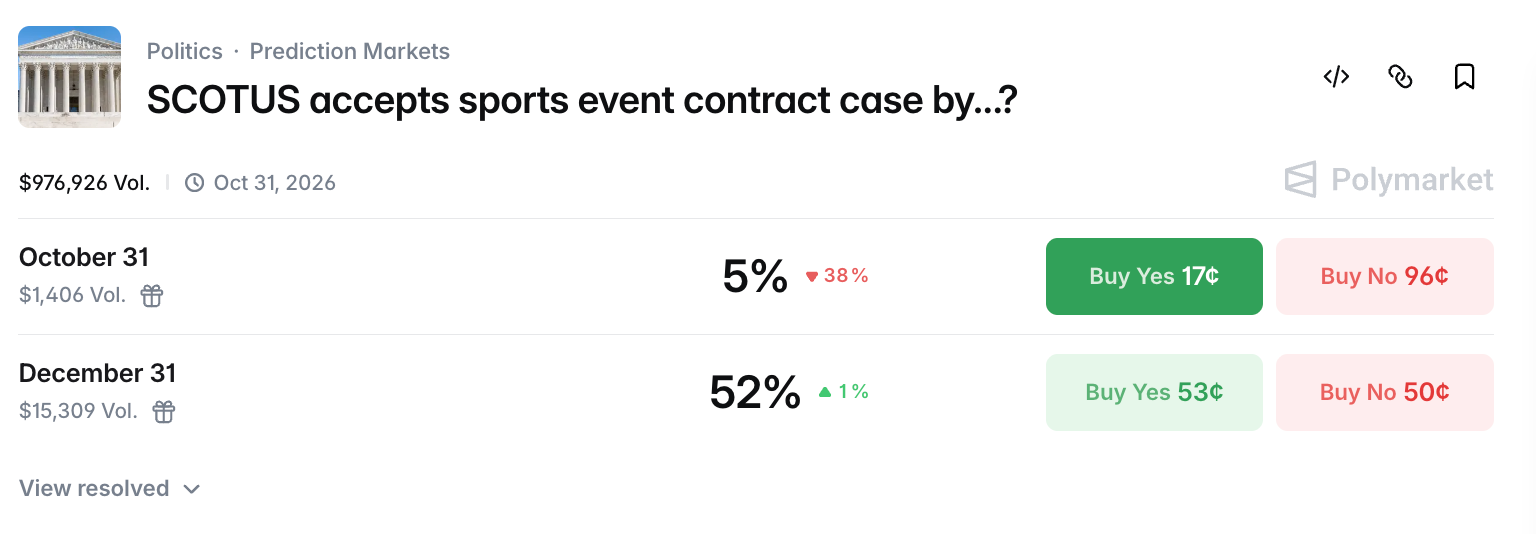
The court’s docket already recorded New Jersey’s earlier extension requests in the dispute. Those filings identified Flaherty and Davenport as applicants against KalshiEX.
The Ninth Circuit ruling increased the legal stakes before the petition arrived. Two federal appeals courts now interpret Kalshi’s sports contracts differently under federal commodities law.
A Supreme Court decision could establish one nationwide rule for similar contracts. It could also define federal derivatives oversight against state gambling authority.
The next verifiable milestone is the Supreme Court’s response to New Jersey’s petition. Until then, conflicting appellate rulings remain in place.
This article is for informational purposes only and does not constitute legal or financial advice.
Source: cryptorank.io