

Don't want to trade it yourself?
Our desk runs DEX portfolios on profit share.
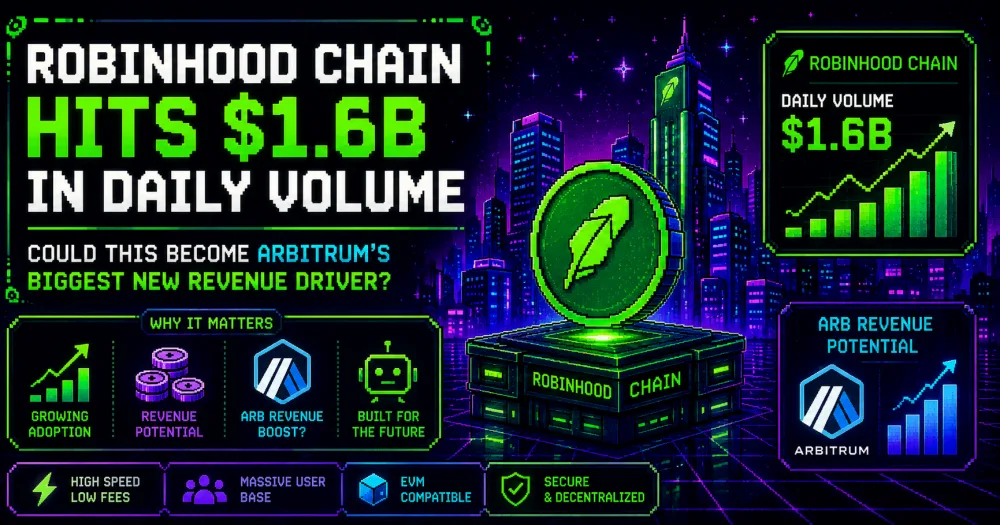
Robinhood Chain has become one of crypto’s new busiest Layer-2 networks. Recent daily DEX volume approached $1.6 billion while fees hit a record. The surge has turned attention to Robinhood Chain revenue and its potential value for Arbitrum.
High activity can drive meaningful cash flow, but there is also a speculative component. Tokenized stocks, stablecoins, and DeFi could determine whether the momentum can be sustained.
Robinhood Chain Hits $1.6B in Daily DEX Volume
Robinhood Chain’s DEX Volume Jumps 61%
Robinhood Chain DEX volume jumped roughly 61% in only a few days, reaching almost $1.6 billion in 24 hours. This $1.6B volume milestone stands out because Robinhood Chain’s mainnet is still young. Traders have identified reasons to bring liquidity onto the chain.
$738M TVL and Nearly $800M in Stablecoins
Trading volume only tells part of the story. Robinhood Chain TVL reached about $738 million around the record, while stablecoin supply approached $800 million. Those figures enable swaps, lending, and leveraged trading. Large stablecoin balances also assist users in staying onchain between trades.
Why the Latest Volume Record Matters
The latest Robinhood Chain volume record shows that the network can attract large short-term flows. More importantly, it tests whether activity can become a recurring economic value. High DEX turnover generates fees across the ecosystem. Sustained demand could make Robinhood Chain DeFi relevant beyond the launch phase.
Robinhood Chain Generates Record Fee Revenue
Daily Fees Reach $3.75M
Robinhood Chain daily fees recently reached about $3.75 million. The figure shows how quickly demand can be converted into network economics. Fees rise as users engage with active applications. The total also explains how Robinhood Chain makes money.
Robinhood Chain Outpaces Ethereum and Base in Daily Fees
At the peak, Robinhood Chain fees exceeded daily chain fees on Ethereum and Base. The comparison highlights the current intensity, not the long-term dominance. Ethereum supports a broader ecosystem, but a new Layer 2 leading major networks on daily fees is noteworthy.
More Than $13M in Fees Since Mainnet Launch
Cumulative Robinhood Chain fees have already surpassed $13 million since mainnet launch. Early totals can climb rapidly during speculative bursts, but straight-line projections remain risky. The figure shows real blockspace demand, but also tests the Robinhood Chain Arbitrum revenue-sharing model.
How Robinhood Chain Generates Revenue for Arbitrum
Robinhood Chain Is Built on Arbitrum Technology
Robinhood Chain employs Arbitrum technology while running as a dedicated Layer-2 network. The setup provides Robinhood with greater control of performance and financial applications. Ethereum remains the settlement base, while Arbitrum provides the technology stack. That structure links Robinhood’s growth to the wider ecosystem.
How the 10% Revenue-Sharing Model Works
The commercial model passes 10% of protocol net revenue back through the Arbitrum licensing framework. It is important to note that protocol net revenue differs from gross transaction fees. Investors should not simply multiply gross fees by 10%. The exact net revenue base matters first before considering the impact.
What $3.75M in Daily Fees Means for Arbitrum DAO
A $3.75 million fee day illustrates the size of the opportunity, but it does not equate directly with DAO revenue. The revenue share applies to protocol net revenue rather than all user fees. However, stronger activity can expand the relevant revenue pool. That distinction matters when asking how much revenue Robinhood Chain generates for Arbitrum.
What Is Driving Robinhood Chain’s Trading Activity?
PONS and Uniswap Dominate DEX Volume
PONS and Uniswap have become majorders with speculative venues and automated market infrastructure. Deeper liquidity reduces friction for larger swaps. Growing volumes can reinforce network effects
Memecoins Remain a Major
Memecoins currently contribute heavily to trading intensity. These assets generate heavy turnover as users rotate positions rapidly. That explains why Robinhood Chain volume is rising so quickly. However, activity can fade just as fast when sentiment changes.
Perpetual Futures Add Another Growth Channel
Perpetual futures create a second high-frequency market outside of spot DEX trading. Leveraged positions generate repeated transactions, liquidations, and collateral movements. Those mechanics can increase Robinhood Chain revenue without matching growth in long-term deposits. Perpetuals also widen the network’s appeal.
Robinhood Chain’s Bigger Bet on Tokenized Stocks
Why Tokenized Equities Could Create More Sustainable Demand
Robinhood Chain tokenized stocks may become more important than today’s memecoin boom. Equities can support recurring trading around familiar assets. They may also become collateral for lending and portfolio strategies. Such applications could generate steadier demand than speculative launches.
Robinhood’s Distribution Advantage in Onchain Finance
Robinhood already has a large consumer finance audience and a recognizable trading brand. That distribution can reduce the challenge of attracting users to a new blockchain. Existing customers may enter onchain markets through familiar products. Few Layer-2 networks combine infrastructure with a major brokerage channel.
From Tokenized Stocks to a Full Onchain Financial Ecosystem
Stock tokens could become the starting point rather than the final product. Once equities exist onchain, developers can build lending, derivatives, and portfolio tools around them. Stablecoins can provide settlement liquidity. Robinhood Chain DeFi could resemble a financial marketplace rather than another general-purpose L2.
Can Robinhood Chain’s Revenue Growth Last?
The Difference Between Trading Volume and Sustainable Revenue
Large volume numbers attract attention, but turnover does not guarantee durable economics. A network can process billions during a brief speculative cycle. Sustainable Robinhood Chain revenue needs repeat users, useful applications, and healthy liquidity. Fees need to remain strong after the cooling of speculation.
How Much of the Activity Is Driven by Speculation?
That question represents the biggest uncertainty around the current record. Memecoins and leverage can inflate volume without creating sticky capital. If those markets cool, Robinhood Chain volume could fall sharply. Investors need to distinguish temporary velocity from lasting adoption.
Why TVL and Stablecoin Growth Matter More Long Term
TVL and stablecoin balances can indicate whether capital stays after trading spikes fade. Increasing deposits strengthen lending and liquidity markets. A larger stablecoin base improves settlement across tokenized assets. These metrics can answer the question: is Robinhood Chain sustainable?
| Metric | Robinhood Chain Data | Why It Matters |
|---|---|---|
| Daily DEX Volume | ~$1.6B | Shows extremely strong trading activity |
| DEX Volume Growth | +61% | Signals rapid acceleration in user demand |
| TVL | ~$738M | Indicates substantial capital locked onchain |
| Stablecoin Supply | Nearly $800M | Supports trading, lending, and settlement liquidity |
| Daily Fees | ~$3.75M | Highlights strong current network monetization |
| Cumulative Fees | More than $13M | Shows meaningful fee generation since mainnet launch |
| Leading DEXs | PONS, Uniswap | Major contributors to current trading volume |
| Key Activity Drivers | Memecoins, DEX trading, perpetuals | Explains much of the recent volume surge |
| Long-Term Growth Driver | Tokenized stocks | Could create more sustainable financial activity |
| Arbitrum Revenue Share | 10% of protocol net revenue | Gives Arbitrum exposure to Robinhood Chain growth |
| Main Bull Case | Finance-focused L2 with Robinhood distribution | Could attract users from traditional finance |
| Main Risk | Speculation-driven activity | Volume and fees could fall if memecoin demand cools |
Robinhood Chain vs. Arbitrum, Base and Other Layer-2 Networks
Comparing DEX Volume and Fee Revenue
Robinhood Chain has already shown that a focused L2 can compete with established networks on daily activity. Its recent DEX volume and fees compare well with larger ecosystems. However, one record day will not define a lasting hierarchy. Arbitrum and Base still have mature developer communities.
Where Robinhood Chain Already Has an Advantage
Robinhood’s greatest advantage is vertical integration. The company can connect brokerage distribution, tokenized assets, wallets, DeFi, and its own chain. That model reduces dependence on outside projects for user acquisition. It also gives Robinhood Chain a financial identity.
Can a Finance-Focused L2 Challenge Established Networks?
A finance-focused network does not need to lead every blockchain category. It can dominate selected financial markets. Tokenized equities, lending, trading, and derivatives form a coherent strategy. If liquidity grows, Robinhood Chain can challenge broader L2s.
What Robinhood Chain Could Mean for ARB
A New Revenue Stream for the Arbitrum Ecosystem
Robinhood creates a new way for Arbitrum technology to generate economic value beyond Arbitrum One. Dedicated chains can expand the stack without putting every application on one network. Revenue sharing gives the ecosystem exposure to successful deployments. Robinhood’s scale could prove important.
Could Robinhood Chain Strengthen the ARB Investment Narrative?
The Robinhood Chain Arbitrum connection can strengthen the narrative around Arbitrum technology. More successful chains will show commercial value beyond one L2. However, investors should separate ecosystem revenue from direct token value capture. ARB▲$0.0808 still needs a link between network economics and token demand.
The Key Metrics ARB Investors Should Watch
ARB investors should track Robinhood Chain daily fees, protocol net revenue, TVL, stablecoin supply, and DEX activity. Revenue transferred through the Arbitrum model matters more than gross fees. Tokenized stock usage may become another key indicator. Persistent growth will matter more than a trading spike.
Robinhood Chain Outlook: Revenue Engine or Short-Term Trading Boom?
Bull Case for Robinhood Chain
The bull case starts with distribution and product-market fit. Robinhood can bring traditional investors toward tokenized assets through an established platform. DEX activity then adds liquidity and fees. If tokenized finance expands, Robinhood Chain could become a major onchain revenue engine.
Bear Case and Key Risks
The bear case is centered around speculative concentration. Memecoin turnover can collapse quickly, and perpetuals add leverage and volatility. Regulation around tokenized securities may stall expansion. Competition from Ethereum, Arbitrum, Base, and other networks remains intense.
What Could Determine the Next Stage of Growth?
The next stage depends on whether users stay after the initial trading boom. Stablecoin growth, TVL, tokenized stock adoption, and recurring fees will best indicate the answer. Developers also need sticky applications. These factors will determine whether Robinhood Chain revenue becomes durable.
How Much Revenue Does Robinhood Chain Generate?
Robinhood Chain daily fees have reached about $3.75 million during the recent peak. Gross fees are not equal to protocol net revenue. Therefore, how much revenue Robinhood Chain generates depends on the metric used. Investors should distinguish chain fees, app fees, and net revenue.
How Does Robinhood Chain Benefit Arbitrum?
Robinhood Chain benefits Arbitrum by using its technology and participating in a revenue-sharing framework. The arrangement provides the ecosystem with exposure to a successful dedicated chain. It also demonstrates demand for Arbitrum infrastructure from a major financial company. That model could prove attractive for more deployments.
How Much Revenue Does Robinhood Chain Generate for Arbitrum?
The 10% model applies to protocol net revenue, not the full $3.75 million daily fee figure. As a result, a simple $375,000 daily estimate would overstate the direct transfer. Actual payments depend on net revenue. Growing activity still raises the potential value flowing back to Arbitrum.
Is Robinhood Chain Sustainable?
Robinhood Chain looks promising, but current records do not prove sustainability. Memecoins and leveraged trading still drive part of the activity. Stronger TVL, stablecoin balances, and Robinhood Chain tokenized stocks could create durable demand. Coming months should show whether speculation can become recurring financial usage.
Source: <a href="https://<a href="https://xpertsstudio.com/why-is-bitcoin-price-rallying-above-80000-today/” title=”Why Is Bitcoin Price Rallying Above $80,000 Today?”>bitcoinfoundation.org/news/altcoins/robinhood-chain-hits-1-6b-in-daily-volume-could-this-become-arbitrums-biggest-new-revenue-driver/” target=”_blank” rel=”nofollow noopener”>bitcoinfoundation.org